Bama Theatre
 Bama Theatre Marquee
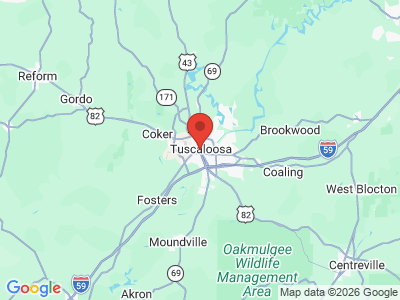
The Bama Theatre is a historic movie palace located in downtown Tuscaloosa, Tuscaloosa County. Opened in 1938 as a movie theater, the structure has also been home to artistic and musical events and school and community gatherings. Unlike many historic theatres that have fallen into disuse or decay, the Bama Theatre continues to thrive as an arts and entertainment venue.
Bama Theatre Marquee
The Bama Theatre is a historic movie palace located in downtown Tuscaloosa, Tuscaloosa County. Opened in 1938 as a movie theater, the structure has also been home to artistic and musical events and school and community gatherings. Unlike many historic theatres that have fallen into disuse or decay, the Bama Theatre continues to thrive as an arts and entertainment venue.
Construction on the 1,200-seat movie theater began in April 1937 as part of a joint city hall and municipal theatre venture that would eventually include a city clerk's office and three retail storefronts. Cecil B. Grimes, the city's manager for local theatres at the time, was influential in bringing the project to fruition. Grimes oversaw the operation of Tuscaloosa's three existing theatres: the Diamond, the Ritz (formerly the Belvedere), and the original Bama Theatre, which was renamed the Druid before the new theatre's unveiling.
 Bama Theatre Construction
Grimes and members of the City Commission Board contracted with Birmingham architect David O. Whilldin, to create the plans and the look for the theater. The Philadelphia-born Whilldin previously had designed many school buildings in the Birmingham and Tuscaloosa areas. He selected for the exterior the style that came to be known as PWA Moderne for its connection with numerous buildings constructed under the auspices of the federal Public Works Administration during the 1930s and 1940s. This style combined aspects of classicism and Art Deco with an emphasis placed on symmetry and simplicity. The building's low profile, curved façade, and restrained ornamentation are also typical characteristics of this style. Whilldin's design for the interior contrasted sharply with the exterior. In keeping with the style of the "atmospheric" class of movie palaces, it incorporated a high ceiling intended to mimic the night sky as a major focal point. A false painted ceiling hid electric lights that twinkled through small holes, mimicking stars as they dimmed and brightened. Decorations for the lobby and interior were modeled on the Renaissance-period Davanzati Palace in Florence, Italy. Whilldin worked with Italian emigrant and painter Navino Nataloni to create the murals and other decorative painted elements of the interior, including scenes on celotex panels underneath arches, cherub-adorned tiles, an alabaster fountain, and faux balconies. Newspaper articles of the time described the theatre's feel as that of Spanish garden on the Mediterranean.
Bama Theatre Construction
Grimes and members of the City Commission Board contracted with Birmingham architect David O. Whilldin, to create the plans and the look for the theater. The Philadelphia-born Whilldin previously had designed many school buildings in the Birmingham and Tuscaloosa areas. He selected for the exterior the style that came to be known as PWA Moderne for its connection with numerous buildings constructed under the auspices of the federal Public Works Administration during the 1930s and 1940s. This style combined aspects of classicism and Art Deco with an emphasis placed on symmetry and simplicity. The building's low profile, curved façade, and restrained ornamentation are also typical characteristics of this style. Whilldin's design for the interior contrasted sharply with the exterior. In keeping with the style of the "atmospheric" class of movie palaces, it incorporated a high ceiling intended to mimic the night sky as a major focal point. A false painted ceiling hid electric lights that twinkled through small holes, mimicking stars as they dimmed and brightened. Decorations for the lobby and interior were modeled on the Renaissance-period Davanzati Palace in Florence, Italy. Whilldin worked with Italian emigrant and painter Navino Nataloni to create the murals and other decorative painted elements of the interior, including scenes on celotex panels underneath arches, cherub-adorned tiles, an alabaster fountain, and faux balconies. Newspaper articles of the time described the theatre's feel as that of Spanish garden on the Mediterranean.
To make way for the new building, the existing city hall structure that had occupied the site on the corner of Greensboro Avenue and Sixth Street since 1886 was leveled. The cost of the undertaking totaled approximately $200,000, with $110,000 coming from a Tuscaloosa city bond issue, $90,000 from a PWA grant, and several loans. The finances also provided for the building of a new jail on a separate site. It was one of the last such projects of the New Deal era before funding was shifted to the war effort as the United States entered World War II.
 Bama Theatre Eagle Relief
On April 12, 1938, the Bama Theatre opened with a parade led by the University of Alabama's Million Dollar Band, followed by a showing of the RKO film Bringing Up Baby, starring Katherine Hepburn and Cary Grant. Local newspaper advertisements heralded the opening of the Bama as the "Showplace of Alabama" and "The South's Most Modern Showplace." H. T. Cole, regional director for the Public Works Administration, formally presented Luther Davis, president of the City Commission Board, with the keys to the facility. Moviegoers on that first day enjoyed the theater's modern amenities, including air conditioning, a sound system that employed Western Electric's advanced Mirrophonic technology, and a projection system using carbon arc lights that conducted a charge to illuminate the nitrite-based film. This projection technique could be highly flammable, and the theater featured an innovative projection booth that could be sealed immediately by the projectionist in case of fire.
Bama Theatre Eagle Relief
On April 12, 1938, the Bama Theatre opened with a parade led by the University of Alabama's Million Dollar Band, followed by a showing of the RKO film Bringing Up Baby, starring Katherine Hepburn and Cary Grant. Local newspaper advertisements heralded the opening of the Bama as the "Showplace of Alabama" and "The South's Most Modern Showplace." H. T. Cole, regional director for the Public Works Administration, formally presented Luther Davis, president of the City Commission Board, with the keys to the facility. Moviegoers on that first day enjoyed the theater's modern amenities, including air conditioning, a sound system that employed Western Electric's advanced Mirrophonic technology, and a projection system using carbon arc lights that conducted a charge to illuminate the nitrite-based film. This projection technique could be highly flammable, and the theater featured an innovative projection booth that could be sealed immediately by the projectionist in case of fire.
 Bama Theatre Junior League Gallery
From its opening day, The Bama Theatre gained popularity in Tuscaloosa, as it was the largest and most decorative movie theater and remained viable through the 1960s. After the construction of a multi-screen theater in 1969, however, the Bama began to lose revenue. Beginning in the 1970s, the theatre changed hands numerous times. In 1973, the city of Tuscaloosa sold the theatre and the adjacent city government office space to engineer Charles Gilbreath of the firm Gilbreath, Foster, and Brooks, Inc. and used funds from the sale to renovate the new City Hall, where it had already moved those offices. Gilbreath continued leasing the Bama as a community venue and movie theater until July 11, 1976, when the Bama screened its last movie as a private theatre. The Tuscaloosa Arts Council, formed in 1970, began leasing the building as a Performing Arts Center. Theatre Tuscaloosa (originally the Tuscaloosa Community Players) used the theatre for its live performances from 1979 until 1999, when the group relocated to the Bean-Brown Theatre on Shelton State Community College's campus in south Tuscaloosa County. Renovations made during the 1970s and 1980s included extending the stage and installing new air conditioning and heating systems. In May 1980, the Tuscaloosa County Park and Recreation Authority (PARA) purchased the theatre from Gilbreath in an effort to maintain civic ownership of the historic structure after a local church group expressed interest in acquiring the building. On September 11, 1983, the Tuscaloosa Junior League donated funds to renovate the second-floor lobby for use as an art gallery, which continues to showcase exhibits and juried shows and draws visitors to the Bama.
Bama Theatre Junior League Gallery
From its opening day, The Bama Theatre gained popularity in Tuscaloosa, as it was the largest and most decorative movie theater and remained viable through the 1960s. After the construction of a multi-screen theater in 1969, however, the Bama began to lose revenue. Beginning in the 1970s, the theatre changed hands numerous times. In 1973, the city of Tuscaloosa sold the theatre and the adjacent city government office space to engineer Charles Gilbreath of the firm Gilbreath, Foster, and Brooks, Inc. and used funds from the sale to renovate the new City Hall, where it had already moved those offices. Gilbreath continued leasing the Bama as a community venue and movie theater until July 11, 1976, when the Bama screened its last movie as a private theatre. The Tuscaloosa Arts Council, formed in 1970, began leasing the building as a Performing Arts Center. Theatre Tuscaloosa (originally the Tuscaloosa Community Players) used the theatre for its live performances from 1979 until 1999, when the group relocated to the Bean-Brown Theatre on Shelton State Community College's campus in south Tuscaloosa County. Renovations made during the 1970s and 1980s included extending the stage and installing new air conditioning and heating systems. In May 1980, the Tuscaloosa County Park and Recreation Authority (PARA) purchased the theatre from Gilbreath in an effort to maintain civic ownership of the historic structure after a local church group expressed interest in acquiring the building. On September 11, 1983, the Tuscaloosa Junior League donated funds to renovate the second-floor lobby for use as an art gallery, which continues to showcase exhibits and juried shows and draws visitors to the Bama.
 Adventures of Tom Sawyer at the Bama Theatre
The theatre was listed on the National Register of Historic Places on August 30, 1984. Since that time, the Bama has hosted a varied roster of events, including a cooking school hosted by Southern Living magazine, beauty pageants, dance recitals, plays, and comedy shows headlined by such notable performers as Lily Tomlin. More recently, the Bama has become a popular venue for musical performances, hosting such names as Joan Baez, Aimee Mann, Bela Fleck, Richard Thompson, the Glen Miller Orchestra, and the Alabama Shakes. The late 1990s saw the installation of an expanded box office, updated seating, and the purchase of new movie equipment, which allowed for the reinstitution of film viewing and the establishment of the Silver Screen Movie Series for showing classic films. Renamed the Cinema Nouveau Series in 2003, the film series now includes independent art films.
Adventures of Tom Sawyer at the Bama Theatre
The theatre was listed on the National Register of Historic Places on August 30, 1984. Since that time, the Bama has hosted a varied roster of events, including a cooking school hosted by Southern Living magazine, beauty pageants, dance recitals, plays, and comedy shows headlined by such notable performers as Lily Tomlin. More recently, the Bama has become a popular venue for musical performances, hosting such names as Joan Baez, Aimee Mann, Bela Fleck, Richard Thompson, the Glen Miller Orchestra, and the Alabama Shakes. The late 1990s saw the installation of an expanded box office, updated seating, and the purchase of new movie equipment, which allowed for the reinstitution of film viewing and the establishment of the Silver Screen Movie Series for showing classic films. Renamed the Cinema Nouveau Series in 2003, the film series now includes independent art films.
The Actor's Charitable Theatre, Tuscaloosa Children's Theatre, and Tuscaloosa Community Dancers make up the venue's three resident companies. In a return to its origins, the Bama's screen once again offers feature films through the Bama Art House Film Series, the German Film Festival, the Jewish Film Festival, and the Manhattan Short Film Festival each year. During the global Covid-19 pandemic, the theater suffered financial hardship but remained open for rentals and live-streaming events.