Atmore
 Downtown Atmore
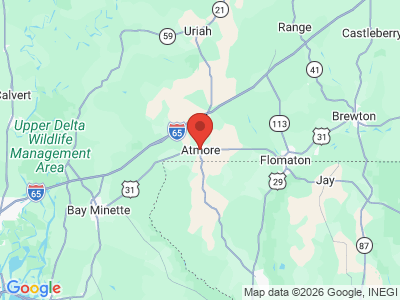
The largest city in Escambia County, Atmore is located in southwestern Alabama near the Florida state line. It has a mayor-city council form of government. The Poarch Band of Creek Indians, the only federally recognized Indian Tribe in the state of Alabama, maintain their government headquarters and operate their Wind Creek Casino in Atmore. Famed boxer Evander Holyfield was born in Atmore.
Downtown Atmore
The largest city in Escambia County, Atmore is located in southwestern Alabama near the Florida state line. It has a mayor-city council form of government. The Poarch Band of Creek Indians, the only federally recognized Indian Tribe in the state of Alabama, maintain their government headquarters and operate their Wind Creek Casino in Atmore. Famed boxer Evander Holyfield was born in Atmore.
History
The area that would become Atmore began as a supply facility, owned by local logging entrepreneur William Larkin Williams, that was located along a spur of the Mobile and Great Northern Railroad. By 1866, the area was known as Williams Station. The settlement grew slowly until 1886, when a sawmill built by William Marshall Carney sparked growth and additional settlement. With a population of 195 by 1885, the town saw its first polling place erected. On March 7, 1896, the town experienced its most notable event when a man believed to be the infamous train robber "Railroad Bill" was killed there in a shootout with law enforcement officers. In 1897, the town had grown considerably and was renamed in honor of C. P. Atmore, the general ticket agent of the Louisville & Nashville Railroad, which connected the town to Mobile. The lumber and turpentine industries became a mainstay of the local economy.
Atmore was incorporated in 1907, and the first telephone company was established in the town in 1908. At about this time, the first electric generator was installed by the W. M. Carney Light Company and brought limited electrical service to Atmore; a larger generator installed in 1914 rendered 24-hour service to houses that were wired to the system. The town also had a water system by about 1911, which was modernized in 1913 by the J. B. McReary Company of Atlanta, Georgia. A second railroad, the Georgia, Florida, and Alabama (later taken over by the Saint Louis-San Francisco line) connected the town to Pensacola, Florida, and to the central Alabama coal fields near Birmingham, Jefferson County, in 1914. The town's first hospital was established in 1915. Gulf Electric took over the Carney Lighting Company in 1926 and later became part of Alabama Power Company.
Atmore became an agricultural center in the early part of the twentieth century, with cotton, corn, and potatoes being the dominant crops, and during the first two decades of the twentieth century the town was also a major producer of satsuma oranges. In the latter half of the century, cotton was largely replaced with soybeans and wheat as the major cash crops. Major industries in the latter half of the century included a natural gas processing plant, a carpet manufacturer, and a chemical company. In 1985, the Poarch Band of Creek Indians opened the first of what would be several casinos in Atmore.
Demographics
According to 2020 Census estimates, Atmore recorded a population of 9,269. Of that number, 57.2 percent identified themselves as African American, 40.1 percent as white, 1.3 as two or more races, 1.3 percent as Hispanic, 0.8 percent as American Indian, 0.5 percent as Native Hawaiian and Other Pacific Islander, and 0.1 percent as Asian. The town's median household income was $25,211 and the per capita income was $12,130.
Employment
The workforce in Atmore, according to 2020 Census estimates, was divided among the following industrial categories:
- Manufacturing (22.7 percent)
- Educational services, and health care and social assistance (18.9 percent)
- Retail trade (17.7 percent)
- Arts, entertainment, recreation, and accommodation and food services (9.5 percent)
- Construction (6.3 percent)
- Finance, insurance, and real estate, rental, and leasing (6.2 percent)
- Other services, except public administration (5.7 percent)
- Public administration (4.5 percent)
- Professional, scientific, management, and administrative and waste management services (4.1 percent)
- Transportation and warehousing and utilities (3.0 percent)
- Wholesale trade (2.7 percent)
- Agriculture, forestry, fishing and hunting, and extractive (2.0 percent)
- Information (1.3 percent)
Education
Schools in Atmore are part of the Escambia County School District; the town has two elementary schools, one middle school, and one high school as well as two private K-12 schools. Coastal Alabama Community College maintains a campus in Atmore, and the Reid State Technical College School of Nursing is also located in the town.
Transportation
Atmore is bisected by U.S. Highway 31 (east to west) and State Highway 21 (north-south). It is located five miles southeast of Interstate 65, connected to it by County Road 1. The Atmore Municipal Airport is located southeast of town; it has one runway.
Events and Places of Interest
 Wind Creek Casino and Hotel
Atmore features a number of recreation and arts venues. The Atmore Heritage Park on Main Street includes several relocated historic buildings, and the downtown Strand Theater is one of the last true small-town theaters. The Greater Escambia Council for the Arts presents plays and other productions featuring local talent.
Wind Creek Casino and Hotel
Atmore features a number of recreation and arts venues. The Atmore Heritage Park on Main Street includes several relocated historic buildings, and the downtown Strand Theater is one of the last true small-town theaters. The Greater Escambia Council for the Arts presents plays and other productions featuring local talent.
The Atmore Country Club has a nine-hole golf course, and the Atmore YMCA offers a number of recreational programs, such as soccer, basketball, dance, and gymnastics. The Atmore Dragway and the Atmore Motocross Park hold regular races that draw competitors from across the South. Two wilderness areas, the Little River State Forest and the Magnolia Branch Wildlife Reserve, are located within a 20-minute drive of the town.
 Atmore Train Station
Atmore also has a number of annual events and celebrations. Mayfest, held the first Saturday in May, has entertainment, food, arts and crafts, and sporting events. The Old-Time Fiddlers Convention takes place the third Saturday in July and showcases musicians from throughout the state in competitions on the fiddle, guitar, banjo, mandolin, and vocals. Williams Station Day, which acknowledges the role that the railroad had in Atmore's founding, is held the fourth Saturday in October and includes in addition to the usual festival events a model train show and a sugarcane mill.
Atmore Train Station
Atmore also has a number of annual events and celebrations. Mayfest, held the first Saturday in May, has entertainment, food, arts and crafts, and sporting events. The Old-Time Fiddlers Convention takes place the third Saturday in July and showcases musicians from throughout the state in competitions on the fiddle, guitar, banjo, mandolin, and vocals. Williams Station Day, which acknowledges the role that the railroad had in Atmore's founding, is held the fourth Saturday in October and includes in addition to the usual festival events a model train show and a sugarcane mill.
The nearby Poarch Band of Creek Indians operates the Wind Creek Casino and Hotel five miles north of Atmore and the Poarch Creek Indians Museum just south of the Poarch Creek Off-Reservation Trust Land. The Poarch Creeks hold an annual Thanksgiving Pow Wow each November.
Additional Resources
- Escambia County Heritage Book Committee. The Heritage of Escambia County, Alabama. Clanton, Ala.: Heritage Publishing Consultants, 2002.