Eutaw
 Greene County Courthouse
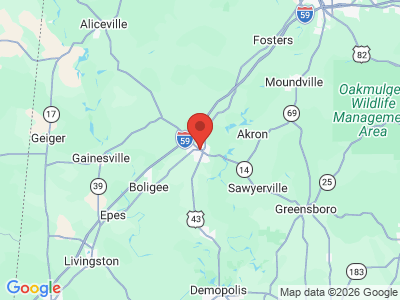
Eutaw is the county seat of Greene County and is located in west-central Alabama in the Black Belt region. It was a center of commerce during the plantation era and is home to a large number of historic structures from that period, many of which are on the National Register of Historic Places. The city is named for the Battle of Eutaw Springs, a decisive battle in the American Revolution in which troops led by war hero Nathaniel Greene (for whom the county is named) recaptured Charleston, South Carolina, from the British. The Eutaw Formation, a geologic feature that underlies parts of Alabama, Georgia, and Mississippi, is named for Eutaw because it is most greatly exposed at the surface near the city. The formation contains numerous Upper Cretaceous fossils, including dinosaurs and sea-dwelling mosasaurs.
Greene County Courthouse
Eutaw is the county seat of Greene County and is located in west-central Alabama in the Black Belt region. It was a center of commerce during the plantation era and is home to a large number of historic structures from that period, many of which are on the National Register of Historic Places. The city is named for the Battle of Eutaw Springs, a decisive battle in the American Revolution in which troops led by war hero Nathaniel Greene (for whom the county is named) recaptured Charleston, South Carolina, from the British. The Eutaw Formation, a geologic feature that underlies parts of Alabama, Georgia, and Mississippi, is named for Eutaw because it is most greatly exposed at the surface near the city. The formation contains numerous Upper Cretaceous fossils, including dinosaurs and sea-dwelling mosasaurs.
History
The town of Eutaw was settled around the same time that Greene County itself was created on December 13, 1819, and was originally known as Mesopotamia. In 1838, the county moved its seat of government to Eutaw from Erie to escape the flooding and disease that plagued that town. The city agreed to change its name to Eutaw to honor the Revolutionary War victory. The town and its surrounding territory were originally settled by planters and merchants; during the first half of the nineteenth century, Eutaw was a commercial center of the cotton and shipping industry because of its location near the Warrior River. A company of soldiers from the town, known as the Eutaw Rangers and headed by future congressman Sydenham Moore, participated in the Battle of Vera Cruz during the Mexican-American War of 1846-48. In 1870, the town was the site of what has come to be known as the Eutaw Riot, in which a party of white men belonging to the Ku Klux Klan attacked a large gathering of disaffected black Republican voters, killing at least four. The terror inspired by the attack kept African American voters away from the polls and tipped the elections that year toward the Democratic Party.

During Reconstruction and its aftermath, Eutaw's economy suffered a serious decline, with a significant portion of its workforce employed as tenant farmers and sharecroppers. By the mid-twentieth century, Greene County was one of the poorest counties in Alabama, and local businesses were subject to boycotts by African American residents during the civil rights movement. The city drew positive media attention in 1970, when African Americans were elected to a majority of the seats on the Greene County Board of Education, headquartered in Eutaw, and on the Eutaw City Council.
Demographics
According to 2020 Census estimates, Eutaw recorded a population of 2,643. Of that number, 72.7 percent identified themselves as African American, 25.8 percent as white, and 1.9 percent as Hispanic. The city's median household income was $28,508, and per capita income was $17,675.
Employment
According to 2020 Census estimates, the workforce in Eutaw was divided among the following industrial categories:
- Public administration (32.5 percent)
- Manufacturing (31.7 percent)
- Educational services, and health care and social assistance (12.9 percent)
- Retail trade (5.8 percent)
- Arts, entertainment, recreation, and accommodation and food services (5.4 percent)
- Finance, insurance, and real estate, rental, and leasing (4.6 percent)
- Professional, scientific, management, and administrative and waste management services (3.4 percent)
- Agriculture, forestry, fishing and hunting, and extractive (3.2 percent)
- Transportation and warehousing and utilities (0.4 percent)
Education
Eutaw schools are administered by the Greene County School System. The city has one elementary school, one middle school, and one high school. The city also has a vocational school and a private K-12 school.
Transportation
Eutaw is served by U.S. Highways 11 and 43, which run north-south through the city, and State Highway 14, which runs east-west and connects the city to nearby Interstate 20/59. Eutaw Municipal Airport serves general aviation.
Events and Places of Interest
 Kirkwood Mansion in Eutaw
Visitors interested in historic homes and architecture will find a wealth of structures in Eutaw, including the Coleman-Banks House (1847). The Greene County Courthouse Square Historic District has a particularly high number of historically significant structures. Each October, the Greene County Historical Society hosts the Eutaw Pilgrimage, during which many of the privately owned historic homes are opened up to the public. The society, housed in the historic Vaughan-Morrow House, operates a museum there related to town history. In August, the town hosts the annual Black Belt Roots Festival, which features blues and gospel performances, crafts, handmade quilts, and food.
Kirkwood Mansion in Eutaw
Visitors interested in historic homes and architecture will find a wealth of structures in Eutaw, including the Coleman-Banks House (1847). The Greene County Courthouse Square Historic District has a particularly high number of historically significant structures. Each October, the Greene County Historical Society hosts the Eutaw Pilgrimage, during which many of the privately owned historic homes are opened up to the public. The society, housed in the historic Vaughan-Morrow House, operates a museum there related to town history. In August, the town hosts the annual Black Belt Roots Festival, which features blues and gospel performances, crafts, handmade quilts, and food.