Tuscumbia

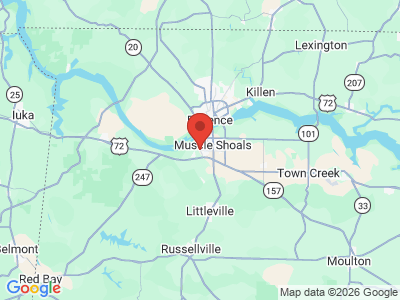
Located in northwest Alabama, Tuscumbia is the county seat of Colbert County. Incorporated in 1820, it is one of Alabama's oldest towns. It has a mayor-council form of government, with a five-member elected council. Tuscumbia is the birthplace of Helen Keller (1880-1968) and home of the Alabama Music Hall of Fame.
U.S. senator and notable jurist Howell Heflin (1921-2005) grew up in Tuscumbia, and Robert Burns Lindsay (1824-1902), who served as governor from 1870 to 1872, spent much of his professional life in the city. Baseball star Henry Emmett "Heinie" Manush (1901-1972) was born in Tuscumbia.
Early History
 Helen Keller Birthplace
Tuscumbia lies in the area of Alabama originally traversed by French traders. Between 1815 and 1817, permanent non-Indian settlers arrived. They found rich farmland and abundant game. In 1820, the federal government completed Jackson's Military Road (named for Gen. Andrew Jackson) connecting Tennessee with Louisiana, passing through what is now Tuscumbia along the way. It became the area's major overland transportation route. The town was incorporated in 1820 as Occocopoosa, then renamed Big Spring in 1821 and in 1822 renamed Tuscumbia in honor of a Chickasaw leader. The Tennessee River provided the area with another potential transportation route, but a 43-mile stretch of shoals made the river nearly impassable. Despite this, Tuscumbia's accessible location and fertile soil allowed it to become north Alabama's farming, agriculture, and commercial center.
Helen Keller Birthplace
Tuscumbia lies in the area of Alabama originally traversed by French traders. Between 1815 and 1817, permanent non-Indian settlers arrived. They found rich farmland and abundant game. In 1820, the federal government completed Jackson's Military Road (named for Gen. Andrew Jackson) connecting Tennessee with Louisiana, passing through what is now Tuscumbia along the way. It became the area's major overland transportation route. The town was incorporated in 1820 as Occocopoosa, then renamed Big Spring in 1821 and in 1822 renamed Tuscumbia in honor of a Chickasaw leader. The Tennessee River provided the area with another potential transportation route, but a 43-mile stretch of shoals made the river nearly impassable. Despite this, Tuscumbia's accessible location and fertile soil allowed it to become north Alabama's farming, agriculture, and commercial center.
The 1820s and 1830s saw an increase in the number of businesses that opened in Tuscumbia. Town business leaders established a steamboat landing and lobbied for creation of a railroad line to bypass the shoals. The line, on the Tuscumbia, Courtland and Decatur (TC&D) Railroad, was completed in 1832; the TC&D Railroad experimented with the use of dry sand as a way to provide traction between the track and the engine's wheels, and this practice remains in use around the world today. Tuscumbia was also an important postal routing center between Nashville and New Orleans. By the 1840s, the town had six stores, three hotels, three cabinetmakers, two doctors, a wagon maker, a blacksmith, a horse-powered mill, and a public school.
 Tuscumbia Depot and Museum
By 1850, Tuscumbia was a major railroad hub for train traffic throughout the South. During the Civil War, this made the town a major target of the Union Army, which destroyed Tuscumbia Landing and other parts of the town. After the war, Tuscumbia experienced renewed growth. In 1872, the city voted to open Spring Commons, an area that surrounded the city and included the big spring and Spring Creek to industry. A cotton gin, an ice company, and mills were built on the land. Although it was not until the early twentieth century that Tuscumbia began to recover from the devastation of the war, the city has many historic buildings dating from the late nineteenth century; they remain as a testament to the post-Civil War recovery and growth. Tuscumbia is believed to contain the largest collection of middle-income historic homes in Alabama. Preservation and restoration of these homes and the historic commercial buildings has made Tuscumbia a popular destination for history-oriented visitors. Tuscumbia and the Shoals benefited during the automotive boom of the 1920s and from the establishment of the Tennessee Valley Authority (TVA) in 1933 by Pres. Franklin D. Roosevelt.
Tuscumbia Depot and Museum
By 1850, Tuscumbia was a major railroad hub for train traffic throughout the South. During the Civil War, this made the town a major target of the Union Army, which destroyed Tuscumbia Landing and other parts of the town. After the war, Tuscumbia experienced renewed growth. In 1872, the city voted to open Spring Commons, an area that surrounded the city and included the big spring and Spring Creek to industry. A cotton gin, an ice company, and mills were built on the land. Although it was not until the early twentieth century that Tuscumbia began to recover from the devastation of the war, the city has many historic buildings dating from the late nineteenth century; they remain as a testament to the post-Civil War recovery and growth. Tuscumbia is believed to contain the largest collection of middle-income historic homes in Alabama. Preservation and restoration of these homes and the historic commercial buildings has made Tuscumbia a popular destination for history-oriented visitors. Tuscumbia and the Shoals benefited during the automotive boom of the 1920s and from the establishment of the Tennessee Valley Authority (TVA) in 1933 by Pres. Franklin D. Roosevelt.
Demographics
Tuscumbia's population according to 2020 Census estimates was 8,445. Of that number, 64.5 percent identified themselves as white, 25.4 percent as black, 4.9 percent as Hispanic or Latino, 4.9 percent as two or more races, 1.5 percent as American Indian, and 0.7 percent as Asian. The city's median household income was $41,131, and per capita income was $21,846.
Employment
According to 2020 Census estimates, the workforce in Tuscumbia was divided among the following industrial categories:
- Manufacturing (21.6 percent)
- Educational services, and health care and social assistance (20.9 percent)
- Retail trade (13.6 percent)
- Arts, entertainment, recreation, accommodation, and food services (10.9 percent)
- Other services, except public administration (8.3 percent)
- Transportation and warehousing and utilities (6.7 percent)
- Professional, scientific, management, and administrative and waste management services (6.1 percent)
- Construction (4.7 percent)
- Finance, insurance, and real estate, rental, and leasing (4.2 percent)
- Public administration (1.6 percent)
- Agriculture, forestry, fishing and hunting, and extractive (0.6 percent)
- Wholesale trade (0.5 percent)
- Information (0.3 percent)
Education
Schools in Tuscumbia are part of the Tuscumbia City school district; the town has one primary school (K-2), one intermediate school (3-5), one middle school, (6-8) and one high school (9-12) as well as one K-12 private school. The city also has one alternative school and one career/technical school. Northwest-Shoals Community College and the University of North Alabama provide the area's post-secondary educational opportunities.
Transportation
Tuscumbia lies along two major highways: U.S. 43 runs north-south and passes through the city, and U.S. 72 runs east-west and passes just south Tuscumbia. The Tennessee River lies two miles outside the city.
Events and Places of Interest
 Spring Park Fountain
The Alabama Music Hall of Fame, located on Highway 72 in Tuscumbia, highlights the musical accomplishments of Alabamians. It is open to the public throughout the year. Ivy Green, the birthplace of Helen Keller, is open to visitors throughout the year. The Helen Keller Festival takes place each June and commemorates Helen Keller's accomplishments. Activities include a parade, an art auction, a tour of historic sites, stage entertainment, puppet shows, a variety of sports tournaments and other athletics events. Spring Park provides a beautiful setting for picnics, arts and crafts shows, and recreation. In September, it hosts the Oka Kapassa Native American cultural festival, which features arts and crafts, Native American food, and educational demonstrations. The first weekend of each December, the town brings Victorian Christmas to life with the It's a Dickens Christmas, Y'all celebration. The multi-day event features carriage rides, music, arts and crafts, and people dressed as characters from Charles Dickens's famous work, A Christmas Carol.
Spring Park Fountain
The Alabama Music Hall of Fame, located on Highway 72 in Tuscumbia, highlights the musical accomplishments of Alabamians. It is open to the public throughout the year. Ivy Green, the birthplace of Helen Keller, is open to visitors throughout the year. The Helen Keller Festival takes place each June and commemorates Helen Keller's accomplishments. Activities include a parade, an art auction, a tour of historic sites, stage entertainment, puppet shows, a variety of sports tournaments and other athletics events. Spring Park provides a beautiful setting for picnics, arts and crafts shows, and recreation. In September, it hosts the Oka Kapassa Native American cultural festival, which features arts and crafts, Native American food, and educational demonstrations. The first weekend of each December, the town brings Victorian Christmas to life with the It's a Dickens Christmas, Y'all celebration. The multi-day event features carriage rides, music, arts and crafts, and people dressed as characters from Charles Dickens's famous work, A Christmas Carol.
The Colbert County Courthouse Square Historic District, the Tuscumbia Historic District, the John and Archibald Christian House, Ivy Green, Johnson's Woods, the Felix Norman Grundy House, The Oaks, the John Daniel Rather House, and the William Winston House are all listed on the National Register of Historic Places. The John Daniel Rather House is also listed on the Alabama Register of Landmarks and Heritage, as are the Glencoe Plantation Cemetery and Melrose. The Land Trust of North Alabama manages the 693-acre Cane Creek Canyon Nature Preserve located 10 miles southwest of the city.
Additional Resources
- McWilliams, John L., ed. Tuscumbia: America's First Frontier Railroad Town. Tuscumbia, Ala.: Tuscumbia Main Street Project and Preservation Incentive Project, 1989.
- The Heritage of Colbert County, Alabama. Clanton, Ala.: Heritage Publishing Consultants, 2000.