Decatur
 Alabama Jubilee Hot Air Balloon Classic
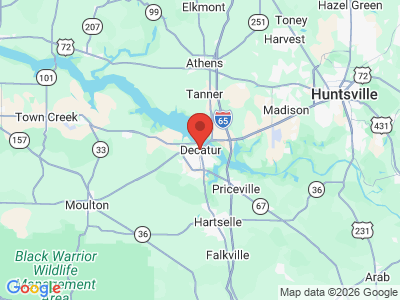
The city of Decatur is located in northern Alabama along the Tennessee River and is the county seat of Morgan County. It is known as the "River City" because it was originally a river crossing for settlers west of the Appalachian Mountains; the location on the river still makes Decatur a major transportation hub in the Southeast. Decatur received its name on June 16, 1820, in honor of Stephen Decatur, a naval hero of the War of 1812. The Alabama Legislature officially incorporated the city in 1826. Decatur has a mayor-council form of government with a mayor who serves as the chief executive officer and five council members who each serve a five-year term each.
Alabama Jubilee Hot Air Balloon Classic
The city of Decatur is located in northern Alabama along the Tennessee River and is the county seat of Morgan County. It is known as the "River City" because it was originally a river crossing for settlers west of the Appalachian Mountains; the location on the river still makes Decatur a major transportation hub in the Southeast. Decatur received its name on June 16, 1820, in honor of Stephen Decatur, a naval hero of the War of 1812. The Alabama Legislature officially incorporated the city in 1826. Decatur has a mayor-council form of government with a mayor who serves as the chief executive officer and five council members who each serve a five-year term each.
Decatur has been home to several nationally and internationally recognized individuals. Astronaut Mae Jemison, the first Black woman to go into space, was born in Decatur in 1956. Actor Dean Jones, best known for his roles in Disney films such as The Love Bug, was born there in 1931. Actor Lucas Black, born in 1982, has appeared in such films as Jarhead, Friday Night Lights, Cold Mountain, and Crazy in Alabama. Football players RaTavious Anton "Taye" Biddle, wide receiver for several teams in the National Football League and the Canadian Football league, and Philip Rivers, starting quarterback for the San Diego Chargers, were both born in Decatur. Truett Banks "Rip" Sewell of Decatur became a starting pitcher in Major League Baseball, where he played for the Detroit Tigers in 1932 and the Pittsburgh Pirates from 1938 to 1949.
Early History
 Decatur Port Scene, ca. 1890
Early settlers were drawn to Decatur because of the area's fertile soil and easy river access to other cities. In 1836, Decatur became the eastern boundary of the first railroad line west of the Appalachian Mountains. This event would change the city's history by boosting the economy and causing a rapid population increase in the area. With the arrival of the railroad, Decatur was connected with two major regional shipping outlets—the Tennessee River and the Tuscumbia, Courtland and Decatur Railroad—and soon became a primary industrial and transportation hub.
Decatur Port Scene, ca. 1890
Early settlers were drawn to Decatur because of the area's fertile soil and easy river access to other cities. In 1836, Decatur became the eastern boundary of the first railroad line west of the Appalachian Mountains. This event would change the city's history by boosting the economy and causing a rapid population increase in the area. With the arrival of the railroad, Decatur was connected with two major regional shipping outlets—the Tennessee River and the Tuscumbia, Courtland and Decatur Railroad—and soon became a primary industrial and transportation hub.
 U.S. Army Pontoon Bridge, 1864
During the Civil War, U.S. and Confederate armies fought to maintain control over the strategic city. By war's end, the city was devastated, with all but three buildings having been dismantled by federal forces and used to construct barracks and other buildings. The citizens of Decatur immediately began rebuilding, but the city suffered a major yellow fever outbreak in 1877. Not until the late 1880s did the city began to expand once again. In 1886, the Decatur Land, Improvement, and Furnace Company began promoting a new city to the southeast of Decatur called New Decatur. In 1888, the city again suffered a yellow fever outbreak, hampering the expansion of New Decatur. In 1905, the Southern Railway company built a depot in the city that is now the Decatur Union Depot Museum.
U.S. Army Pontoon Bridge, 1864
During the Civil War, U.S. and Confederate armies fought to maintain control over the strategic city. By war's end, the city was devastated, with all but three buildings having been dismantled by federal forces and used to construct barracks and other buildings. The citizens of Decatur immediately began rebuilding, but the city suffered a major yellow fever outbreak in 1877. Not until the late 1880s did the city began to expand once again. In 1886, the Decatur Land, Improvement, and Furnace Company began promoting a new city to the southeast of Decatur called New Decatur. In 1888, the city again suffered a yellow fever outbreak, hampering the expansion of New Decatur. In 1905, the Southern Railway company built a depot in the city that is now the Decatur Union Depot Museum.
 Decatur Union Depot Museum
In September 1916, the people of New Decatur voted to change the town's name to Albany to avoid the "Decatur" label. During the construction of the Keller Memorial Bridge across the Tennessee River, both Albany and Decatur cooperated financially. After a move toward municipal unity, the Alabama legislature attempted to make Albany part of Decatur on August 28, 1923, but conflicts arose over higher taxes in Albany and different debt loads between the two towns. Ultimately, the Alabama Supreme Court ruled that the union of the two towns was unconstitutional. Four years later, in 1927, after the issues were resolved, the legislature was finally able to merge the towns prior to the completion of the Keller Memorial Bridge.
Decatur Union Depot Museum
In September 1916, the people of New Decatur voted to change the town's name to Albany to avoid the "Decatur" label. During the construction of the Keller Memorial Bridge across the Tennessee River, both Albany and Decatur cooperated financially. After a move toward municipal unity, the Alabama legislature attempted to make Albany part of Decatur on August 28, 1923, but conflicts arose over higher taxes in Albany and different debt loads between the two towns. Ultimately, the Alabama Supreme Court ruled that the union of the two towns was unconstitutional. Four years later, in 1927, after the issues were resolved, the legislature was finally able to merge the towns prior to the completion of the Keller Memorial Bridge.
Economic Development
 Wheeler National Wildlife Refuge
Decatur continued to expand during the early twentieth century, and by 1929 Decatur's first traffic lights were installed. Also, after the U.S. Congress created the Tennessee Valley Authority (TVA) in 1933, Decatur and other parts of north Alabama benefited from dams and hydroelectric plants constructed in the area. The dams provided flood control, improved navigation, and offered affordable electricity to Decatur and other residents of the Tennessee Valley. By the late 1930s, Decatur's agricultural economy began to make a recovery from the Great Depression.
Wheeler National Wildlife Refuge
Decatur continued to expand during the early twentieth century, and by 1929 Decatur's first traffic lights were installed. Also, after the U.S. Congress created the Tennessee Valley Authority (TVA) in 1933, Decatur and other parts of north Alabama benefited from dams and hydroelectric plants constructed in the area. The dams provided flood control, improved navigation, and offered affordable electricity to Decatur and other residents of the Tennessee Valley. By the late 1930s, Decatur's agricultural economy began to make a recovery from the Great Depression.
Demographics
According to 2020 Census estimates, Decatur recorded a population of 54,344. Of that number, 66.5 percent reported themselves as White, 22.3 percent as African American, 13.9 percent as Hispanic or Latino, 3.7 percent as two or more races, 0.3 percent as Asian, and 0.2 percent as American Indian. The city's median household income was $49,296 and the per capita income was $30,146.
Employment
According to 2020 Census estimates, the workforce in Decatur was divided among the following industrial categories:
- Manufacturing (22.1 percent)
- Educational services, and health care and social assistance (17.5 percent)
- Retail trade (11.4 percent)
- Arts, entertainment, recreation, and accommodation and food services (10.1 percent)
- Professional, scientific, management, and administrative and waste management services (9.8 percent)
- Construction (8.2 percent)
- Other services, except public administration (4.7 percent)
- Transportation and warehousing and utilities (4.0 percent)
- Finance, insurance, and real estate, rental, and leasing (3.8 percent)
- Public administration (3.6 percent)
- Wholesale trade (2.7 percent)
- Agriculture, forestry, fishing and hunting, and extractive (1.2 percent)
- Information (0.9 percent)
Education
The Decatur City School District oversees a preschool, twelve elementary schools, three middle schools, two high schools, and a career and technical center. Several of Decatur's schools offer the International Baccalaureate program. Calhoun Community College is the largest two-year institution in the Alabama Community College System; it offers 49 associate degree programs and 52 career and certificate programs.
Transportation
 Norfolk Southern Tennessee River Bridge
The Tennessee River, which serves as the northernmost border of Decatur, is still an important transportation resource, with the Tennessee-Tombigbee Waterway connecting Morgan County with other major inland waterway ports. This waterway reduces the original navigational distance from Tennessee, north Alabama, and Mississippi to the Gulf of Mexico by hundreds of miles. Three public barge terminals are also used by the city. The Norfolk Southern railroad system connects Decatur with other major rail terminals in the United States.
Norfolk Southern Tennessee River Bridge
The Tennessee River, which serves as the northernmost border of Decatur, is still an important transportation resource, with the Tennessee-Tombigbee Waterway connecting Morgan County with other major inland waterway ports. This waterway reduces the original navigational distance from Tennessee, north Alabama, and Mississippi to the Gulf of Mexico by hundreds of miles. Three public barge terminals are also used by the city. The Norfolk Southern railroad system connects Decatur with other major rail terminals in the United States.
Interstate 65 and US 31 both link Morgan County to north-south interstate systems, and Interstate 565 as well as US 72 both provide east-west connections. Alabama Highway 20/US 72A, which serves as the main east-west route between Memphis and Atlanta, runs through Decatur. AL 67 is used as the western edge business road that connects Decatur to surrounding counties in the southeastern direction. AL 24 is a four-lane highway that travels southwest from Decatur.
Events and Places of Interest
 Point Mallard Park
Decatur offers residents a number of opportunities for outdoor recreation. Its location on the Tennessee River allows locals and visitors to enjoy boating, fishing, and water skiing. Decatur is also the location of Point Mallard, one of Alabama's largest recreational facilities. The park includes 750 acres of land hosting the J. Gilmer Blackburn Aquatic Center, a golf course, an indoor ice rink, hiking/biking trails by the river, sports fields, and campgrounds. Other places of interest include the Jack Allen Sports Complex, North Alabama Birding Trail, Riverwalk Marina, and other parks. Decatur is the nearest city to the Wheeler National Wildlife Refuge, which includes 35,000 acres of land to provide a safe habitat for wintering and migrating birds in the eastern United States. It is named for war veteran and politician Joseph Wheeler, as is nearby Wheeler Lake. Decatur served as the location for the filming of the movie Tom and Huck in 1995.
Point Mallard Park
Decatur offers residents a number of opportunities for outdoor recreation. Its location on the Tennessee River allows locals and visitors to enjoy boating, fishing, and water skiing. Decatur is also the location of Point Mallard, one of Alabama's largest recreational facilities. The park includes 750 acres of land hosting the J. Gilmer Blackburn Aquatic Center, a golf course, an indoor ice rink, hiking/biking trails by the river, sports fields, and campgrounds. Other places of interest include the Jack Allen Sports Complex, North Alabama Birding Trail, Riverwalk Marina, and other parks. Decatur is the nearest city to the Wheeler National Wildlife Refuge, which includes 35,000 acres of land to provide a safe habitat for wintering and migrating birds in the eastern United States. It is named for war veteran and politician Joseph Wheeler, as is nearby Wheeler Lake. Decatur served as the location for the filming of the movie Tom and Huck in 1995.
 Carnegie Visual Arts Center
Decatur is home to several places that celebrate the arts, including the Carnegie Visual Arts Center and the historic Princess Theatre Center for the Performing Arts, which was created in 1919 from a renovated livery stable. The Old State Bank Museum offers exhibits on early banking in Alabama. Cook's Natural Science Museum was founded in the 1960s by John R. Cook Jr., founder of Cook's Pest Control, as a training facility and now houses more than 2,000 exhibits on all aspects of natural science. The Morgan County Archives, located in the Art Deco former headquarters of the Tennessee Valley Bank, house documents, artifacts, memorabilia, and other items related to county history.
Carnegie Visual Arts Center
Decatur is home to several places that celebrate the arts, including the Carnegie Visual Arts Center and the historic Princess Theatre Center for the Performing Arts, which was created in 1919 from a renovated livery stable. The Old State Bank Museum offers exhibits on early banking in Alabama. Cook's Natural Science Museum was founded in the 1960s by John R. Cook Jr., founder of Cook's Pest Control, as a training facility and now houses more than 2,000 exhibits on all aspects of natural science. The Morgan County Archives, located in the Art Deco former headquarters of the Tennessee Valley Bank, house documents, artifacts, memorabilia, and other items related to county history.
 Princess Theatre in Decatur
The city is home to a number of festivals each year. Each January, the Wheeler National Wildlife Refuge hosts the Festival of the Cranes, where visitors can see some the 20,000 Sandhill cranes and 20 or more Whooping cranes who pass through the park around this time; the event also includes children's activities, workshops, nature walks, live raptors, and sponsor booths. Decatur hosts its annual Alabama Jubilee Hot Air Balloon Classic Festival at Point Mallard Park every Memorial Day weekend. Along with hot air balloons, the festival offers an antique car show, antique tractor show, art show, and kite festival. The annual Spirit of America Festival, which began in 1969, is also held at Point Mallard Park on July 4. Each October, Decatur hosts the River Clay Fine Arts festival, a free event featuring art vendors, live music, children's activities, and food trucks.
Princess Theatre in Decatur
The city is home to a number of festivals each year. Each January, the Wheeler National Wildlife Refuge hosts the Festival of the Cranes, where visitors can see some the 20,000 Sandhill cranes and 20 or more Whooping cranes who pass through the park around this time; the event also includes children's activities, workshops, nature walks, live raptors, and sponsor booths. Decatur hosts its annual Alabama Jubilee Hot Air Balloon Classic Festival at Point Mallard Park every Memorial Day weekend. Along with hot air balloons, the festival offers an antique car show, antique tractor show, art show, and kite festival. The annual Spirit of America Festival, which began in 1969, is also held at Point Mallard Park on July 4. Each October, Decatur hosts the River Clay Fine Arts festival, a free event featuring art vendors, live music, children's activities, and food trucks.
Additional Resources
- Jenkins, William H., and John Knox. The Story of Decatur, Alabama. Decatur, Ala.: Decatur Printing Co., 1970.
External Links
- City of Decatur
- Morgan County Commission
- Decatur City Schools
- Decatur Downtown Redevelopment Authority
- Decatur Parks and Recreation
- Encycylopedia of Southern Jewish Communities
- Spirit of America Festival
- Alabama Jubilee Hot Air Balloon Classic
- Decatur Public Library
- Princess Theatre Center for the Performing Arts
- Point Mallard Park
- Alabama Birding Trails
- Wheeler National Wildlife Refuge
- Carnegie Visual Arts Center
- John C. Calhoun Community College
- Decatur-Morgan County Chamber of Commerce
- Alabama Mountain Lakes Tourist Association
- Morgan County Archives