Tuskegee
 White Hall at Tuskegee University
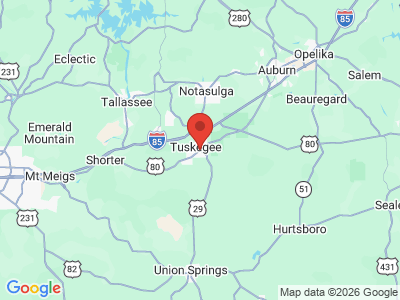
Tuskegee is located in central Alabama, 40 miles east of Montgomery, and is the seat of Macon County. The city of Tuskegee has a council-city manager form of government. Tuskegee has been home to many significant figures in national and even international history, most notably educators Booker T. Washington and George Washington Carver of Tuskegee Institute (present-day Tuskegee University), and civil rights activist Rosa Parks, who was born there in 1913. Famed recording artists The Commodores, who had a number of funk and soul hits during the 1970s and 1980s, met as students at Tuskegee University. Their lead singer, Lionel Ritchie, who later went on to considerable success as a solo act, attended Tuskegee on a tennis scholarship and graduated with a major in economics. Andre Thornton, who had a 14-year career in Major League Baseball, was born in Tuskegee in 1949.
White Hall at Tuskegee University
Tuskegee is located in central Alabama, 40 miles east of Montgomery, and is the seat of Macon County. The city of Tuskegee has a council-city manager form of government. Tuskegee has been home to many significant figures in national and even international history, most notably educators Booker T. Washington and George Washington Carver of Tuskegee Institute (present-day Tuskegee University), and civil rights activist Rosa Parks, who was born there in 1913. Famed recording artists The Commodores, who had a number of funk and soul hits during the 1970s and 1980s, met as students at Tuskegee University. Their lead singer, Lionel Ritchie, who later went on to considerable success as a solo act, attended Tuskegee on a tennis scholarship and graduated with a major in economics. Andre Thornton, who had a 14-year career in Major League Baseball, was born in Tuskegee in 1949.
Early History
The land on which Tuskegee now stands was first settled soon after the French and Indian War of 1754-63. The treaty officially ending the war declared that France would surrender Alabama to the English, who took control of a French fort at Tuskegee. After the American Revolution, the United States took possession of the area, which became part of the Mississippi Territory and in 1819 part of the state of Alabama. The settlement of Tuskegee was founded and laid out in 1833, one year after the establishment of Macon County, by Gen. Thomas Simpson Woodward, who fought in the Creek War of 1813-14 under Gen. Andrew Jackson. Woodward is said to have selected Tuskegee as the county seat. He also built the first home in town.
At the time of Tuskegee's founding, the area was still inhabited by members of the Creek Nation. The town itself was named after the nearby Creek town of Taskigi, located in the triangle formed by the convergence of the Coosa and Tallapoosa Rivers. Tuskegee was located along an historic Native American trade route that later became the highway between Fort Mitchell and Montgomery. After the Creek Indians were forcibly removed from Alabama in 1836, the area began to fill with White settlers. The city was officially incorporated in 1843, and the first local newspaper, the Tuskegee News, was first published in April 1865.
Tuskegee was one of five settlements in Macon County that attracted a significant amount of trading business by 1855. Of these settlements, Tuskegee was the only one that did not have the advantage of being located on a railroad; however, because it was the county seat and occupied a central location, it still drew business. Also, because the railroad did not run through Tuskegee, as it did in most towns, the town streets were laid out around the central square where the courthouse was located.
 Tuskegee Institute Movable School
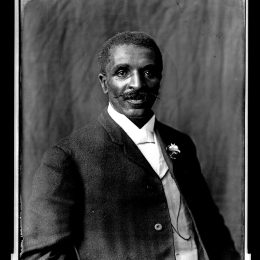
The town gained national fame with the establishment of what is now Tuskegee University in 1881 by educator Booker T. Washington and through the agricultural research made famous by George Washington Carver. The city and school have long stood at the crossroads of civil rights activism, education, and political transformation in the American South. Residents and administrators nurtured generations of Black leaders, educators, and activists who challenged systemic racism and fought for equal rights. From healthcare and voting access to public school integration, Tuskegee played a central role in the legal and grassroots campaigns that reshaped American life in the twentieth century.
Tuskegee Institute Movable School
The town gained national fame with the establishment of what is now Tuskegee University in 1881 by educator Booker T. Washington and through the agricultural research made famous by George Washington Carver. The city and school have long stood at the crossroads of civil rights activism, education, and political transformation in the American South. Residents and administrators nurtured generations of Black leaders, educators, and activists who challenged systemic racism and fought for equal rights. From healthcare and voting access to public school integration, Tuskegee played a central role in the legal and grassroots campaigns that reshaped American life in the twentieth century.
In the Jim Crow South, Black Americans were systematically excluded from most medical facilities, both as patients and as professionals. This lack of access gave rise in the late nineteenth century to the Black Hospital Movement, which sought to establish institutions where Black Americans could receive care and training. In 1892, Tuskegee Institute opened Alabama’s first Black hospital to serve its students and faculty. Initially limited to nurse training, the facility expanded in 1902 following a donation in honor of Massachusetts governor John A. Andrew; it was renamed the John A. Andrew Memorial Hospital in his honor. It soon became one of the only centers for training Black physicians in the South.

Following World War I, the federal government began building hospitals for wounded veterans, including Black veterans. Tuskegee Institute donated 300 acres for a 600-bed veterans' hospital, with the stipulation from Tuskegee president Robert R. Moton that it employ Black medical staff. White opposition, including Ku Klux Klan protests, led the Veterans' Bureau to reverse course and appoint an all-White staff, however. Moton, the NAACP, and the National Medical Association petitioned Pres. Warren Harding, arguing that excluding Black professionals betrayed African American support for the war. In response, the hospital agreed to hire four Black physicians in 1923, and by the following year, the majority of staff were Black. Located adjacent to Tuskegee Institute, the hospital expanded over time and became part of the U.S. Veterans Administration in 1930. (In 1997, it merged with other regional facilities to form the Central Alabama Veterans Health Care System, serving more than 130,000 veterans across 43 counties in Alabama and western Georgia.) Despite these advances in health care, Tuskegee also became infamous as the site of Tuskegee Syphilis Study, in which the U.S. Public Health Service and Tuskegee Institute conducted a medical experiment on men infected with syphilis without their consent from 1932 to 1972. (The experiment would spark the establishment of Tuskegee’s National Center for Bioethics in Research and Healthcare in 1997.)
In the 1940s, Tuskegee gained additional recognition during World War II as the home of the renowned Tuskegee Airmen. More than Black 1,000 pilots were trained at historic Moton Field and nearby Tuskegee Army Air Field, later opened as civilian Sharpe Field.

During the post-war years, the city became a national flashpoint in the struggle for voting rights. Following the 1957 Civil Rights Act, Black voter registration in Tuskegee surged, making a majority-Black local government a real possibility. In response, White leaders lobbied the state legislature to redraw city boundaries. State senator Samuel Martin “Sam” Engelhardt Jr., a staunch segregationist, authored Local Law 140, which created a 28-sided gerrymander that excluded nearly all Black voters. In protest, Tuskegee Institute professor Charles G. Gomillion led a damaging boycott of White-owned businesses and, in 1960, helped bring the case Gomillion v. Lightfoot before the U.S. Supreme Court. The Court ruled that the redistricting was unconstitutional, violating the Fourteenth Amendment. The original city boundaries were restored in 1961, and the case helped pave the way for the 1965 Voting Rights Act. In response to the boycott, Engelhardt unsuccessfully proposed eliminating Macon County altogether and apportioning it out to neighboring counties.

Tuskegee was also at the center of school desegregation litigation in the state. In 1963, attorney Fred Gray filed Lee v. Macon County Board of Education on behalf of Black students denied admission to Tuskegee High School. Despite the 1954 Brown v. Board of Education Supreme Court decision outlawing segregation in public schools, most in Alabama, including those in Macon County, remained segregated. A federal court consisting of Frank M. Johnson Jr., Richard T. Rives, and Harlan H. Grooms, ordered immediate desegregation, but state officials, led by Gov. George Wallace, refused to comply. In 1967, the court placed Alabama’s entire public school system under federal oversight, the first such ruling in the nation. The state’s federally monitored desegregation plan became a model for dismantling school segregation nationwide.
Demographics
According to 2020 Census estimates, Tuskegee recorded a population of 8,443. Of that number, 96.8 percent identified themselves as African American, 2.2 percent as white, 0.7 percent Hispanic, 0.6 percent as two or more races, 0.3 percent Asian, and 0.1 percent American Indian. The median household income was $28,629 and a the per capita income was $18,811.
Employment
According to 2020 Census estimates, the workforce in Tuskegee was divided among the following industrial categories:
- Educational services, and health care and social assistance (38.7 percent)
- Arts, entertainment, recreation, accommodation, and food services (13.1 percent)
- Retail trade (11.5 percent)
- Manufacturing (10.2 percent)
- Professional, scientific, management, and administrative and waste management services (6.9 percent)
- Public administration (6.2 percent)
- Other services, except public administration (5.7 percent)
- Finance, insurance, and real estate, rental, and leasing (3.4 percent)
- Transportation and warehousing and utilities (2.1 percent)
- Construction (1.7 percent)
- Wholesale trade (0.5 percent)
- Agriculture, forestry, fishing and hunting, and extractive (0.4 percent)
Education
Tuskegee is part of the Macon County Schools, which oversees an early learning center, two elementary schools, a middle school, and a high school in the city.

Tuskegee has played a major role in the history of Alabama, as well as the nation, especially in the field of education. It was the site of the first law school in Alabama and also was important in women's education with the opening of the Baptist College for Women in 1848 and the Tuskegee Female College in 1856 (which later moved to Montgomery and became Huntingdon College). The Tuskegee Military Institute for Boys was established there in 1898. Of most significance was the establishment of the Tuskegee Normal School for Colored Teachers in 1881, later called the Tuskegee Institute, and now Tuskegee University. In addition to innovative and beneficial research by George Washington Carver, the school made great strides in agricultural education and outreach among area farmers with its Movable School, headed by Thomas Monroe Campbell.
Transportation
Two major highways intersect in Tuskegee; U.S. Highway 80 is the main east-west artery, and U.S. Highway 29 provides a north-south route. Historic Moton Field Municipal Airport is located three miles north of the central business district in Tuskegee and is still used for public air transportation. Tuskegee also is serviced by the Greyhound Bus line, which provides transportation to many cities all over the United States, and specifically offers a route to and from the Hartsfield-Jackson Atlanta International Airport.
Events and Places of Interest
 Moton Field Hangar 2 and Control Tower
Tuskegee University is home to several attractions, including the Tuskegee Institute National Historic Site, which includes the original buildings constructed in brick by the first students. It has been part of the National Park System since 1974. The site also includes the George Washington Carver Museum and The Oaks, Booker T. Washington's home. The Tuskegee Airmen National Historic Site, at Moton Field, highlights the role that the Tuskegee Airmen played in breaking down racial barriers in the United States military as well as their contributions to the Allied victory in World War II.
Moton Field Hangar 2 and Control Tower
Tuskegee University is home to several attractions, including the Tuskegee Institute National Historic Site, which includes the original buildings constructed in brick by the first students. It has been part of the National Park System since 1974. The site also includes the George Washington Carver Museum and The Oaks, Booker T. Washington's home. The Tuskegee Airmen National Historic Site, at Moton Field, highlights the role that the Tuskegee Airmen played in breaking down racial barriers in the United States military as well as their contributions to the Allied victory in World War II.
The Butler Chapel AME Zion Church, located in downtown Tuskegee, served an important role during the civil rights movement. On June 25, 1957, three thousand black residents met at this church to protest the state legislature's decisions to minimize the number of Black voters in Tuskegee.
 Lovette W. Harper Collection of African Art
Tuskegee has an active cultural scene, and many citizens participate in the Tuskegee Repertory Theatre at the Jesse Clinton Arts Centre. Founded by renowned dancer and choreographer Dyann Robinson, the organization presents dramatic and musical productions that reflect the cultural legacy of the town and its Black residents. Visitors can learn about the contributions of Tuskegee citizens to its history and to the history of human rights at the Tuskegee History Center (formerly the Tuskegee Human and Civil Rights Multicultural Center), which offers displays and programming related to town and county history and the role it has played in human rights. The Legacy Museum exhibits numerous objects and works of art given to the university by donors and alumni.
Lovette W. Harper Collection of African Art
Tuskegee has an active cultural scene, and many citizens participate in the Tuskegee Repertory Theatre at the Jesse Clinton Arts Centre. Founded by renowned dancer and choreographer Dyann Robinson, the organization presents dramatic and musical productions that reflect the cultural legacy of the town and its Black residents. Visitors can learn about the contributions of Tuskegee citizens to its history and to the history of human rights at the Tuskegee History Center (formerly the Tuskegee Human and Civil Rights Multicultural Center), which offers displays and programming related to town and county history and the role it has played in human rights. The Legacy Museum exhibits numerous objects and works of art given to the university by donors and alumni.

Recreational opportunities can be found at Lake Tuskegee, which offers picnic areas and 92 acres of water for fishing, boating, and water skiing. The 11,000-acre Tuskegee National Forest features hiking trails.
In honor of one of Tuskegee's most famous figures, the town holds the George Washington Carver (GWC) Arts and Crafts Festival on the Tuskegee Square every May on the Saturday before Mother's Day. It features arts and crafts, vendors, rides, farm exhibits, talent shows, and other entertainment including door prizes.
Additional Resources
- Amaki, Amalia K., and Amelia Boynton Robinson. Tuskegee. Charleston, S.C.: Arcadia Publishing, 2013.
- Caver, Joseph, Jerome Ennels, and Daniel Haulman. The Tuskegee Airmen: An Illustrated History, 1939-1949. Montgomery, Ala.: NewSouth Books, 2011.
- Heritage of Macon County, Alabama. Clanton, Ala.: Heritage Publishing Consultants, 2003.
- Reverby, Susan M., ed. Tuskegee’s Truths: Rethinking the Tuskegee Syphilis Study. Chapel Hill: University of North Carolina Press, 2000.