New South Art Collective
 August-Mother with Child under Newspaper
Founded in 1938, the New South art collective was an important showcase for Social Realist painting in the South, a school of painting that portrayed the gritty realities of southern life. The young artists and arts patrons who formed the organization hoped to encourage interest in art among people of all backgrounds and economic classes. This egalitarian goal was revolutionary at the time in the South. The individuals involved in this short-lived but influential movement documented a disappearing southern culture that existed before World War II through the art of Social Realism and first promoted the work of internationally famous self-taught artist Bill Traylor.
August-Mother with Child under Newspaper
Founded in 1938, the New South art collective was an important showcase for Social Realist painting in the South, a school of painting that portrayed the gritty realities of southern life. The young artists and arts patrons who formed the organization hoped to encourage interest in art among people of all backgrounds and economic classes. This egalitarian goal was revolutionary at the time in the South. The individuals involved in this short-lived but influential movement documented a disappearing southern culture that existed before World War II through the art of Social Realism and first promoted the work of internationally famous self-taught artist Bill Traylor.
 New South Members
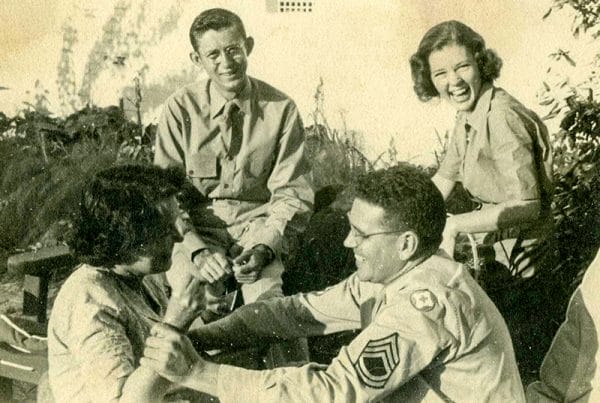
The idea for New South took shape in Butler County, in the log-cabin studio of Charles Shannon, a young artist who had already obtained a measure of fame. Shannon’s outgoing personality drew people to him, and his retreat soon became a destination for many friends. Roy Flint, Shannon’s roommate from the Cleveland School of Art, reportedly inspired the idea for New South. But the core group who founded the organization included Shannon, Blanche Balzer (who later married Shannon), George and Jean Lewis, and Paul Sanderson. Mattie Mae Knight, who later married Sanderson, also became a member of the organization.
New South Members
The idea for New South took shape in Butler County, in the log-cabin studio of Charles Shannon, a young artist who had already obtained a measure of fame. Shannon’s outgoing personality drew people to him, and his retreat soon became a destination for many friends. Roy Flint, Shannon’s roommate from the Cleveland School of Art, reportedly inspired the idea for New South. But the core group who founded the organization included Shannon, Blanche Balzer (who later married Shannon), George and Jean Lewis, and Paul Sanderson. Mattie Mae Knight, who later married Sanderson, also became a member of the organization.
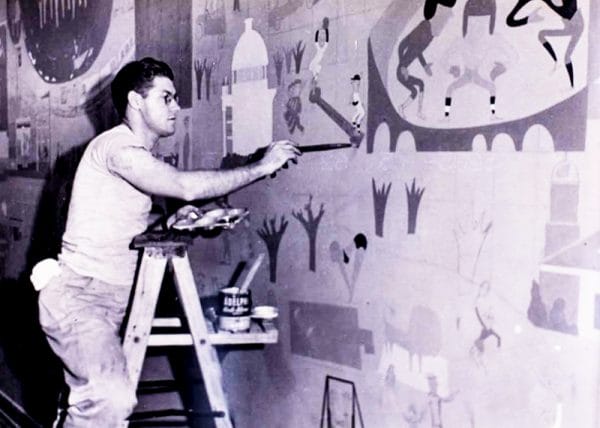
The group wrote a three-page constitution for New South and formed a board of trustees. The document called for keeping the center open at all times, promoting and nurturing southern art and artists, encouraging the formation of discussion groups, and sponsoring lectures. Other young artists and friends, including Ben and Kitty Baldwin, Jim Durden, Crawford Gillis, John Lapsley, Franz Adler, Dorothea Kahn, Victor Kern, and Jay Leavell, soon joined the core group.
 Jay C. Leavell
The first location for New South was in downtown Montgomery at 24½ Dexter Avenue in two rooms on a second floor; the front room was a gallery, and the other was used as an office and bookstore. New South also provided art instruction and a class in creative writing, as well as a venue for literary discussion groups. For a short time, this space was donated free of charge to the organization by the owner. In early 1939, the gallery mounted its first exhibition, called Growth of Corn, to show how the Sun influenced the life of all things. Another exhibit at the Dexter Avenue gallery featured a display of now-renowned Shearwater pottery, from Foley, in Baldwin County, operated by brothers Walter and James Anderson.
Jay C. Leavell
The first location for New South was in downtown Montgomery at 24½ Dexter Avenue in two rooms on a second floor; the front room was a gallery, and the other was used as an office and bookstore. New South also provided art instruction and a class in creative writing, as well as a venue for literary discussion groups. For a short time, this space was donated free of charge to the organization by the owner. In early 1939, the gallery mounted its first exhibition, called Growth of Corn, to show how the Sun influenced the life of all things. Another exhibit at the Dexter Avenue gallery featured a display of now-renowned Shearwater pottery, from Foley, in Baldwin County, operated by brothers Walter and James Anderson.
 Bill Traylor
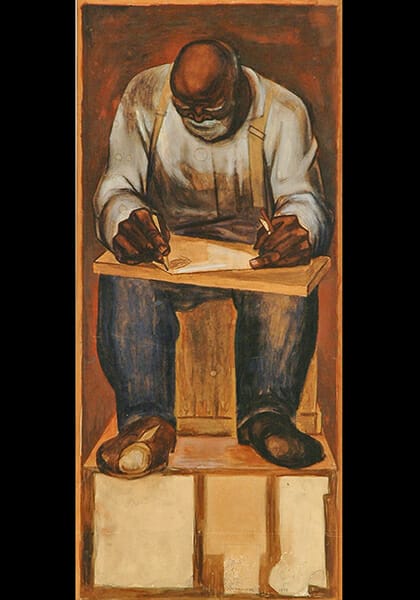
The popularity of the gallery soon forced the group to find new quarters. They moved to a huge third-floor space in the 200 block of Commerce Street that once housed a cotton-grading operation. It was owned by Robert Arrington, whose sister Pauline owned a local bookstore, The Booklover’s, that was a hangout for the avant-garde set in Montgomery. Robert was reluctant to lease to a group of artists and, according to Jean Lewis, required that they sign a lease forbidding “wild parties” or defacing the property. In the back room, the group installed panels featuring Charles Shannon’s fresco of folk artist Bill Traylor drawing on the streets of Montgomery, and John Lapsley’s fresco of a young black man, kneeling, breaking the chains that bound him. Several members of the New South group had met and befriended Traylor, providing him with art supplies (including colored pencils and paints for the first time) and purchasing his work whenever they passed by. New South mounted the first exhibition of Traylor’s work, a bold move at a time when few African American artists were accepted in the art world.
Bill Traylor
The popularity of the gallery soon forced the group to find new quarters. They moved to a huge third-floor space in the 200 block of Commerce Street that once housed a cotton-grading operation. It was owned by Robert Arrington, whose sister Pauline owned a local bookstore, The Booklover’s, that was a hangout for the avant-garde set in Montgomery. Robert was reluctant to lease to a group of artists and, according to Jean Lewis, required that they sign a lease forbidding “wild parties” or defacing the property. In the back room, the group installed panels featuring Charles Shannon’s fresco of folk artist Bill Traylor drawing on the streets of Montgomery, and John Lapsley’s fresco of a young black man, kneeling, breaking the chains that bound him. Several members of the New South group had met and befriended Traylor, providing him with art supplies (including colored pencils and paints for the first time) and purchasing his work whenever they passed by. New South mounted the first exhibition of Traylor’s work, a bold move at a time when few African American artists were accepted in the art world.
 John Kelly Fitzpatrick and Students
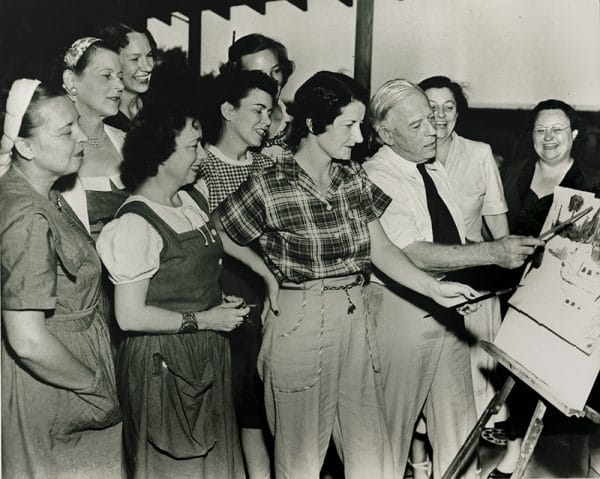
Perhaps the most lasting legacy of the New South group is its promotion of the art style known as Social Realism. This genre focuses on the hard realities of poverty and other social ills as well as cultural eccentricities in a highly representational manner. The artists of the New South Gallery focused largely on life in the working-class African American community around them. Even before the formation of New South, Charles Shannon, John Lapsley, and Crawford Gillis had been drawing and painting in this style, which purported to show the harsh facts of life around them. According to Lapsley, telling the story in somber colors and showing people in overalls was more important than “getting an arm or leg right.” In addition to art shows, the group also ventured into theater with an anti-war play, Bury the Dead, the first written by Irvin Shaw. The actors were members of New South, and it was presented at the Little Theater on Julia Street in Montgomery. Perhaps because of the anti-war theme of this play, or perhaps because of some of the people that frequented the center, the FBI made several visits to the organization and questioned members.
John Kelly Fitzpatrick and Students
Perhaps the most lasting legacy of the New South group is its promotion of the art style known as Social Realism. This genre focuses on the hard realities of poverty and other social ills as well as cultural eccentricities in a highly representational manner. The artists of the New South Gallery focused largely on life in the working-class African American community around them. Even before the formation of New South, Charles Shannon, John Lapsley, and Crawford Gillis had been drawing and painting in this style, which purported to show the harsh facts of life around them. According to Lapsley, telling the story in somber colors and showing people in overalls was more important than “getting an arm or leg right.” In addition to art shows, the group also ventured into theater with an anti-war play, Bury the Dead, the first written by Irvin Shaw. The actors were members of New South, and it was presented at the Little Theater on Julia Street in Montgomery. Perhaps because of the anti-war theme of this play, or perhaps because of some of the people that frequented the center, the FBI made several visits to the organization and questioned members.
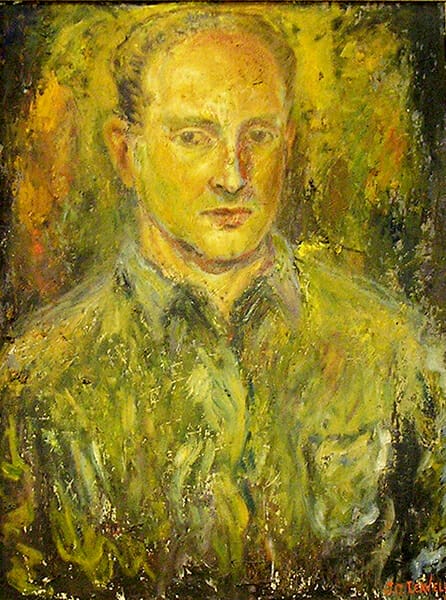 Portrait of Lonnie Coleman
This social experiment began to collapse sometime in 1940, when conflict arose among some of the members. Two of the couples who helped to organize the New South were no longer friendly, thereby making it difficult to keep the center open at all times. Also, the last art exhibition was of the work of multi-talented Selma artist Crawford Gillis and proved to be controversial. One of the paintings was a full frontal nude of a dancer from a “men only” performance at a traveling minstrel show. A local rabbi, who had brought a group of his young male students in to see the Gillis exhibition, was appalled at the risqué art; he complained, and it was removed. The incident created some level of animosity toward the gallery in the community. Finally, with the advent of World War II, the group’s members found themselves with two basic choices: go to work or go to war. The group released a flyer announcing the demise of the New South organization.
Portrait of Lonnie Coleman
This social experiment began to collapse sometime in 1940, when conflict arose among some of the members. Two of the couples who helped to organize the New South were no longer friendly, thereby making it difficult to keep the center open at all times. Also, the last art exhibition was of the work of multi-talented Selma artist Crawford Gillis and proved to be controversial. One of the paintings was a full frontal nude of a dancer from a “men only” performance at a traveling minstrel show. A local rabbi, who had brought a group of his young male students in to see the Gillis exhibition, was appalled at the risqué art; he complained, and it was removed. The incident created some level of animosity toward the gallery in the community. Finally, with the advent of World War II, the group’s members found themselves with two basic choices: go to work or go to war. The group released a flyer announcing the demise of the New South organization.
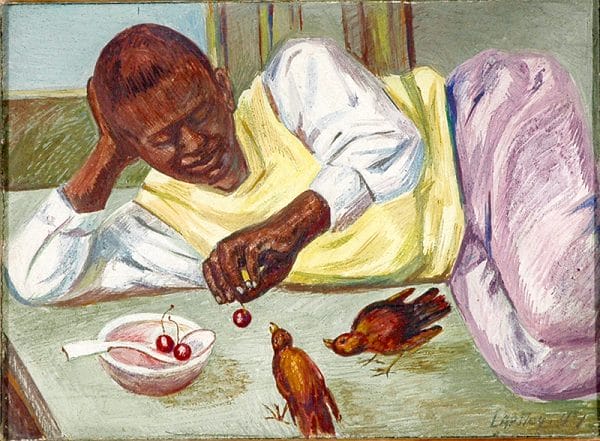 Boy Feeding Birds
Several New South members, including Gillis, Shannon, Lapsley, Leavell, and Sanderson, served in the military during the war. After the war, they pursued various careers, ranging from academics to advertising to civil service. The lasting legacy of Lapsley, Shannon, Gillis, and Leavell is the prewar art, classified as Social Realism, that brings to life an era in Alabama that changed forever after World War II. In retrospect, however, the members of New South thought of their adventure as a youthful folly and did not consider those works great art.
Boy Feeding Birds
Several New South members, including Gillis, Shannon, Lapsley, Leavell, and Sanderson, served in the military during the war. After the war, they pursued various careers, ranging from academics to advertising to civil service. The lasting legacy of Lapsley, Shannon, Gillis, and Leavell is the prewar art, classified as Social Realism, that brings to life an era in Alabama that changed forever after World War II. In retrospect, however, the members of New South thought of their adventure as a youthful folly and did not consider those works great art.
Additional Resources
Fowler, Miriam Rogers, ed. New South, New Deal and Beyond. Montgomery: Alabama State Council on the Arts, 1989.