Paul "Bear" Bryant
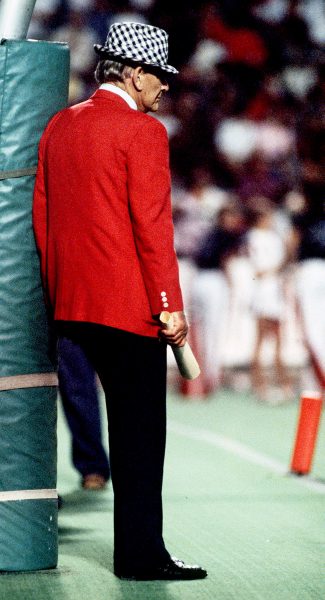 Paul "Bear" Bryant
 (1913-1983) is considered the world's greatest college football coach and remains one of the most successful coaches in history. His ability to connect with and motivate players created winning programs at several schools. Bryant is best known, however, for his tenure at the University of Alabama, where he led the Crimson Tide to six national championships, 24 bowl games, 13 conference titles, and three undefeated seasons.
Paul "Bear" Bryant
Paul "Bear" Bryant (1913-1983) is considered the world's greatest college football coach and remains one of the most successful coaches in history. His ability to connect with and motivate players created winning programs at several schools. Bryant is best known, however, for his tenure at the University of Alabama, where he led the Crimson Tide to six national championships, 24 bowl games, 13 conference titles, and three undefeated seasons.
Paul William Bryant was born to William Monroe and Ida Kilgore Bryant September 11, 1913, in rural Cleveland County, Arkansas. His birth certificate lists Kingsland as the place of birth as it was the nearest town. Moro Creek was the nearest geographic landmark. The local farmers identified with the creek's bottom land as home, hence the references to Bryant being from "Moro Bottom." He was the 11th of 12 children born to the couple; three others had died in infancy. Bryant was raised in the poor rural South. His father was disabled much of his life, forcing Bryant and his siblings to work on the family farm.
 Young Paul Bryant
As Bryant neared his teens, the family moved to the nearby town of Fordyce, where the large-framed boy (six feet one and 180 pounds at age 13, according to some sources) played football and basketball for Fordyce High School. A visit from a traveling circus resulted in the teenage Bryant earning the nickname that became permanently associated with his name. While attending a sideshow at the Lyric Theater, Bryant was unable to resist the offer of a dollar-a-minute to wrestle a bear. During the match the bear's muzzle came off and Bryant jumped out of the ring and did not get paid in the confusion. Bryant, in his senior year in high school, was a member of the 1930 Arkansas state football champion "Red Bugs."
Young Paul Bryant
As Bryant neared his teens, the family moved to the nearby town of Fordyce, where the large-framed boy (six feet one and 180 pounds at age 13, according to some sources) played football and basketball for Fordyce High School. A visit from a traveling circus resulted in the teenage Bryant earning the nickname that became permanently associated with his name. While attending a sideshow at the Lyric Theater, Bryant was unable to resist the offer of a dollar-a-minute to wrestle a bear. During the match the bear's muzzle came off and Bryant jumped out of the ring and did not get paid in the confusion. Bryant, in his senior year in high school, was a member of the 1930 Arkansas state football champion "Red Bugs."
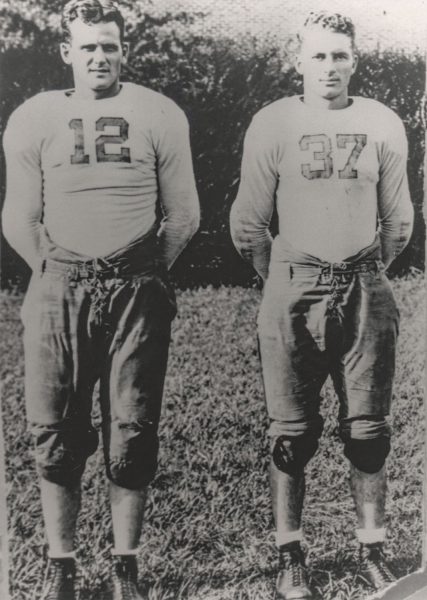 Paul Bryant and Don Hutson, 1934
Bryant was recruited by the University of Alabama's football team but had to take additional classes at the local high school to meet the university's admission requirements because he had not graduated from high school. At UA, Bryant joined fellow Arkansan Don Hutson, who would become a legendary star at Alabama and in the National Football League with the Green Bay Packers. During their playing days at Alabama, Bryant was known as "the other end" to Hutson, and the pair became lifelong friends and business partners. On June 2, 1935, Bryant wed Troy, Pike County, native Mary Harmon Black. They would raise two children, Mae Martin Bryant and Paul William Bryant Jr.
Paul Bryant and Don Hutson, 1934
Bryant was recruited by the University of Alabama's football team but had to take additional classes at the local high school to meet the university's admission requirements because he had not graduated from high school. At UA, Bryant joined fellow Arkansan Don Hutson, who would become a legendary star at Alabama and in the National Football League with the Green Bay Packers. During their playing days at Alabama, Bryant was known as "the other end" to Hutson, and the pair became lifelong friends and business partners. On June 2, 1935, Bryant wed Troy, Pike County, native Mary Harmon Black. They would raise two children, Mae Martin Bryant and Paul William Bryant Jr.
During his playing days at Alabama, Bryant lettered from 1933 to 1935 as the team amassed a record of 23 victories, 3 losses, and 2 ties. The Crimson Tide was named national champion for 1934 and defeated Stanford in the Rose Bowl on New Year's Day, 1935. After working with the Union College team in Jackson, Tennessee, in the spring of 1935, Bryant was offered a position on the Alabama staff by Coach Frank Thomas and stayed through the 1939 season. He then joined the staff of Harold "Red" Sanders at Vanderbilt University for two years.
 Paul Bryant in Uniform, 1941
Bryant was considering the head coaching position at the University of Arkansas when World War II broke out. He enlisted in the U.S. Navy, and after a stint at a Georgia pre-flight school, where he coached football, Bryant was stationed in North Africa. Near the war's end Bryant was assigned to a Carolina pre-flight school, again as a coach. He received an honorable discharge as a lieutenant commander on September 23, 1945. Days before his military service ended, Bryant signed a contract to be the head football coach of the University of Maryland, at age 32. After a 6-2-1 season and a disagreement with the university president, who reinstated a player Bryant had suspended, Bryant resigned. The University of Kentucky quickly signed Bryant to coach the Wildcats, a team that included football notables George Blanda, Vito Parilli, and Jerry Claiborne. During Bryant's eight-season tenure in Lexington, the team compiled a 60-23-5 record. In 1950, Bryant led the team to a Southeastern Conference (SEC) title and a national championship. In addition, Bryant was voted SEC coach of the year, and Kentucky broke the University of Oklahoma's 31-game winning streak with a victory in the Sugar Bowl. During his stint at Kentucky, Bryant also coached the Wildcats to victories in the Great Lakes Bowl and Cotton Bowl and a loss in the Orange Bowl.
Paul Bryant in Uniform, 1941
Bryant was considering the head coaching position at the University of Arkansas when World War II broke out. He enlisted in the U.S. Navy, and after a stint at a Georgia pre-flight school, where he coached football, Bryant was stationed in North Africa. Near the war's end Bryant was assigned to a Carolina pre-flight school, again as a coach. He received an honorable discharge as a lieutenant commander on September 23, 1945. Days before his military service ended, Bryant signed a contract to be the head football coach of the University of Maryland, at age 32. After a 6-2-1 season and a disagreement with the university president, who reinstated a player Bryant had suspended, Bryant resigned. The University of Kentucky quickly signed Bryant to coach the Wildcats, a team that included football notables George Blanda, Vito Parilli, and Jerry Claiborne. During Bryant's eight-season tenure in Lexington, the team compiled a 60-23-5 record. In 1950, Bryant led the team to a Southeastern Conference (SEC) title and a national championship. In addition, Bryant was voted SEC coach of the year, and Kentucky broke the University of Oklahoma's 31-game winning streak with a victory in the Sugar Bowl. During his stint at Kentucky, Bryant also coached the Wildcats to victories in the Great Lakes Bowl and Cotton Bowl and a loss in the Orange Bowl.
Bryant then held the head coaching position at Texas A&M from 1954 to 1957. During the first season, Bryant bused the team to a remote agricultural station in Junction, Texas, for pre-season training camp drills during a heat wave. Nearly two-thirds of the team quit, but those who remained became known as the "Junction Boys." The team went 1-9, Bryant's only losing season. The 1956 team however, won the Southwest Conference with a 9-0-1 record and defeated archrival Texas 34-21.
 Joe Namath
Meanwhile, the mid-1950s had brought hard times for the University of Alabama's football program, and the Crimson Tide won only four games between 1955 and 1957. When the school offered Bryant the head coaching position in 1958, he said he returned to his alma mater because, "Mama called." In Bryant's first year, the team went 5-4-1 and started one of the most successful tenures by any college coach. In his 25 years, Alabama compiled a 232-46-9 record on its way to six national championships (1961, 1964, 1965, 1973, 1978, and 1979) and 13 SEC titles. His teams participated in 24 consecutive bowl games, including the Sugar, Orange, Liberty, Cotton, Bluebonnet, and Gator Bowls. He was national coach of the year three times and SEC coach of the year 10 times, and his players received 67 All-America honors. Numerous players went on to distinguished NFL careers, including Joe Namath, Kenny Stabler, Ozzie Newsome, and Lee Roy Jordan.
Joe Namath
Meanwhile, the mid-1950s had brought hard times for the University of Alabama's football program, and the Crimson Tide won only four games between 1955 and 1957. When the school offered Bryant the head coaching position in 1958, he said he returned to his alma mater because, "Mama called." In Bryant's first year, the team went 5-4-1 and started one of the most successful tenures by any college coach. In his 25 years, Alabama compiled a 232-46-9 record on its way to six national championships (1961, 1964, 1965, 1973, 1978, and 1979) and 13 SEC titles. His teams participated in 24 consecutive bowl games, including the Sugar, Orange, Liberty, Cotton, Bluebonnet, and Gator Bowls. He was national coach of the year three times and SEC coach of the year 10 times, and his players received 67 All-America honors. Numerous players went on to distinguished NFL careers, including Joe Namath, Kenny Stabler, Ozzie Newsome, and Lee Roy Jordan.
 Pres. Kennedy with Bear Bryant and UA Sports Figures
Bryant's coaching life was not without challenges. Bryant and Georgia coach Wally Butts were accused in 1963 by a national magazine of manipulating the score of a game. Butts and Bryant won a court judgment against the publication, including monetary compensation, that led to the magazine's demise. In the late 1960s, as his team had subpar seasons, he made a bold move, completely changing his offensive scheme to the wishbone system and recruiting larger players. The civil rights movement and the political landscape of the state also played out on the field of athletics as Bryant postponed recruiting African American players to conform with the social mores of the South. In 1970 however, he recruited Wilbur Jackson as the first African American football player signed as a freshman to a scholarship at Alabama. John Mitchell signed a scholarship after attending a junior college and was the first African American to play football for Alabama.
Pres. Kennedy with Bear Bryant and UA Sports Figures
Bryant's coaching life was not without challenges. Bryant and Georgia coach Wally Butts were accused in 1963 by a national magazine of manipulating the score of a game. Butts and Bryant won a court judgment against the publication, including monetary compensation, that led to the magazine's demise. In the late 1960s, as his team had subpar seasons, he made a bold move, completely changing his offensive scheme to the wishbone system and recruiting larger players. The civil rights movement and the political landscape of the state also played out on the field of athletics as Bryant postponed recruiting African American players to conform with the social mores of the South. In 1970 however, he recruited Wilbur Jackson as the first African American football player signed as a freshman to a scholarship at Alabama. John Mitchell signed a scholarship after attending a junior college and was the first African American to play football for Alabama.
On November 28, 1981, Alabama defeated Auburn University 28-17, and Bryant passed Amos Alonzo Stagg on the all-time victory list with 315 wins. Bryant announced his retirement in 1982; last game was a 21-15 victory over the University of Illinois in the Liberty Bowl December 29, 1982, ending his career with 323 victories, 85 defeats, and 17 ties.
Bryant, who suffered from heart problems for many years, was admitted to Tuscaloosa's Druid City Hospital January 26, 1983, with chest pains. He passed away at 1:30 that afternoon at the age of 69 after suffering a heart attack. He was buried on January 28 at Elmwood Cemetery in Birmingham.
 Bryant-Denny Stadium
Coach Paul "Bear" Bryant remains an integral part of the Alabama football tradition. Bryant established a scholarship assistance fund to enable children of his former players to attend the University of Alabama that continues to this day. Among the buildings and structures named for Bryant on the University of Alabama campus and in Tuscaloosa are the Paul W. Bryant Museum, Paul W. Bryant High School, Bryant-Denny Stadium, Bryant Hall, Bryant Bridge, the Paul W. Bryant Conference Center, and Bryant Drive. His trademark houndstooth hat is still worn with reverence by Tide fans. He was posthumously awarded the Medal of Freedom by Pres. Ronald Reagan on February 23, 1983. In addition, the Paul W. Bryant Museum hosts an annual reunion for the more than 500 children who are his namesakes.
Bryant-Denny Stadium
Coach Paul "Bear" Bryant remains an integral part of the Alabama football tradition. Bryant established a scholarship assistance fund to enable children of his former players to attend the University of Alabama that continues to this day. Among the buildings and structures named for Bryant on the University of Alabama campus and in Tuscaloosa are the Paul W. Bryant Museum, Paul W. Bryant High School, Bryant-Denny Stadium, Bryant Hall, Bryant Bridge, the Paul W. Bryant Conference Center, and Bryant Drive. His trademark houndstooth hat is still worn with reverence by Tide fans. He was posthumously awarded the Medal of Freedom by Pres. Ronald Reagan on February 23, 1983. In addition, the Paul W. Bryant Museum hosts an annual reunion for the more than 500 children who are his namesakes.
Additional Resources
- Barra, Allan. The Last Coach. New York: W. M. Norton, 2005.
- Briley, John David. Career in Crisis: Paul "Bear" Bryant and the 1971 Season of Change.. Mercer University Press, 2006.
- Bryant, Paul W., and John Underwood. Bear: The Hard Life and Good Times of Alabama's Coach Bryant. Boston: Little, Brown 2007.
- Reed, Delbert. Paul "Bear" Bryant, What Made Him a Winner. Wolfe Creek Media, 2003.
- Stoddard, Tom. Turnaround: The Untold Story of Bear Bryant's First Year as Head Coach at Alabama. Montgomery, Ala.: Black Belt Press, 2000.
- Williams, Sylvia B. Paul Bryant, Football Legend. Seacoast Publishing, 2002.