Jefferson County
 Birmingham Botanical Gardens
Located in the north-central part of Alabama, Jefferson County is the most populous county in Alabama. It was the setting of Alabama's industrial revolution during the nineteenth and early twentieth centuries and the site of many important moments in the civil rights movement. Today, the county is a business center, especially for the banking industry and the medical field. It is also home to numerous outdoor parks and other facilities, performance spaces, and top museums of history, science, and art. Jefferson County is governed by an elected five-member commission and includes 36 incorporated communities, including the county seat of Birmingham.
Birmingham Botanical Gardens
Located in the north-central part of Alabama, Jefferson County is the most populous county in Alabama. It was the setting of Alabama's industrial revolution during the nineteenth and early twentieth centuries and the site of many important moments in the civil rights movement. Today, the county is a business center, especially for the banking industry and the medical field. It is also home to numerous outdoor parks and other facilities, performance spaces, and top museums of history, science, and art. Jefferson County is governed by an elected five-member commission and includes 36 incorporated communities, including the county seat of Birmingham.
- Founding Date: December 13, 1819
- Area: 1,119 square miles
- Population: 658,615 (2020 Census estimate)
- Major Waterways: Black Warrior River, Cahaba River
- Major Highways: Interstates 65, 59, and 20; Highway 78
- County Seat: Birmingham
- Largest City: Birmingham
History
Jefferson County was created by the Alabama Legislature on December 13, 1819, and by 1820 its boundaries were fixed at their current locations. The area now encompassed in Jefferson County was originally part of Monroe County in the Mississippi Territory on land acquired from the Creek Indians in the 1814 Treaty of Fort Jackson. It was then named Blount County in 1816 before the land that became Jefferson County was carved out. The county was named in honor of U.S. president Thomas Jefferson. The first settlers were largely of English descent from the Carolinas, Tennessee, and Georgia. Some of the earliest settlements and towns were Jonesboro (now Bessemer), Blountsville, Carrollsville, Bethlehem, Greensville, Trussville, and Elyton.
 Jefferson County Courthouse
Carrollsville served as the first county seat of Jefferson County from 1819 to 1821. The courthouse in Carrollsville was a simple log structure that is no longer in existence. In 1821, the county seat moved to Elyton, where it remained until 1873, when the county seat moved to its present location in Birmingham. The first courthouse in Birmingham was a two-story brick structure, followed by a three-story brick courthouse built in the late 1880s. The three-story structure was in use until 1931, when a new granite and limestone courthouse was built. In 1964, the county added an annex to the north side. Sculptured reliefs on the western face of the courthouse depict the history of Jefferson County. In 1920, Jefferson County created the Bessemer Division and built a courthouse in the town. The Bessemer courthouse underwent several enlargements and improvements throughout the twentieth century.
Jefferson County Courthouse
Carrollsville served as the first county seat of Jefferson County from 1819 to 1821. The courthouse in Carrollsville was a simple log structure that is no longer in existence. In 1821, the county seat moved to Elyton, where it remained until 1873, when the county seat moved to its present location in Birmingham. The first courthouse in Birmingham was a two-story brick structure, followed by a three-story brick courthouse built in the late 1880s. The three-story structure was in use until 1931, when a new granite and limestone courthouse was built. In 1964, the county added an annex to the north side. Sculptured reliefs on the western face of the courthouse depict the history of Jefferson County. In 1920, Jefferson County created the Bessemer Division and built a courthouse in the town. The Bessemer courthouse underwent several enlargements and improvements throughout the twentieth century.
 Birmingham
During the mid- to late-nineteenth century, Birmingham became the leading industrial city of Alabama. Pratt Coal and Coke Company, the Sloss Furnace Company, and Tennessee Coal, Iron and Railroad Company. among others, processed steel, coal, and iron ore that drove production in numerous other industries. By 1915, a system of locks and dams built on the Tombigbee and Warrior Rivers further boosted economic development. From the late 1950s to the early 1970s, Birmingham played a major role in the civil rights movement, being the site of such notable events as the Birmingham Campaign of 1963, the Children's Crusade and Martin Luther King Jr.'s renowned "Letter from Birmingham Jail." The city was also home to noted civil rights leader Fred Shuttlesworth and infamous commissioner of public safety Eugene "Bull" Connor. Today, Birmingham remains an important industrial center as well as the home of significant economic sectors in medical research, banking, and insurance.
Birmingham
During the mid- to late-nineteenth century, Birmingham became the leading industrial city of Alabama. Pratt Coal and Coke Company, the Sloss Furnace Company, and Tennessee Coal, Iron and Railroad Company. among others, processed steel, coal, and iron ore that drove production in numerous other industries. By 1915, a system of locks and dams built on the Tombigbee and Warrior Rivers further boosted economic development. From the late 1950s to the early 1970s, Birmingham played a major role in the civil rights movement, being the site of such notable events as the Birmingham Campaign of 1963, the Children's Crusade and Martin Luther King Jr.'s renowned "Letter from Birmingham Jail." The city was also home to noted civil rights leader Fred Shuttlesworth and infamous commissioner of public safety Eugene "Bull" Connor. Today, Birmingham remains an important industrial center as well as the home of significant economic sectors in medical research, banking, and insurance.
On April 27, 2011, a massive storm, causing numerous powerful tornadoes, struck the southeastern United States. More than 250 people were killed in Alabama, including 20 people in Jefferson County communities of Pleasant Grove (10), Concord (6), Cahaba Heights (1), Pratt City (1), Forestdale (1), and McDonald Chapel (1).
Major Cities and Demographics
 Robert Trent Jones Golf Trail at Ross Bridge
According to 2020 Census estimates, the population of Jefferson County was 658,615, making it the largest county in Alabama by far. Approximately 51.4 percent of respondents identified themselves as white, 42.9 percent as African American, 3.9 percent as Hispanic, 2.2 percent as two or more races, 1.6 percent as Asian, 0.2 percent as American Indian, and 0.1 as Native Hawaiian and Other Pacific Islander. The county seat Birmingham is the largest city in Jefferson County with an estimated population of 210,928. Other significant population centers include Hoover, Bessemer, Homewood, Cardiff, and Mountain Brook. The median household income for Jefferson County was $55,088 compared with $52,035 for the state as a whole, and the per capita income was $33,343, compared with $28,934 for the state as a whole.
Robert Trent Jones Golf Trail at Ross Bridge
According to 2020 Census estimates, the population of Jefferson County was 658,615, making it the largest county in Alabama by far. Approximately 51.4 percent of respondents identified themselves as white, 42.9 percent as African American, 3.9 percent as Hispanic, 2.2 percent as two or more races, 1.6 percent as Asian, 0.2 percent as American Indian, and 0.1 as Native Hawaiian and Other Pacific Islander. The county seat Birmingham is the largest city in Jefferson County with an estimated population of 210,928. Other significant population centers include Hoover, Bessemer, Homewood, Cardiff, and Mountain Brook. The median household income for Jefferson County was $55,088 compared with $52,035 for the state as a whole, and the per capita income was $33,343, compared with $28,934 for the state as a whole.
Economy
 Historic Furnaces at Tannehill
Until well into the twentieth century, farming was the prevailing occupation in Jefferson County. Cotton was the major agricultural product until the early twentieth century, when farmers diversified into corn, wheat, peanuts, soybeans, and vegetables. Early settlers also took advantage of the area's abundant mineral deposits, especially iron ore and coal. Iron production increased throughout the nineteenth century, and Jefferson County became a major supplier of coal to the Confederate Army in the Civil War. By 1865, the county had become one of the South's major suppliers of iron and steel, with the state of Alabama delivering more iron to the Confederacy than the rest of the southern states combined. Following the war, the county spent a great deal of time and money to improve Jefferson County's transportation system, particularly its rail lines, resulting in the continuing importance of the iron and steel industries up until the present day. Textile mills also benefited from improved transportation and remained an important component of the county's economy well into the twentieth century. By the mid-twentieth century, Jefferson County also benefited from a rise in the health-care industry and became the state leader by the turn of the twenty-first century.
Historic Furnaces at Tannehill
Until well into the twentieth century, farming was the prevailing occupation in Jefferson County. Cotton was the major agricultural product until the early twentieth century, when farmers diversified into corn, wheat, peanuts, soybeans, and vegetables. Early settlers also took advantage of the area's abundant mineral deposits, especially iron ore and coal. Iron production increased throughout the nineteenth century, and Jefferson County became a major supplier of coal to the Confederate Army in the Civil War. By 1865, the county had become one of the South's major suppliers of iron and steel, with the state of Alabama delivering more iron to the Confederacy than the rest of the southern states combined. Following the war, the county spent a great deal of time and money to improve Jefferson County's transportation system, particularly its rail lines, resulting in the continuing importance of the iron and steel industries up until the present day. Textile mills also benefited from improved transportation and remained an important component of the county's economy well into the twentieth century. By the mid-twentieth century, Jefferson County also benefited from a rise in the health-care industry and became the state leader by the turn of the twenty-first century.
Between 2006 and 2009, six former members of the Jefferson County Commission were convicted of a variety of corruption charges, including bribery, mail fraud, and money-laundering; one of them, Larry Langford, was sitting mayor of Birmingham at the time. In November 2011, the county declared bankruptcy; it was the largest municipal bankruptcy in U.S. history at approximately $3.1 billion.
Employment
According to 2020 Census estimates, the workforce in Jefferson County was divided among the following industrial categories:
- Educational services, and health care and social assistance (25.7 percent)
- Retail trade (10.9 percent)
- Professional, scientific, management, and administrative and waste management services (10.6 percent)
- Arts, entertainment, recreation, and accommodation and food services (9.0 percent)
- Manufacturing (9.0 percent)
- Finance and insurance, and real estate, rental, and leasing (8.7 percent)
- Transportation and warehousing, and utilities (5.7 percent)
- Construction (5.3 percent)
- Other services, except public administration (5.3 percent)
- Public administration (4.3 percent)
- Wholesale trade (2.7 percent)
- Information (2.2 percent)
- Agriculture, forestry, fishing and hunting, and extractive (0.6 percent)
Education

The Jefferson County School System oversees 57 primary and secondary schools. Birmingham City Schools oversees 42 primary and secondary schools, Hoover City Schools oversees 15 primary and secondary schools, Bessemer City Schools oversee nine primary and secondary schools, Trussville City Schools oversees four primary and secondary schools, Homewood City Schools oversees five primary and secondary schools, and Mountain Brook City Schools oversees six primary and secondary schools. Jefferson County is home to a number of institutions of higher education. The public University of Alabama at Birmingham is a significant employer in the city, and Lawson State and Jefferson State Community Colleges are also public. Private institutions are Samford University, Birmingham-Southern College, the former Southeastern Bible College (now part of Carolina University with a campus in Birmingham), and HBCUs Birmingham-Easonian Baptist Bible College and Miles College.
Geography
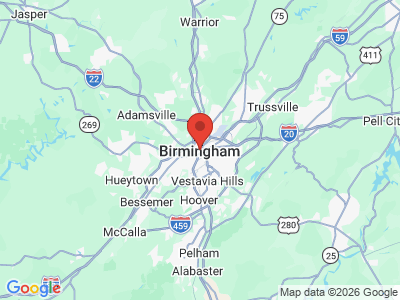
 Jefferson County Map
Located in the north-central part of the state at the southern end of the Appalachian Mountains, Jefferson County lies within the Cumberland Plateau and Tennessee Valley and Ridge physiographic sections. The county encompasses 1,119 square miles that lie atop iron, coal, and limestone deposits. Shades Mountain is the county's highest point, at 1,150 feet. Jefferson County is bordered by Blount County to the northeast, St. Clair County to the east, Shelby County to the southeast, Bibb County to the south, Tuscaloosa County to the west, and Walker County to the northwest.
Jefferson County Map
Located in the north-central part of the state at the southern end of the Appalachian Mountains, Jefferson County lies within the Cumberland Plateau and Tennessee Valley and Ridge physiographic sections. The county encompasses 1,119 square miles that lie atop iron, coal, and limestone deposits. Shades Mountain is the county's highest point, at 1,150 feet. Jefferson County is bordered by Blount County to the northeast, St. Clair County to the east, Shelby County to the southeast, Bibb County to the south, Tuscaloosa County to the west, and Walker County to the northwest.
Jefferson County is drained by both the Black Warrior and Cahaba rivers. Shades Creek, Little Shades Creek, and Patton Creek flow into the Cahaba River, whereas Valley Creek and Village Creek flow into the Black Warrior River. A number of smaller tributaries feed into these larger tributaries, offering scenic views and recreational opportunities. Several major highways and interstates run through Jefferson County: Interstate 65 runs north-south through Birmingham, Interstates 59 and 20 run southwest-northeast, and Highway 78 runs northwest-southeast. Birmingham-Shuttlesworth International Airport, located in Birmingham, provides domestic and international service for air travelers. The county is home to 13 private airports and three municipal airports.
Events and Places of Interest
Jefferson County offers a wide variety of recreational opportunities. The Red Rock Trail System, managed by the Freshwater Land Trust, is a system of 160 miles of developed trails that range throughout the county. Ruffner Mountain is a nature preserve covering over 1,000 acres. Visitors to the preserve can hike the trails that traverse through various geological formations. Oak Mountain State Park in Birmingham boasts a golf course, several beaches, a zipline water-skiing course, camping, and hiking in its 9,940 acres. The Alabama Wildlife Center, located in Oak Mountain State Park, is the largest rehabilitation center for wildlife in the state of Alabama. Visitors can view the rehab process and learn about some of Alabama's native species. The Birmingham Botanical Gardens, located in the Redmont Park neighborhood, features 67 acres of themed gardens and wooded trails. The 122-acre Birmingham Zoo is located in the park as well. Both the Ross Bridge and Oxmoor Valley courses of the Robert Trent Jones Golf Trail are located in Jefferson County.
 Sloss Furnaces National Historic Landmark
In addition to outdoor recreational opportunities, Jefferson County also has a number of historic places of interest. The West Jefferson Pioneer Homes offer visitors the chance to tour three structures that date from the early nineteenth century. The Sixteenth Street Baptist Church in the Birmingham Civil Rights District dates to 1874 and was the site of the 1963 bombing that killed four young African American girls. Sloss Furnaces National Historic Landmark encompasses a 32-acre blast furnace and factory that produced iron and steel for more than 100 years. The site is open to visitors and houses a museum of industry and center for metal arts. The 56-foot statue of Vulcan, which stands atop Red Mountain, was built in the early 1900s by sculptor Giuseppe Moretti to symbolize Birmingham's importance as an industrial center. Jefferson County is also home to a number of historic districts with landmark homes and buildings, including the Five Points Southern Historic District in Birmingham and the Downtown Bessemer National Historic District.
Sloss Furnaces National Historic Landmark
In addition to outdoor recreational opportunities, Jefferson County also has a number of historic places of interest. The West Jefferson Pioneer Homes offer visitors the chance to tour three structures that date from the early nineteenth century. The Sixteenth Street Baptist Church in the Birmingham Civil Rights District dates to 1874 and was the site of the 1963 bombing that killed four young African American girls. Sloss Furnaces National Historic Landmark encompasses a 32-acre blast furnace and factory that produced iron and steel for more than 100 years. The site is open to visitors and houses a museum of industry and center for metal arts. The 56-foot statue of Vulcan, which stands atop Red Mountain, was built in the early 1900s by sculptor Giuseppe Moretti to symbolize Birmingham's importance as an industrial center. Jefferson County is also home to a number of historic districts with landmark homes and buildings, including the Five Points Southern Historic District in Birmingham and the Downtown Bessemer National Historic District.
 Birmingham Civil Rights Institute
Visitors to Jefferson County will find an abundance of museums. The Birmingham Civil Rights Institute, located across from historic Kelly Ingram Park, offers exhibitions of historical events from segregation during the early twentieth century to present-day racial issues. The Birmingham Museum of Art is the largest municipal museum in the southeastern United States. It contains more than 24,000 objects from ancient to modern times. The Bessemer Hall of History is housed in a renovated railway terminal and contains artifacts, documents, photos, and nineteenth-century furniture and farm implements. The Alabama Jazz Hall of Fame in Birmingham pays tribute to jazz musicians with ties to Alabama, such as Erskine Hawkins and Lionel Hampton, and the Alabama Sports Hall of Fame Museum houses memorabilia from more than 200 inductees, including Paul "Bear" Bryant, Joe Louis, and Jesse Owens.
Birmingham Civil Rights Institute
Visitors to Jefferson County will find an abundance of museums. The Birmingham Civil Rights Institute, located across from historic Kelly Ingram Park, offers exhibitions of historical events from segregation during the early twentieth century to present-day racial issues. The Birmingham Museum of Art is the largest municipal museum in the southeastern United States. It contains more than 24,000 objects from ancient to modern times. The Bessemer Hall of History is housed in a renovated railway terminal and contains artifacts, documents, photos, and nineteenth-century furniture and farm implements. The Alabama Jazz Hall of Fame in Birmingham pays tribute to jazz musicians with ties to Alabama, such as Erskine Hawkins and Lionel Hampton, and the Alabama Sports Hall of Fame Museum houses memorabilia from more than 200 inductees, including Paul "Bear" Bryant, Joe Louis, and Jesse Owens.
Additional Resources
- Atkins, Leah Rawls. The Valley and the Hills: An Illustrated History of Birmingham and Jefferson County. Tarzana, Calif.: Preferred Marketing, 1996.
- Bennett, James R. Historic Birmingham and Jefferson County: An Illustrated History. San Antonio, Texas: Historic Publication Network, 2008.
- Jefferson County Heritage Book Committee. The Heritage of Jefferson County. Clanton, Ala.: Heritage Publishing Consultants, 2002.
- Satterfield, Carolyn Green. Historic Sites of Jefferson County, Alabama. Birmingham, Ala.: Gray Printing Company, 1985.
External Links
- Jefferson County
- Jefferson County Schools
- Jefferson County Library Cooperative
- City of Birmingham
- City of Bessemer
- City of Homewood
- City of Hoover
- City of Mountain Brook
- City of Pleasant Grove
- City of Trussville
- Birmingham Business Alliance
- University of Alabama at Birmingham
- Birmingham-Southern College
- Jefferson State Community College
- Lawson State Community College
- Miles College
- Samford University
- National Register of Historic Places: Jefferson County
- Bessemer Hall of History Museum
- Alabama Wildlife Center
- Ruffner Mountain
- Oak Mountain State Park
- Birmingham Botanical Gardens
- Birmingham Zoo
- Birmingham Civil Rights Institute
- Sloss Furnaces National Historic Landmark
- Birmingham Museum of Art
- Alabama Jazz Hall of Fame
- Alabama Sports Hall of Fame
- Red Mountain Park
- Robert Trent Jones Golf Trail: Ross Bridge
- Robert Trent Jones Golf Trail: Oxmoor Valley