Emma Sansom (Johnson)
 Emma Sansom
 (1847-1900) is notable in Alabama for aiding Confederate general Nathan Bedford Forrest during a raid by U.S. Army forces under Col. Abel D. Streight through northern Alabama. Sansom's assistance led to Forrest's capture of Streight and his large federal raiding party near Cedar Bluff in the spring of 1863.
Emma Sansom
Emma Sansom (1847-1900) is notable in Alabama for aiding Confederate general Nathan Bedford Forrest during a raid by U.S. Army forces under Col. Abel D. Streight through northern Alabama. Sansom's assistance led to Forrest's capture of Streight and his large federal raiding party near Cedar Bluff in the spring of 1863.
Emma Sansom was born on June 2, 1847, near the small town of Social Circle, Georgia, to Micajah and Levina Vann Sansom, a niece of influential Cherokee leader James Vann. When Emma was five years old, her parents moved the family, which would include 12 children, to a farm in Alabama outside the town of Gadsden, Etowah County. Emma's father died six years later on Christmas Eve.
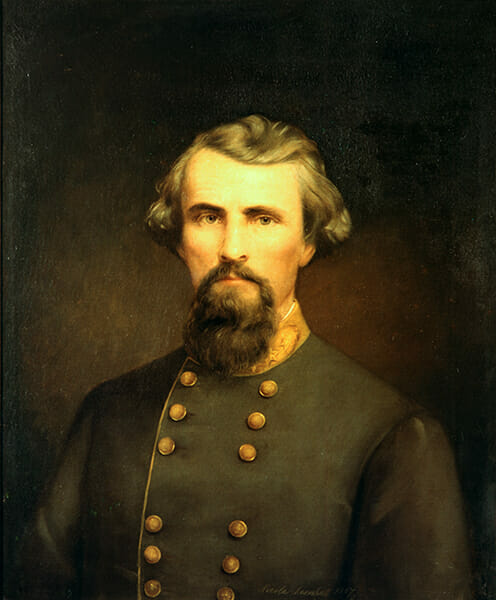 Nathan Bedford Forrest
The story of Sansom's actions during Streight's raid of April 19-May 3, 1863, is part history and part myth. Although she did aid Forrest in locating a crossing on Black Creek, some of the details, particularly alleged conversations between Sansom and the cavalry commander, have undoubtedly been dramatized. On the afternoon of May 2, Streight and 1,700 infantry, many mounted on mules, crossed Black Creek (located three miles from Gadsden) ahead of Forrest and destroyed the only local bridge, thus impeding the Confederate pursuit. Unable to use the bridge to cross the swollen creek, Forrest rode to a nearby home to find someone knowledgeable about the local terrain and came upon 16-year-old Sansom. According to an account published in the Jacksonville Republican one week later, Sansom volunteered to guide Forrest to a nearby ford. Initially, her mother objected to the idea of her daughter being escorted by a group of strangers. But Forrest was well known and respected, and Sansom's mother dropped her objections. With Sansom's guidance, Forrest located the ford, crossed it, and caught up with the Union forces. While escorting the general, Sansom reportedly faced enemy fire that ceased after the Union soldiers discovered that they had been firing upon a teenage girl.
Nathan Bedford Forrest
The story of Sansom's actions during Streight's raid of April 19-May 3, 1863, is part history and part myth. Although she did aid Forrest in locating a crossing on Black Creek, some of the details, particularly alleged conversations between Sansom and the cavalry commander, have undoubtedly been dramatized. On the afternoon of May 2, Streight and 1,700 infantry, many mounted on mules, crossed Black Creek (located three miles from Gadsden) ahead of Forrest and destroyed the only local bridge, thus impeding the Confederate pursuit. Unable to use the bridge to cross the swollen creek, Forrest rode to a nearby home to find someone knowledgeable about the local terrain and came upon 16-year-old Sansom. According to an account published in the Jacksonville Republican one week later, Sansom volunteered to guide Forrest to a nearby ford. Initially, her mother objected to the idea of her daughter being escorted by a group of strangers. But Forrest was well known and respected, and Sansom's mother dropped her objections. With Sansom's guidance, Forrest located the ford, crossed it, and caught up with the Union forces. While escorting the general, Sansom reportedly faced enemy fire that ceased after the Union soldiers discovered that they had been firing upon a teenage girl.
 Abel D. Streight
Sansom's actions directly helped Forrest capture Streight and his raiders near Cedar Bluff the following day. By aiding the Confederate general, Sansom risked possible retribution for herself and her family from the federal soldiers had they escaped capture. At the time of the raid, her brother, who had been wounded in battle while serving in the Confederate Army, was at home recuperating from his injuries. His presence, in addition to her actions, would have certainly stirred the interest of the raiding party. That potential sacrifice would make Sansom an enduring heroine of the Confederacy for generations.
Abel D. Streight
Sansom's actions directly helped Forrest capture Streight and his raiders near Cedar Bluff the following day. By aiding the Confederate general, Sansom risked possible retribution for herself and her family from the federal soldiers had they escaped capture. At the time of the raid, her brother, who had been wounded in battle while serving in the Confederate Army, was at home recuperating from his injuries. His presence, in addition to her actions, would have certainly stirred the interest of the raiding party. That potential sacrifice would make Sansom an enduring heroine of the Confederacy for generations.
In October 1864, Sansom married farmer Christopher B. Johnson. Around 1868, they moved to Upshur County, Texas, and the remainder of Sansom's life was spent primarily rearing the couple's seven children and running her household. In 1887, Johnson died, and Sansom never remarried. Years after the war, Sansom's account of the events were published after she was sought out by journalists and Confederate veterans. She died on August 9, 1900, and was buried in Little Mound Cemetery in Upshur County.
 Emma Sansom Statue
Sansom's legacy has endured as an idealized representation of a feminine heroine defending the Confederacy. Her association with Forrest further cemented her distinction as a heroine of the white South. In 1906, the Gadsden Chapter of the United Daughters of the Confederacy erected a monument honoring her Civil War contributions. The base of the statue contains a carving of Sansom accompanying Forrest on horseback. In the 1920s, the town named a high school in her honor. She was also the subject of a poem written by John Trotwood Moore. A chapter of the Sons of Confederate Veterans in Louisiana bears her name. In 2020, several descendants of Emma Sansom called for the removal of her statue in the midst of re-evaluations of Confederate memorials in the South, citing her as a symbol of the neo-Confederate Lost Cause romanticization of the Civil War and its causes.
Emma Sansom Statue
Sansom's legacy has endured as an idealized representation of a feminine heroine defending the Confederacy. Her association with Forrest further cemented her distinction as a heroine of the white South. In 1906, the Gadsden Chapter of the United Daughters of the Confederacy erected a monument honoring her Civil War contributions. The base of the statue contains a carving of Sansom accompanying Forrest on horseback. In the 1920s, the town named a high school in her honor. She was also the subject of a poem written by John Trotwood Moore. A chapter of the Sons of Confederate Veterans in Louisiana bears her name. In 2020, several descendants of Emma Sansom called for the removal of her statue in the midst of re-evaluations of Confederate memorials in the South, citing her as a symbol of the neo-Confederate Lost Cause romanticization of the Civil War and its causes.
Additional Resources
- Hurst, Jack. Nathan Bedford Forrest: A Biography. New York: Vintage Books, 1994.
- William Warren Rogers, Robert David Ward, Leah Rawls Atkins, Wayne Flynt. Alabama: The History of a Deep South State. Tuscaloosa: University of Alabama Press, 1994.