Lowndes County
 Lowndes Interpretive Center
Part of Alabama's Black Belt, Lowndes County is located in the south-central part of the state. The county hosts one of the sites on the trail that commemorates the Selma to Montgomery March and is home to the oldest arts and crafts fair in the state, the Calico Fort Arts and Crafts Festival. Lowndes County is governed by an elected, five-member commission and includes six incorporated communities.
Lowndes Interpretive Center
Part of Alabama's Black Belt, Lowndes County is located in the south-central part of the state. The county hosts one of the sites on the trail that commemorates the Selma to Montgomery March and is home to the oldest arts and crafts fair in the state, the Calico Fort Arts and Crafts Festival. Lowndes County is governed by an elected, five-member commission and includes six incorporated communities.
- Founding Date: January 20, 1830
- Area: 714 square miles
- Population: 10,311 (2020 Census estimate)
- Major Waterways: Alabama River
- Major Highways: Interstate 65, U.S. 80, U.S. 31
- County Seat: Hayneville
- Largest City: Fort Deposit
History
 Lowndes County Courthouse
Lowndes County was established by an act of the Alabama General Assembly on January 20, 1830. The county was formed from parts of Montgomery, Dallas, and Butler Counties. The section taken from Butler County was later added to Crenshaw County, giving Lowndes County its final dimensions. Lowndes County was named in honor of William Lowndes, a U.S. congressman from South Carolina. The earliest settlers came to the county from Georgia and Tennessee, and some of the first settlements and towns included Fort Deposit, Hayneville, Lowndesboro, and White Hall.
Lowndes County Courthouse
Lowndes County was established by an act of the Alabama General Assembly on January 20, 1830. The county was formed from parts of Montgomery, Dallas, and Butler Counties. The section taken from Butler County was later added to Crenshaw County, giving Lowndes County its final dimensions. Lowndes County was named in honor of William Lowndes, a U.S. congressman from South Carolina. The earliest settlers came to the county from Georgia and Tennessee, and some of the first settlements and towns included Fort Deposit, Hayneville, Lowndesboro, and White Hall.
 Stokely Carmichael
Lowndes County's first and only county seat was established at Hayneville in 1830. The original brick courthouse was constructed in 1832. In 1856, the courthouse was deemed unsafe by the county commission and a second Greek Revival courthouse was built. Still in use today, the courthouse had two-story wings added in 1905 to create more office space. In 1981, an annex was added to the rear of the building. The courthouse has also undergone some minor restoration as well.
Stokely Carmichael
Lowndes County's first and only county seat was established at Hayneville in 1830. The original brick courthouse was constructed in 1832. In 1856, the courthouse was deemed unsafe by the county commission and a second Greek Revival courthouse was built. Still in use today, the courthouse had two-story wings added in 1905 to create more office space. In 1981, an annex was added to the rear of the building. The courthouse has also undergone some minor restoration as well.
During the civil rights era of the 1960s, Lowndes County was at the forefront of efforts to reform voting rights and racial injustice in the South. The Lowndes County Freedom Organization, founded by local activists and former members of the Student Nonviolent Coordinating Committee, was the earliest incarnation of what would become the Black Panther Party. Civil rights activist and seminarian Jonathan Myrick Daniels was murdered by a white store owner in Hayneville on August 20, 1965, after being released from jail there. Daniels had been among a group of 30 arrested for participating in civil rights demonstrations in Fort Deposit.
Major Cities and Demographics
 C.M.E. Church in Lowndesboro
According to 2020 Census estimates, the population of Lowndes County was 10,311. Of that total, 72.5 percent of respondents identified themselves as African American, 25.9 percent as white, 1.9 percent as Hispanic, 0.8 percent as two or more race, 0.5 percent as Asian and 0.4 percent as Native American. The largest city in Lowndes County is Fort Deposit, with an estimated population of 1,225. The county seat Hayneville has an estimated population of 830. Other significant population centers include Hayneville, Gordonville, Benton, and Mosses. The median household income was $33,634, compared with $52,035 for the rest of the state, and the per capita income was $21,298, compared with $28,934 for the rest of the state.
C.M.E. Church in Lowndesboro
According to 2020 Census estimates, the population of Lowndes County was 10,311. Of that total, 72.5 percent of respondents identified themselves as African American, 25.9 percent as white, 1.9 percent as Hispanic, 0.8 percent as two or more race, 0.5 percent as Asian and 0.4 percent as Native American. The largest city in Lowndes County is Fort Deposit, with an estimated population of 1,225. The county seat Hayneville has an estimated population of 830. Other significant population centers include Hayneville, Gordonville, Benton, and Mosses. The median household income was $33,634, compared with $52,035 for the rest of the state, and the per capita income was $21,298, compared with $28,934 for the rest of the state.
Economy
 Sorting at Priester's Pecans
Like so much of Alabama, farming was the prevailing occupation of Lowndes County until well into the twentieth century. As part of the Black Belt, cotton was Lowndes County's main agricultural product in the nineteenth century. By the early to mid-twentieth century, farmers had diversified into corn, potatoes, and livestock. Although Lowndes County has attempted to move toward a more industrialized economy, it has done so slowly and with limited success. The county remains largely rural and agricultural.
Sorting at Priester's Pecans
Like so much of Alabama, farming was the prevailing occupation of Lowndes County until well into the twentieth century. As part of the Black Belt, cotton was Lowndes County's main agricultural product in the nineteenth century. By the early to mid-twentieth century, farmers had diversified into corn, potatoes, and livestock. Although Lowndes County has attempted to move toward a more industrialized economy, it has done so slowly and with limited success. The county remains largely rural and agricultural.
Employment
According to 2020 Census estimates, the workforce in Lowndes County was divided among the following industrial categories:
- Manufacturing (22.8 percent)
- Educational services, and health care and social assistance (16.7 percent)
- Retail trade (10.9 percent)
- Professional, scientific, management, and administrative and waste management services (9.1 percent)
- Transportation and warehousing, and utilities (6.8 percent)
- Construction (6.7 percent)
- Agriculture, forestry, fishing and hunting, and extractive (6.6 percent)
- Arts, entertainment, recreation, and accommodation and food services (6.0 percent)
- Public administration (5.2 percent)
- Wholesale trade (4.1 percent)
- Other services, except public administration (3.1 percent)
- Finance and insurance, and real estate, rental, and leasing (2.0 percent)
Education
The Lowndes County school system oversees nine primary and secondary schools. Trenholm State Community College maintains a campus in Hayneville.
Geography
 Lowndes County Map
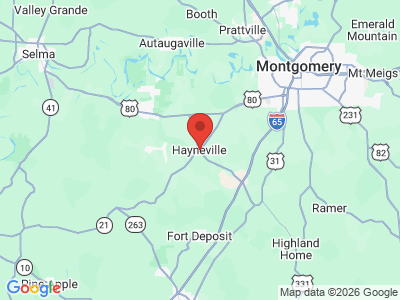
Comprising more than 700 square miles, Lowndes County is located in the south-central part of the state in Alabama's Black Belt, wholly within the Coastal Plain physiographic section. The county is characterized by rolling prairies and flat plains dotted with pine and oak forests. Lowndes County is bordered to the north by Autauga County, to the east by Montgomery County, to the southeast by Crenshaw County, to the south by Butler County, and to the west by Wilcox and Dallas Counties. The Alabama River and its middle tributaries flow throughout Lowndes County. The Alabama River serves as the unifier of Alabama's eastern and western rivers and provides both economic and recreational opportunities for Lowndes County. More than 144 species of fish have been identified in the Alabama River.
Lowndes County Map
Comprising more than 700 square miles, Lowndes County is located in the south-central part of the state in Alabama's Black Belt, wholly within the Coastal Plain physiographic section. The county is characterized by rolling prairies and flat plains dotted with pine and oak forests. Lowndes County is bordered to the north by Autauga County, to the east by Montgomery County, to the southeast by Crenshaw County, to the south by Butler County, and to the west by Wilcox and Dallas Counties. The Alabama River and its middle tributaries flow throughout Lowndes County. The Alabama River serves as the unifier of Alabama's eastern and western rivers and provides both economic and recreational opportunities for Lowndes County. More than 144 species of fish have been identified in the Alabama River.
Interstate 65 is one of Lowndes County's main transportation routes and runs north-south near the eastern border. U.S. Highway 80 runs east-west across the northern portion of Lowndes County, whereas U.S. Highway 31 runs north-south along the eastern border. The Fort Deposit-Lowndes County Airport in Fort Deposit serves general aviation.
Events and Places of Interest
 Lowndes Interpretive Center Building
The Lowndes Interpretative Center, run by the National Park Service, officially opened its doors to the public in 2006. The site celebrates and interprets the people and events of the Selma to Montgomery March for voting rights and is one of several sites along the 54-mile Selma to Montgomery March National Historic Trail. Exhibits include a re-creation of "Tent City," the temporary village that housed families dislodged by white landowners in Lowndes County.
Lowndes Interpretive Center Building
The Lowndes Interpretative Center, run by the National Park Service, officially opened its doors to the public in 2006. The site celebrates and interprets the people and events of the Selma to Montgomery March for voting rights and is one of several sites along the 54-mile Selma to Montgomery March National Historic Trail. Exhibits include a re-creation of "Tent City," the temporary village that housed families dislodged by white landowners in Lowndes County.
About two miles north of the town of White Hall is the site of the December 1813 Battle of Holy Ground between Creeks led by William Weatherford and American forces under Brig. Gen. Ferdinand Claiborne and their Choctaw allies, led by Pushmataha.
Located just south of Prattville, the small town of Lowndesboro was founded by planters in the 1830s and contains approximately 30 surviving antebellum structures. Marengo, an 1835 plantation home, is owned by the Lowndesboro Landmarks Foundation and currently serves as a restaurant.
Each April, the town of Fort Deposit hosts the annual Calico Fort Arts and Crafts Fair, which began in 1972 and is one of the oldest and largest fairs in the South. The outdoor festival includes various artists and approximately 200 exhibitors of jewelry, furniture, folk art, dolls, clothing, soft sculpture, toys, puppets, quilts, birdhouses and feeders, rugs, pillows, and stained glass.
Additional Resources
- The Heritage of Lowndes County, Alabama. Clanton, Ala.: Heritage Publishing Consultants, 2005.
- Jeffries, Hasan K. Bloody Lowndes: Civil Rights and Black Power in Alabama's Black Belt. New York: NYU Press, 2009.