Houston County
 Johnny Mack Brown
Located in the southeastern part of Alabama, Houston County is in the heart of the state's Wiregrass region, which produces one-fourth of the nation's peanuts, rightly earning it the title of Peanut Capital of the World. Houston County was also the birthplace and childhood home of College Football Hall of Famer and western film star Johnny Mack Brown (1904-1974). The county is governed by an elected, five-member commission.
Johnny Mack Brown
Located in the southeastern part of Alabama, Houston County is in the heart of the state's Wiregrass region, which produces one-fourth of the nation's peanuts, rightly earning it the title of Peanut Capital of the World. Houston County was also the birthplace and childhood home of College Football Hall of Famer and western film star Johnny Mack Brown (1904-1974). The county is governed by an elected, five-member commission.
- Founding Date: February 9, 1903
- Area: 577 square miles
- Population: 105,319 (2020 Census estimate)
- Major Waterways: Chattahoochee River
- Major Highways: U.S. 231, U.S. 84
- County Seat: Dothan
- Largest City: Dothan
History
 Houston County Courthouse
Houston County was created by an act of the Alabama State Legislature on February 9, 1903, making it the newest of Alabama's 67 counties. The history of Houston County is closely linked to the histories of Henry, Dale, and Geneva counties: 72 percent of Houston County was carved from Henry County, and the remainder came from Dale and Geneva counties. The county owes its existence to those political leaders who, during the 1901 Constitutional Convention, eliminated the requirement that counties have an area of at least 600 square miles. The main argument for the creation of a new county was the great distance citizens in the lower half of Henry County had to travel to pay taxes and attend to legal affairs. A branch courthouse was established in Dothan in 1894 but proved insufficient for residents of lower Henry County. Houston County was named in honor of Gov. George Smith Houston of Limestone County.
Houston County Courthouse
Houston County was created by an act of the Alabama State Legislature on February 9, 1903, making it the newest of Alabama's 67 counties. The history of Houston County is closely linked to the histories of Henry, Dale, and Geneva counties: 72 percent of Houston County was carved from Henry County, and the remainder came from Dale and Geneva counties. The county owes its existence to those political leaders who, during the 1901 Constitutional Convention, eliminated the requirement that counties have an area of at least 600 square miles. The main argument for the creation of a new county was the great distance citizens in the lower half of Henry County had to travel to pay taxes and attend to legal affairs. A branch courthouse was established in Dothan in 1894 but proved insufficient for residents of lower Henry County. Houston County was named in honor of Gov. George Smith Houston of Limestone County.
On March 16, 1903, Dothan was chosen as county seat and remains so today. The first court house, a traditional brick building, was built in 1905 and stood until 1962. In 1962, a modern courthouse was built as a replacement for the 1905 courthouse, and this in turn was replaced in 2003 by the current structure.
Major Cities and Demographics
According to 2020 Census estimates, the population of Houston County was 105,319. Approximately 68.2 percent of respondents identified themselves as white, 27.2 percent as African American, 3.4 percent as Hispanic, 2.7 percent as two or more races, 0.9 percent as Asian, and 0.3 percent as Native American. The county seat Dothan had an estimated population of 68,608. Other significant population centers include Taylor, Madrid, Gordon, Ashford, and Kinsey. The median household income was $49,069, compared with $52,035 for the state as a whole, and the per capita income was $27,794, compared with $28,934 for the state as a whole.
Economy
 National Peanut Festival Signs
Like most of Alabama, farming was the prevailing occupation in the area that became Houston County until well into the twentieth century. The region's relative isolation and seemingly poor soil meant that it was sparsely settled until after the Civil War. Prior to that time, only a few subsistence farms existed in the area. After the war, the timber industry boomed as lumbering interests rushed in to take advantage of the longleaf pine forests that covered the county. During the early years of the twentieth century, farmers realized that the sandy soil could be made fertile with the aid of commercial fertilizers, and the county became a cotton-producing region. The arrival of the boll weevil in the early twentieth century forced a shift from cotton to crops such as peanuts, corn, and pecans as well as to the raising of livestock. Peanuts became so important to the county's economy that approximately half of the peanuts produced in the United States are grown within a 100-mile radius of Dothan. With the introduction of hydroelectric power in the 1930s and 1940s, Houston County moved from an agriculture-based economy to an industry-based economy, although most major industries in the county remain tied to the land in the form of textile factories or food-production factories.
National Peanut Festival Signs
Like most of Alabama, farming was the prevailing occupation in the area that became Houston County until well into the twentieth century. The region's relative isolation and seemingly poor soil meant that it was sparsely settled until after the Civil War. Prior to that time, only a few subsistence farms existed in the area. After the war, the timber industry boomed as lumbering interests rushed in to take advantage of the longleaf pine forests that covered the county. During the early years of the twentieth century, farmers realized that the sandy soil could be made fertile with the aid of commercial fertilizers, and the county became a cotton-producing region. The arrival of the boll weevil in the early twentieth century forced a shift from cotton to crops such as peanuts, corn, and pecans as well as to the raising of livestock. Peanuts became so important to the county's economy that approximately half of the peanuts produced in the United States are grown within a 100-mile radius of Dothan. With the introduction of hydroelectric power in the 1930s and 1940s, Houston County moved from an agriculture-based economy to an industry-based economy, although most major industries in the county remain tied to the land in the form of textile factories or food-production factories.
Employment
According to 2020 Census estimates, the workforce in Houston County was divided among the following industrial categories:
- Educational services, and health care and social assistance (24.5 percent)
- Retail trade (14.1 percent)
- Manufacturing (9.0 percent)
- Arts, entertainment, recreation, and accommodation and food services (9.4 percent)
- Transportation and warehousing, and utilities (8.6 percent)
- Professional, scientific, management, and administrative and waste management services (7.7 percent)
- Construction (5.9 percent)
- Other services, except public administration (5.9 percent)
- Public administration (5.1 percent)
- Finance and insurance, and real estate, rental, and leasing (3.7 percent)
- Wholesale trade (3.6 percent)
- Agriculture, forestry, fishing and hunting, and extractive (1.3 percent)
- Information (1.2 percent)
Education
The Houston County School System oversees 11 primary and secondary schools. Dothan City Schools oversees 20 primary and secondary schools. Troy University has a branch campus in Dothan that offers undergraduate and graduate degrees as well as continuing-education courses and distance-learning opportunities. Located in Dothan, Wallace Community College offers two-year associate degrees as well as career and technical programs.
Geography
 Houston County Map
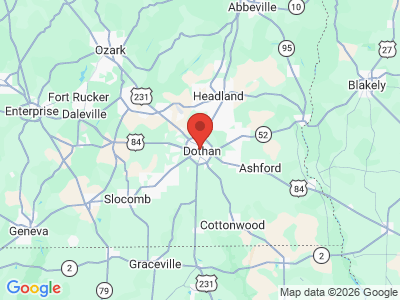
Comprising more than 575 square miles, Houston County lies in the southeast corner of the state. The county is part of the Coastal Plain physiographic section and consists of sandy and shallow soils dotted throughout with pine forests. Houston County is bordered to the north by Henry County, to the east by the state of Georgia, to the south by the state of Florida, to the west by Geneva County, and to the northwest by Dale County.
Houston County Map
Comprising more than 575 square miles, Houston County lies in the southeast corner of the state. The county is part of the Coastal Plain physiographic section and consists of sandy and shallow soils dotted throughout with pine forests. Houston County is bordered to the north by Henry County, to the east by the state of Georgia, to the south by the state of Florida, to the west by Geneva County, and to the northwest by Dale County.
The Chattahoochee River and its lower tributaries flow throughout Houston County. Because the Chattahoochee River is one of the most dammed rivers in the southeast, its physical and biological systems have been severely altered during the last half century. The overall biological diversity of the river has declined, and several fish and mussel species are at risk.
U.S. Highway 231 and U.S. Highway 84 are Houston County's main transportation routes. U.S. 231 runs north-south along the western border of Houston County, and U.S. 84 runs generally east-west across the middle of the county. The Dothan-Houston County Airport is the county's only public airport.
Events and Places of Interest
 Landmark Park General Store and School
Houston County offers a number of recreational opportunities to visitors. Landmark Park in Dothan is a 100-acre living-history farmstead with various animals, including sheep, goats, pigs, chickens, and cattle. Visitors to the park can tour a blacksmith shop, pioneer log cabin, smokehouse, cane-mill syrup shed, and other outbuildings authentic to an 1890s farm. The park offers a number of special events throughout the year, with demonstrations of seasonal farming activities, pioneer skills, and various crafts.
Landmark Park General Store and School
Houston County offers a number of recreational opportunities to visitors. Landmark Park in Dothan is a 100-acre living-history farmstead with various animals, including sheep, goats, pigs, chickens, and cattle. Visitors to the park can tour a blacksmith shop, pioneer log cabin, smokehouse, cane-mill syrup shed, and other outbuildings authentic to an 1890s farm. The park offers a number of special events throughout the year, with demonstrations of seasonal farming activities, pioneer skills, and various crafts.
Each fall Dothan hosts the National Peanut Festival, with various events such as demonstrations of square dance rounds by the Goober Gamboleers as well as contests for prize-winning peanut recipes. Large, individually decorated peanut sculptures are located throughout downtown Dothan for the annual celebration. The George Washington Carver Interpretive Museum celebrates the noted agricultural scientist and educator who inspired peanut farming in the region.
 Wiregrass Museum of Art
There are a number of other attractions in downtown Dothan. The Wiregrass Museum of Art features rotating exhibits displayed in two galleries flanking the entrance atrium. The museum contains a classroom/studio and a children's hands-on gallery. The downtown area offers motorists a pictorial history of the town through a number of colorful murals on various city buildings. The Dothan Opera House is an impressive Neoclassical Revival structure that dates from 1915. The Mule Marker in Poplar Head Park pays tribute to the animal that played a major role in the Wiregrass region's early development.
Wiregrass Museum of Art
There are a number of other attractions in downtown Dothan. The Wiregrass Museum of Art features rotating exhibits displayed in two galleries flanking the entrance atrium. The museum contains a classroom/studio and a children's hands-on gallery. The downtown area offers motorists a pictorial history of the town through a number of colorful murals on various city buildings. The Dothan Opera House is an impressive Neoclassical Revival structure that dates from 1915. The Mule Marker in Poplar Head Park pays tribute to the animal that played a major role in the Wiregrass region's early development.
Additional Resources
- The Heritage of Houston County, Alabama. Clanton, Ala.: Heritage Publishing Consultants, 2003.
External Links
- Houston County
- Houston County Schools
- City of Dothan
- City of Taylor
- City of Ashford
- Dothan Area Chamber of Commerce
- Dothan-Houston County Library System
- Troy University
- Wallace Community College
- National Register of Historic Places: Houston County
- National Peanut Festival
- Wiregrass Museum of Art
- Landmark Park