Jackson County
 Russell Cave National Monument
Located in the extreme northeast corner of the state, Jackson County is home to Russell Cave, an important archaeological site that contains one of the most complete records of prehistoric culture in the southeast United States. The city of Scottsboro was the site of the infamous Scottsboro Trials. It also boasts the Unclaimed Baggage Center, a huge outlet for lost baggage from airports worldwide. The county is governed by an elected five-member commission.
Russell Cave National Monument
Located in the extreme northeast corner of the state, Jackson County is home to Russell Cave, an important archaeological site that contains one of the most complete records of prehistoric culture in the southeast United States. The city of Scottsboro was the site of the infamous Scottsboro Trials. It also boasts the Unclaimed Baggage Center, a huge outlet for lost baggage from airports worldwide. The county is governed by an elected five-member commission.
- Founding Date: December 13, 1819
- Area: 1,069 square miles
- Population: 51,765 (2020 Census estimate)
- Major Waterways: Tennessee River
- Major Highways: U.S. 72
- County Seat: Scottsboro
- Largest City: Scottsboro
History
 Jackson County Courthouse
Jackson County was created by the Alabama State Legislature on December 13, 1819, from land acquired from the Cherokee Indians. The original county consisted of nearly twice its current area, but in 1821, it was cut in half in the creation of Decatur County, which was soon abolished. Some of its former territory was divided between Jackson and Madison Counties, but most of the land went to the newly created Marshall County. Jackson County was named in honor of Gen. Andrew Jackson, who was visiting Huntsville and the Alabama General Assembly when the county was established. Most of the earliest settlers came to Jackson County from South Carolina, Tennessee, and Georgia, although some came from as far away as North Carolina and Virginia. Some of the earliest settlements and towns included Sauta Cave, Camden (later Paint Rock), Bellefonte, Bridgeport, Stevenson, and Scottsboro. During the Civil War, Jackson County was the site of much fighting between Union and Confederate troops. The courthouse and several homes in Bellefonte were burned by Union troops, and combat took place at the Battle of Bridgeport and the Scottsboro Skirmish. Scottsboro gained national media attention during the 1930s when nine African American men were wrongfully accused and convicted of raping two white women. In 1934, the federal government established Skyline Farms, one of several experimental cooperative farms, in Jackson County.
Jackson County Courthouse
Jackson County was created by the Alabama State Legislature on December 13, 1819, from land acquired from the Cherokee Indians. The original county consisted of nearly twice its current area, but in 1821, it was cut in half in the creation of Decatur County, which was soon abolished. Some of its former territory was divided between Jackson and Madison Counties, but most of the land went to the newly created Marshall County. Jackson County was named in honor of Gen. Andrew Jackson, who was visiting Huntsville and the Alabama General Assembly when the county was established. Most of the earliest settlers came to Jackson County from South Carolina, Tennessee, and Georgia, although some came from as far away as North Carolina and Virginia. Some of the earliest settlements and towns included Sauta Cave, Camden (later Paint Rock), Bellefonte, Bridgeport, Stevenson, and Scottsboro. During the Civil War, Jackson County was the site of much fighting between Union and Confederate troops. The courthouse and several homes in Bellefonte were burned by Union troops, and combat took place at the Battle of Bridgeport and the Scottsboro Skirmish. Scottsboro gained national media attention during the 1930s when nine African American men were wrongfully accused and convicted of raping two white women. In 1934, the federal government established Skyline Farms, one of several experimental cooperative farms, in Jackson County.
 Scottsboro Defendants
When Jackson County was created in 1819, Sauta Cave was established as the temporary seat of justice, but shortly thereafter it was moved to the village of Sauta located near Birdsong Spring. In 1828, county records were moved into the new brick, two story courthouse in Bellefonte, which served as the county seat for 40 years. In 1859, a county election was held to determine whether a new courthouse should be more centrally located in Stevenson or Scottsboro. Stevenson was chosen, but the Civil War nullified this action, and the matter was not settled until 1868. On September 5, 1868, the Commissioners Court met in Bellefonte and voted to remove the county seat from Bellefonte to Scottsboro, named for its founder Robert T. Scott, a native of North Carolina. In November 1868, county records were moved from Bellefonte to a small brick house in Scottsboro rented by Probate Judge David Tate. (In the 1980s, this building was moved to the grounds of the Scottsboro-Jackson County Heritage Center, located one block from the courthouse square.) The new courthouse was completed in 1870 at a cost of $25,000 and served the county until 1912, when the county commissioners began dismantling it. The new building opened in January 1913 and cost the county $44,503.03. A mass renovation was completed in 1954, and new office additions were added to the courthouse in 1967. The four small glass panes in the north door transom are the only components remaining from the original 1870 building in Scottsboro.
Scottsboro Defendants
When Jackson County was created in 1819, Sauta Cave was established as the temporary seat of justice, but shortly thereafter it was moved to the village of Sauta located near Birdsong Spring. In 1828, county records were moved into the new brick, two story courthouse in Bellefonte, which served as the county seat for 40 years. In 1859, a county election was held to determine whether a new courthouse should be more centrally located in Stevenson or Scottsboro. Stevenson was chosen, but the Civil War nullified this action, and the matter was not settled until 1868. On September 5, 1868, the Commissioners Court met in Bellefonte and voted to remove the county seat from Bellefonte to Scottsboro, named for its founder Robert T. Scott, a native of North Carolina. In November 1868, county records were moved from Bellefonte to a small brick house in Scottsboro rented by Probate Judge David Tate. (In the 1980s, this building was moved to the grounds of the Scottsboro-Jackson County Heritage Center, located one block from the courthouse square.) The new courthouse was completed in 1870 at a cost of $25,000 and served the county until 1912, when the county commissioners began dismantling it. The new building opened in January 1913 and cost the county $44,503.03. A mass renovation was completed in 1954, and new office additions were added to the courthouse in 1967. The four small glass panes in the north door transom are the only components remaining from the original 1870 building in Scottsboro.
On April 27, 2011, a massive storm, causing numerous powerful tornadoes, struck the southeastern United States. More than 250 people were killed in Alabama, including eight people in Jackson County communities of Pisgah (3), Higdon (1), Flat Rock (3), and Bridgeport (1).
Major Cities and Demographics
 Stevenson
According to 2020 Census estimates, the population of Jackson County was 51,765. Approximately 91.2 percent of respondents identified themselves as white, 3.7 percent as African American, 3.0 percent as Hispanic, 2.7 percent as two or more races, 1.1 percent as American Indian, 0.4 percent as Asian, and 0.1 percent as Hawaiian or Pacific Islander. The county seat Scottsboro is the largest city in the county with an estimated population of 14,452. Other significant population centers include Bridgeport, Pleasant Groves, Langston, Hytop, and Stevenson. The median household income was $42,578, compared with $52,035 for the state as a whole, and the per capita income was $23,844, compared with $28,934 for the state as a whole.
Stevenson
According to 2020 Census estimates, the population of Jackson County was 51,765. Approximately 91.2 percent of respondents identified themselves as white, 3.7 percent as African American, 3.0 percent as Hispanic, 2.7 percent as two or more races, 1.1 percent as American Indian, 0.4 percent as Asian, and 0.1 percent as Hawaiian or Pacific Islander. The county seat Scottsboro is the largest city in the county with an estimated population of 14,452. Other significant population centers include Bridgeport, Pleasant Groves, Langston, Hytop, and Stevenson. The median household income was $42,578, compared with $52,035 for the state as a whole, and the per capita income was $23,844, compared with $28,934 for the state as a whole.
Economy
 Home at Skyline Farms
Like much of Alabama, farming was the prevailing occupation in Jackson County until the early twentieth century. The county's rugged terrain prevented large-scale agriculture, but the small farms in the valleys were relatively productive. Tobacco, livestock, wool, sorghum, and honey were some of the most important cash crops. Although there is an abundance of iron ore and coal in Jackson County, little mining has ever taken place. Some marble has been quarried in Jackson County, although not as much as in Talladega County. Large-scale industry began to develop in the first quarter of the twentieth century, and by the 1950s and 1960s, with the benefits of hydroelectric power, industry had surpassed agriculture as the major economic force in the county.
Home at Skyline Farms
Like much of Alabama, farming was the prevailing occupation in Jackson County until the early twentieth century. The county's rugged terrain prevented large-scale agriculture, but the small farms in the valleys were relatively productive. Tobacco, livestock, wool, sorghum, and honey were some of the most important cash crops. Although there is an abundance of iron ore and coal in Jackson County, little mining has ever taken place. Some marble has been quarried in Jackson County, although not as much as in Talladega County. Large-scale industry began to develop in the first quarter of the twentieth century, and by the 1950s and 1960s, with the benefits of hydroelectric power, industry had surpassed agriculture as the major economic force in the county.
Employment
According to 2020 Census estimates, the workforce in Jackson County was divided among the following industrial categories:
- Manufacturing (28.4 percent)
- Educational services, and health care and social assistance (21.1 percent)
- Retail trade (9.3 percent)
- Professional, scientific, management, and administrative and waste management services (7.6 percent)
- Construction (7.3 percent)
- Arts, entertainment, recreation, and accommodation and food services (6.7 percent)
- Transportation and warehousing, and utilities (4.7 percent)
- Other services, except public administration (4.4 percent)
- Public administration (3.6 percent)
- Finance and insurance, and real estate, rental, and leasing (3.0 percent)
- Wholesale trade (1.7 percent)
- Agriculture, forestry, fishing and hunting, and extractive (1.4 percent)
- Information (0.7 percent)
Education
The Jackson County School System oversees 19 primary and secondary schools. Scottsboro City Schools has six primary and secondary schools.
Geography
 Jackson County Map
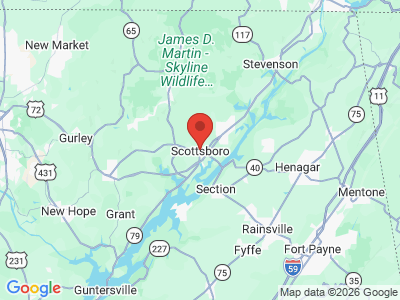
Comprising more than 1,000 square miles, Jackson County is located in the northeastern corner of the state. The county is part of the Cumberland Plateau physiographic section and sits in the southern range of the Appalachian Mountains. The varied terrain of Jackson County includes mountains and caves as well as limestone valleys and uplands covered with oak and pine forests. A section of the Warrior Coal Field is located in Jackson County. The county is bordered to the north by the state of Tennessee, to the east by the state of Georgia, to the southeast by DeKalb County, to the southwest by Marshall County, and to the west by Madison County.
Jackson County Map
Comprising more than 1,000 square miles, Jackson County is located in the northeastern corner of the state. The county is part of the Cumberland Plateau physiographic section and sits in the southern range of the Appalachian Mountains. The varied terrain of Jackson County includes mountains and caves as well as limestone valleys and uplands covered with oak and pine forests. A section of the Warrior Coal Field is located in Jackson County. The county is bordered to the north by the state of Tennessee, to the east by the state of Georgia, to the southeast by DeKalb County, to the southwest by Marshall County, and to the west by Madison County.
Portions of the Tennessee River flow throughout Jackson County. The county is drained by both the Guntersville Lake and the Wheeler Lake sections of the river. Paint Rock River, one of the most significant tributaries of the Tennessee River, begins in the northwestern part of Jackson County. The river and its tributaries offer scenic views as well as recreational and economic opportunities for visitors and residents of Jackson County.
U.S. Highway 72 serves as Jackson County's main transportation route, running southwest-northeast. It connects the county to the Huntsville metropolitan area and to Chattanooga, Tennessee. Jackson County has two public airports: Scottsboro Municipal Airport in Scottsboro and Stevenson-Bridgeport Municipal Airport in Doran Cove.
Events and Places of Interest
 Stephens Gap
There are several opportunities for recreation in Jackson County. One of the most popular attractions in the county is Russell Cave National Monument, just west of Bridgeport. Evidence of human habitation in the cave dates back more than 10,000 years, and is one of the most complete records of prehistoric culture in the southeastern United States. The cave sits at the end of a 12-mile hiking trail and is surrounded by 310 acres of dense woodlands. The visitor's center houses a museum containing Native American artifacts and offers several audiovisual presentations. A ranger-led tour takes visitors to the cave, where they can learn about how occupants fed, clothed, and protected themselves. Each spring, the site serves as the venue for the Russell Cave Native American Festival, which features educational demonstrations about historic Native American culture.
Stephens Gap
There are several opportunities for recreation in Jackson County. One of the most popular attractions in the county is Russell Cave National Monument, just west of Bridgeport. Evidence of human habitation in the cave dates back more than 10,000 years, and is one of the most complete records of prehistoric culture in the southeastern United States. The cave sits at the end of a 12-mile hiking trail and is surrounded by 310 acres of dense woodlands. The visitor's center houses a museum containing Native American artifacts and offers several audiovisual presentations. A ranger-led tour takes visitors to the cave, where they can learn about how occupants fed, clothed, and protected themselves. Each spring, the site serves as the venue for the Russell Cave Native American Festival, which features educational demonstrations about historic Native American culture.
 Walls of Jericho
Part of Guntersville Lake lies within Jackson County. The 69,000-acre lake is located on the southernmost point of the Tennessee River and is surrounded by the Appalachian Mountains. Visitors to the lake can camp, hike, boat, and fish. Goose Pond Colony in Scottsboro is a 360-acre recreational complex also located on the Tennessee River. The site includes lakefront cottages, camping and RV sites, and fishing, swimming, and boating opportunities. The site also boasts a civic center and amphitheater as well as two 18-hole golf courses. The North Alabama Birding Trail crosses Jackson County as well. Site 44 of the trail is located at Russell Cave, and more than 115 species of birds have been recorded along its length. Visitors can also hike to the Walls of Jericho, a unique natural amphitheater at the headwaters of the Paint Rock River.
Walls of Jericho
Part of Guntersville Lake lies within Jackson County. The 69,000-acre lake is located on the southernmost point of the Tennessee River and is surrounded by the Appalachian Mountains. Visitors to the lake can camp, hike, boat, and fish. Goose Pond Colony in Scottsboro is a 360-acre recreational complex also located on the Tennessee River. The site includes lakefront cottages, camping and RV sites, and fishing, swimming, and boating opportunities. The site also boasts a civic center and amphitheater as well as two 18-hole golf courses. The North Alabama Birding Trail crosses Jackson County as well. Site 44 of the trail is located at Russell Cave, and more than 115 species of birds have been recorded along its length. Visitors can also hike to the Walls of Jericho, a unique natural amphitheater at the headwaters of the Paint Rock River.
 Stevenson Railroad Depot
In addition to a variety of outdoor recreational activities and sites, Jackson County is home to a number of historical attractions. The Scottsboro Jackson Heritage Center is housed in an 1881 Greek Revival mansion and includes a museum with exhibits on Native Americans and the Tennessee Valley Authority. The 1868 Jackson County Courthouse sits behind the mansion, and the nearby Sagetown pioneer village features a collection of log structures, including a cabin, schoolhouse, barn, and blacksmith shop. The Scottsboro Boys Museum and Cultural Center offers visitors exhibits about the history of civil rights in Alabama, beginning with the infamous Scottsboro Trials. Stevenson is home to the Stevenson Railroad Depot Museum, and Bridgeport is home to the Bridgeport Train Depot Museum. The railroad junction played an important role during the Civil War as a Union stronghold and is today listed on the National Register of Historic Places. The museum includes exhibits of Native American artifacts and Civil War memorabilia.
Stevenson Railroad Depot
In addition to a variety of outdoor recreational activities and sites, Jackson County is home to a number of historical attractions. The Scottsboro Jackson Heritage Center is housed in an 1881 Greek Revival mansion and includes a museum with exhibits on Native Americans and the Tennessee Valley Authority. The 1868 Jackson County Courthouse sits behind the mansion, and the nearby Sagetown pioneer village features a collection of log structures, including a cabin, schoolhouse, barn, and blacksmith shop. The Scottsboro Boys Museum and Cultural Center offers visitors exhibits about the history of civil rights in Alabama, beginning with the infamous Scottsboro Trials. Stevenson is home to the Stevenson Railroad Depot Museum, and Bridgeport is home to the Bridgeport Train Depot Museum. The railroad junction played an important role during the Civil War as a Union stronghold and is today listed on the National Register of Historic Places. The museum includes exhibits of Native American artifacts and Civil War memorabilia.
Each June, the Stevenson Depot Days celebration commemorates the city's historic past with parades, music, food, and games. Jackson County also offers visitors a wealth of historic districts in Stevenson, Scottsboro, and Bridgeport. Each March, Bridgeport hosts the Siege of Bridgeport, the largest Civil War reenactment in Alabama, complete with cavalry charges and cannon firings.
Additional Resources
- The Heritage of Jackson County, Alabama. Clanton, Ala.: Heritage Publishing Consultants, 1998.
- Kennamer, John Robert. The History of Jackson County, Alabama. Scottsboro, Ala.: Jackson County Historical Association, 1993.
External Links
- Jackson County
- Jackson County School District
- City of Scottsboro
- City of Stevenson
- Town of Hytop
- Town of Pisgah
- Jackson County Historical Association
- Scottsboro Jackson Heritage Center
- Scottsboro Boys Museum
- National Register of Historic Places: Jackson County
- Alabama Birding Trails: North Alabama
- Visit North Alabama
- Guntersville Lake
- Sauta Cave
- Russell Cave National Monument