Crenshaw County
 World's Largest Peanut Boil
Located in south-central Alabama, Crenshaw County is a center of the state's timber industry. The town of Luverne boasts a number of historic homes and hosts the annual "World's Largest Peanut Boil" festival. The county is governed by an elected four-member commission and includes six incorporated communities.
World's Largest Peanut Boil
Located in south-central Alabama, Crenshaw County is a center of the state's timber industry. The town of Luverne boasts a number of historic homes and hosts the annual "World's Largest Peanut Boil" festival. The county is governed by an elected four-member commission and includes six incorporated communities.
- Founding Date: November 24, 1866
- Area: 611 square miles
- Population: 13,826 (2020 Census estimate)
- Major Waterways: Conecuh River
- County Seat: Luverne
- Largest City: Luverne
History
 Patsaliga Creek
Crenshaw County was created by an act of the Alabama State Legislature on November 24, 1866, from parts of Butler, Coffee, Covington, Pike, and Lowndes Counties. The county was named for Anderson Crenshaw of Alabama, a judge and prominent settler of Butler County. In 1856, Highland Home College was established in the community of Highland Home and operated until 1915. The region's infertile soil and hilly terrain hindered large-scale farming, and settlers focused instead on timbering. Crenshaw County's economy received a boost in 1886 when the Montgomery and Florida Railroad company began purchasing land, completing a line through the county in 1888. The new town of Luverne sprang up east of Patsaliga Creek and by March of 1890 boasted a population of almost 1,000. Businesses included grocery, hardware, and clothing stores, a saloon and restaurant, a blacksmith shop, telegraph service, several sawmills, a grist mill, a planing mill, a hotel, and a newspaper. The town of Glenwood, created in 1896 after completion of a Central of Georgia Railroad line, soon included a bank, several sawmills, a number of stores, a school, and a cotton gin.
Patsaliga Creek
Crenshaw County was created by an act of the Alabama State Legislature on November 24, 1866, from parts of Butler, Coffee, Covington, Pike, and Lowndes Counties. The county was named for Anderson Crenshaw of Alabama, a judge and prominent settler of Butler County. In 1856, Highland Home College was established in the community of Highland Home and operated until 1915. The region's infertile soil and hilly terrain hindered large-scale farming, and settlers focused instead on timbering. Crenshaw County's economy received a boost in 1886 when the Montgomery and Florida Railroad company began purchasing land, completing a line through the county in 1888. The new town of Luverne sprang up east of Patsaliga Creek and by March of 1890 boasted a population of almost 1,000. Businesses included grocery, hardware, and clothing stores, a saloon and restaurant, a blacksmith shop, telegraph service, several sawmills, a grist mill, a planing mill, a hotel, and a newspaper. The town of Glenwood, created in 1896 after completion of a Central of Georgia Railroad line, soon included a bank, several sawmills, a number of stores, a school, and a cotton gin.
Major Cities and Demographics
 Crenshaw County Courthouse
According to 2020 Census estimates, Crenshaw County recorded a population of 13,826. Approximately 71.5 percent of respondents identified themselves as white, 23.6 percent as African American, 2.3 percent as two or more races, 2.2 percent as Hispanic, 1.3 percent as Asian, 0.8 percent as Native American, and 0.1 percent as Hawaiian or Pacific Islander. The county seat, Luverne, had a population of 2,742. Other population centers in the county include Glenwood, Brantley, Rutledge, Petrey, and Dozier. The median household income was $42,611, as compared with $52,035 for the state as a whole, and the per capita income was $26,351, compared with $28,934 for the state as a whole.
Crenshaw County Courthouse
According to 2020 Census estimates, Crenshaw County recorded a population of 13,826. Approximately 71.5 percent of respondents identified themselves as white, 23.6 percent as African American, 2.3 percent as two or more races, 2.2 percent as Hispanic, 1.3 percent as Asian, 0.8 percent as Native American, and 0.1 percent as Hawaiian or Pacific Islander. The county seat, Luverne, had a population of 2,742. Other population centers in the county include Glenwood, Brantley, Rutledge, Petrey, and Dozier. The median household income was $42,611, as compared with $52,035 for the state as a whole, and the per capita income was $26,351, compared with $28,934 for the state as a whole.
Economy
The rugged terrain and infertile soil of Crenshaw County made large-scale farming impractical. As a result, early settlers focused their efforts on timbering in the piney woods of the county. In 1886, the Montgomery and Florida Railroad company began purchasing land in Crenshaw County for a right-of-way for a rail line to run from Sprague Junction in Montgomery County to Crenshaw County, allowing lumber mills to ship their products with greater ease.
Employment
According to 2020 Census estimates, the workforce in Crenshaw County was divided among the following industrial categories:
- Educational services, and health care and social assistance (20.1 percent)
- Manufacturing (16.4 percent)
- Retail trade (12.4 percent)
- Professional, scientific, management, and administrative and waste management services (8.7 percent)
- Construction (7.9 percent)
- Public administration (6.7 percent)
- Transportation and warehousing, and utilities (6.5 percent)
- Agriculture, forestry, fishing and hunting, and extractive (5.3 percent)
- Other services, except public administration (4.3 percent)
- Arts, entertainment, recreation, and accommodation and food services (4.2 percent)
- Finance and insurance, and real estate, rental, and leasing (4.0 percent)
- Wholesale trade (2.4 percent)
- Information (1.1 percent)
Education
The Crenshaw County School System oversees four schools.
Geography
 Crenshaw County Map
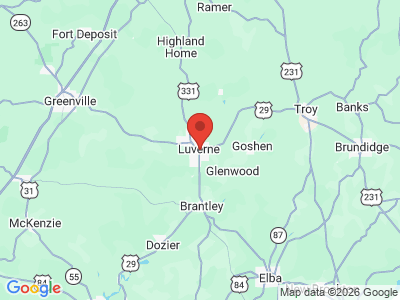
Encompassing approximately 611 square miles, Crenshaw County lies in the south-central area of the state, wholly within the Coastal Plain physiographic section. It is bounded to the north by Montgomery and Lowndes counties, to the east by Pike and Coffee counties, to the south by Covington County, and to the west by Butler County.
Crenshaw County Map
Encompassing approximately 611 square miles, Crenshaw County lies in the south-central area of the state, wholly within the Coastal Plain physiographic section. It is bounded to the north by Montgomery and Lowndes counties, to the east by Pike and Coffee counties, to the south by Covington County, and to the west by Butler County.
The Conecuh River runs along the southern border of the county, and one of its largest tributaries, Patsaliga Creek runs through the northwestern portion of the county. The major transportation routes through Crenshaw are U.S 29 and U.S. 331, which run north-south through the center of the county.
Events and Places of Interest
Every fall the town of Luverne holds its annual "World's Largest Peanut Boil." The town also boasts an historic district featuring several Queen Anne- and Craftsmen-style homes, including the 1904 F. M. Douglass House, now the Camellia House bed and breakfast.
Additional Resources
- Heritage of Crenshaw County, Alabama. Clanton, Ala.: Heritage Publishing Consultants, Inc., 2002.