Henry County
 Abbeville
Located in the southeastern part of the state, Henry County is known as the Cradle of the Wiregrass because nine Alabama counties in the Wiregrass region were formed from lands once encompassed by the county. Henry County is a center of the peanut industry, and the city of Dothan, part of which is located in Henry County, hosts an annual National Peanut Festival to honor this important cash crop. The county is governed by an elected six-member commission and includes the five incorporated communities. Musician Eddie Kirkland, known as the "Gypsy of the Blues," was raised in Henry County.
Abbeville
Located in the southeastern part of the state, Henry County is known as the Cradle of the Wiregrass because nine Alabama counties in the Wiregrass region were formed from lands once encompassed by the county. Henry County is a center of the peanut industry, and the city of Dothan, part of which is located in Henry County, hosts an annual National Peanut Festival to honor this important cash crop. The county is governed by an elected six-member commission and includes the five incorporated communities. Musician Eddie Kirkland, known as the "Gypsy of the Blues," was raised in Henry County.
- Founding Date: December 13, 1819
- Area: 557 square miles
- Population: 17,123 (2020 Census estimate)
- Major Waterways: Chattahoochee River
- Major Highways: U.S. 431
- County Seat: Abbeville
- Largest City: Headland
History
 Henry County Courthouse
Henry County was created by the Alabama General Territorial Assembly on December 13, 1819. At the time of its creation, Henry County encompassed a vast area that included the entire southeast Wiregrass region and beyond. Throughout the nineteenth century, however, large portions of Henry County were carved out to create a total of nine other Alabama counties: Coffee, Covington, Dale, Geneva, Henry, and Houston as well as parts of Barbour, Pike, and Crenshaw. Over the course of nearly 100 years, Henry County went from being the largest county in Alabama to one of the smallest in the state. In 1832, the state government added a portion of land now in the northwestern corner of the county. The area, which sticks out from the rest of Henry County, is now known as "The Nook."
Henry County Courthouse
Henry County was created by the Alabama General Territorial Assembly on December 13, 1819. At the time of its creation, Henry County encompassed a vast area that included the entire southeast Wiregrass region and beyond. Throughout the nineteenth century, however, large portions of Henry County were carved out to create a total of nine other Alabama counties: Coffee, Covington, Dale, Geneva, Henry, and Houston as well as parts of Barbour, Pike, and Crenshaw. Over the course of nearly 100 years, Henry County went from being the largest county in Alabama to one of the smallest in the state. In 1832, the state government added a portion of land now in the northwestern corner of the county. The area, which sticks out from the rest of Henry County, is now known as "The Nook."
Henry County was named for Patrick Henry, the famous statesman and orator from Virginia. The earliest settlers came to the area from Georgia and the Carolinas via Fort Gaines after the 1814 Treaty at Fort Jackson, in which the Creeks ceded their lands along the Chattahoochee River to the United States. The first settlements were established in the northeastern part of the county and along the banks of the Chattahoochee River. Some of the earliest settlements and towns included Abbeville, Headland, and Newville.
The county seat of Henry County has changed locations several times because of the many reductions in its size. The first county seat was Richmond, a town no longer in existence. A small log building served as the county courthouse from 1822 to 1826, when the county seat moved to Columbia, where a log courthouse was in use from 1826 to 1833. At that time, the county seat was moved to its final location in Abbeville. Several wooden courthouses served the county between 1833 and 1889, when a two-story brick courthouse with a four-sided clock tower was built on the same site. In 1935, the fifth courthouse was remodeled with the exterior plastered and painted white, becoming known as the "White House." In 1965, the fifth courthouse was torn down to make way for the sixth and present-day courthouse, a three-story Neoclassical structure surrounded by 46 narrow columns.
Major Cities and Demographics
 Haleburg Mural
According to 2020 Census estimates, the population of Henry County is 17,123. Approximately 70.0 percent of respondents identified themselves as white, 26.6 percent as African American, 2.6 percent as Hispanic, and 1.7 percent as two or more races, 0.4 percent as Asian, 0.2 percent as Hawaiian or Pacific Islander, and 0.2 percent as Native American. The county seat, Abbeville, has a population of 2,572. Other significant population centers include Headland, Newville, and Haleburg. Part of the city of Dothan lies within Henry County. The median household income was $51,715, compared with $52,035 for the state as a whole, and the per capita income was $26,011, compared with $28,934 for the state as a whole.
Haleburg Mural
According to 2020 Census estimates, the population of Henry County is 17,123. Approximately 70.0 percent of respondents identified themselves as white, 26.6 percent as African American, 2.6 percent as Hispanic, and 1.7 percent as two or more races, 0.4 percent as Asian, 0.2 percent as Hawaiian or Pacific Islander, and 0.2 percent as Native American. The county seat, Abbeville, has a population of 2,572. Other significant population centers include Headland, Newville, and Haleburg. Part of the city of Dothan lies within Henry County. The median household income was $51,715, compared with $52,035 for the state as a whole, and the per capita income was $26,011, compared with $28,934 for the state as a whole.
Economy
 Peanut Harvest, 1940s
Like most of Alabama, farming was the prevailing occupation in Henry County until well into the twentieth century. Because of the isolation of the Wiregrass region and its relatively poor soil, however, the area was sparsely settled until after the Civil War. What farming occurred before the war was mostly subsistence. After the war, the timber industry boomed, as lumbering interests rushed in to take advantage of the yellow pine trees that covered the county. During the early years of the twentieth century, the advent of commercial fertilizers enabled farmers to boost the fertility of the county's sandy soil, and the area became a cotton-producing region. The arrival of the boll weevil, however, forced a shift from cotton to crops such as peanuts, corn, and pecans as well as to the raising of livestock. Peanuts became so important to the county's economy that approximately half of the peanuts grown in the United States are grown within a 100-mile radius of Dothan. With the introduction of hydroelectric power in the 1930s and 1940s, Henry County moved from an agriculture-based economy to an industry-based economy, although most major industries in the county remain tied to the land in the form of textile factories or food-processing factories.
Peanut Harvest, 1940s
Like most of Alabama, farming was the prevailing occupation in Henry County until well into the twentieth century. Because of the isolation of the Wiregrass region and its relatively poor soil, however, the area was sparsely settled until after the Civil War. What farming occurred before the war was mostly subsistence. After the war, the timber industry boomed, as lumbering interests rushed in to take advantage of the yellow pine trees that covered the county. During the early years of the twentieth century, the advent of commercial fertilizers enabled farmers to boost the fertility of the county's sandy soil, and the area became a cotton-producing region. The arrival of the boll weevil, however, forced a shift from cotton to crops such as peanuts, corn, and pecans as well as to the raising of livestock. Peanuts became so important to the county's economy that approximately half of the peanuts grown in the United States are grown within a 100-mile radius of Dothan. With the introduction of hydroelectric power in the 1930s and 1940s, Henry County moved from an agriculture-based economy to an industry-based economy, although most major industries in the county remain tied to the land in the form of textile factories or food-processing factories.
According to 2020 Census estimates, the workforce in present-day Henry County is divided among the following industrial categories:
- Educational services, and health care and social assistance (22.8 percent)
- Manufacturing (14.4 percent)
- Retail trade (12.4 percent)
- Professional, scientific, management, and administrative and waste management services (8.9 percent)
- Other services, except public administration (7.8 percent)
- Transportation and warehousing, and utilities (7.8 percent)
- Arts, entertainment, recreation, and accommodation and food services (5.7 percent)
- Agriculture, forestry, fishing and hunting, and extractive (4.7 percent)
- Wholesale trade (4.2 percent)
- Finance and insurance, and real estate, rental, and leasing (4.1 percent)
- Construction (3.6 percent)
- Public administration (2.4 percent)
- Information (1.2 percent)
Education
The Henry County School System oversees seven primary and secondary schools.
Geography
 Henry County Map
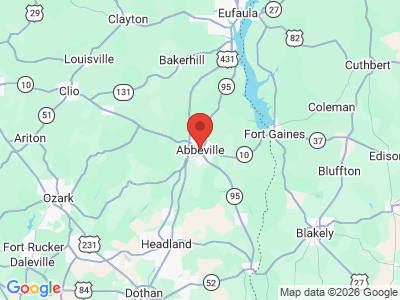
Comprising more than 550 square miles, Henry County lies in the southeastern part of the state. The county is part of the East Gulf Coastal Plain physiographic section and consists of sandy and shallow coastal plains soils. The county is dotted throughout with pine forests. Henry County is bordered by Barbour County to the north, the state of Georgia to the east, Houston County to the south, and Dale and Barbour Counties to the west. The Gravel Creek lignite (a low-grade form of coal) fields cover northern portions of Houston County.
Henry County Map
Comprising more than 550 square miles, Henry County lies in the southeastern part of the state. The county is part of the East Gulf Coastal Plain physiographic section and consists of sandy and shallow coastal plains soils. The county is dotted throughout with pine forests. Henry County is bordered by Barbour County to the north, the state of Georgia to the east, Houston County to the south, and Dale and Barbour Counties to the west. The Gravel Creek lignite (a low-grade form of coal) fields cover northern portions of Houston County.
The Chattahoochee River and its lower tributaries flow throughout Henry County, as do several tributaries of the Choctawhatchee River. Because the Chattahoochee River is one of the most dammed rivers in the Southeast, its ecosystems have been severely altered over the last half century. The overall biological diversity of the river has declined, and several fish and mussel species are at risk. Both rivers provide scenic views and recreational opportunities for visitors to Henry County.
U.S. Highway 431 is Henry County's main transportation route. U.S. 431 runs north-south along the western border of Henry County. Abbeville Municipal Airport in Abbeville and Headland Municipal Airport in Headland are the county's two public airports.
Events and Places of Interest
 Bethune-Kennedy House
There are a number of recreational opportunities for visitors to Henry County. The Cross Key Shooting Preserve in Abbeville, which ranges over 4,000 acres, offers visitors opportunities to take part in guided quail hunts and horseback riding. Walter F. George Lake, at the northeast border of Henry County, encompasses 45,181 acres of water and has 640 miles of shoreline. Visitors to the lake can take part in a number of activities, including camping, hunting, fishing, and boating.
Bethune-Kennedy House
There are a number of recreational opportunities for visitors to Henry County. The Cross Key Shooting Preserve in Abbeville, which ranges over 4,000 acres, offers visitors opportunities to take part in guided quail hunts and horseback riding. Walter F. George Lake, at the northeast border of Henry County, encompasses 45,181 acres of water and has 640 miles of shoreline. Visitors to the lake can take part in a number of activities, including camping, hunting, fishing, and boating.
The National Peanut Festival is held each fall in Dothan and is the nation's largest peanut festival. It includes amusement rides, animal acts, agricultural displays, live music concerts, and food and games. In the city of Headland, the chamber of commerce hosts an annual Harvest Day Festival each October and a Daylily Festival each June. The festival includes live entertainment, antique car shows, rides and games, arts and crafts, and pony and train rides. The city of Abbeville is home to several historic structures, including the Abbeville Methodist Church (1896) and the Bethune-Kennedy House (ca. 1870). The town hosts a Yatta Abba Day arts and crafts festival each May.
Additional Resources
- The Heritage of Henry County, Alabama. Clanton, Ala.: Heritage Publishing Consultants, 2002.
External Links
- Henry County
- Henry County School District
- City of Abbeville
- City of Dothan
- City of Headland
- Headland Chamber of Commerce
- Abbeville Chamber of Commerce
- Wiregrass Museum of Art
- Dothan Area Botanical Gardens
- National Peanut Festival
- Walter F. George Lake/Lake George W. Andrews
- National Register of Historic Places: Henry County