Hale County
 Reconstructed Mississippian Compound
Located in the west-central part of the state in Alabama's Black Belt, the area that now constitutes Hale County was home to three Alabama governors: Israel Pickens, John Gayle, and Thomas Seay. Hale County's Moundville Archaeological Park includes a number of Mississippian-era mounds built by Native Americans more than 1,000 years ago. The town of Greensboro claims the title of Alabama's "Catfish Capital" and was the birthplace of the Hale County Civic Improvement League, one of the nation's first civil-rights associations. The county is governed by a representative five-member commission and includes four incorporated communities.
Reconstructed Mississippian Compound
Located in the west-central part of the state in Alabama's Black Belt, the area that now constitutes Hale County was home to three Alabama governors: Israel Pickens, John Gayle, and Thomas Seay. Hale County's Moundville Archaeological Park includes a number of Mississippian-era mounds built by Native Americans more than 1,000 years ago. The town of Greensboro claims the title of Alabama's "Catfish Capital" and was the birthplace of the Hale County Civic Improvement League, one of the nation's first civil-rights associations. The county is governed by a representative five-member commission and includes four incorporated communities.
- Founding Date: January 30, 1867
- Area: 661 square miles
- Population: 14,754 (2020 Census estimate)
- Major Waterways: Black Warrior River
- Major Highways: State Route 69, State Route 14
- County Seat: Greensboro
- Largest City: Greensboro
History
 Hale County Courthouse
The lands of present-day Hale County were ceded to the United States by the Choctaw Indians in the 1816 Treaty of Fort St. Stephens. Hale County was created by the Alabama State Legislature on January 30, 1867, from parts of Greene, Marengo, Perry, and Tuscaloosa Counties. The county was named in honor of Lt. Col. Stephen F. Hale, a Greene County lawyer and soldier who died in Richmond, Virginia, during the Civil War. The earliest settlers came to Hale County from Georgia, Tennessee, Kentucky, and the Carolinas. Some of the earliest settlements and towns included Greensboro, New Bern (now Newbern), Moundville (originally known as Carthage), and Havana. Greensboro was the first county seat of Hale County and remains so today. The first Hale County courthouse was established in 1867 in the former Salem Baptist Church. That structure was torn down in 1907 and replaced with the current building in 1908. It suffered a major fire in 1935, which destroyed most of the upper floors and clocktower; they were rebuilt that year.
Hale County Courthouse
The lands of present-day Hale County were ceded to the United States by the Choctaw Indians in the 1816 Treaty of Fort St. Stephens. Hale County was created by the Alabama State Legislature on January 30, 1867, from parts of Greene, Marengo, Perry, and Tuscaloosa Counties. The county was named in honor of Lt. Col. Stephen F. Hale, a Greene County lawyer and soldier who died in Richmond, Virginia, during the Civil War. The earliest settlers came to Hale County from Georgia, Tennessee, Kentucky, and the Carolinas. Some of the earliest settlements and towns included Greensboro, New Bern (now Newbern), Moundville (originally known as Carthage), and Havana. Greensboro was the first county seat of Hale County and remains so today. The first Hale County courthouse was established in 1867 in the former Salem Baptist Church. That structure was torn down in 1907 and replaced with the current building in 1908. It suffered a major fire in 1935, which destroyed most of the upper floors and clocktower; they were rebuilt that year.
 Butterfly House
Throughout the twentieth and twenty-first centuries, Hale County has been connected with several well-known artists. In 1936, Walker Evans photographed the area for the 1941 book Let Us Now Praise Famous Men, on which he collaborated with writer James Agee. Multimedia artist William Christenberry photographed Hale County's architecture from the 1960s to 2000s. Hale County is also the home to Auburn University's Rural Studio, a nationally renowned architectural outreach program founded by Samuel Mockbee and D. K. Ruth and based in Newbern.
Butterfly House
Throughout the twentieth and twenty-first centuries, Hale County has been connected with several well-known artists. In 1936, Walker Evans photographed the area for the 1941 book Let Us Now Praise Famous Men, on which he collaborated with writer James Agee. Multimedia artist William Christenberry photographed Hale County's architecture from the 1960s to 2000s. Hale County is also the home to Auburn University's Rural Studio, a nationally renowned architectural outreach program founded by Samuel Mockbee and D. K. Ruth and based in Newbern.
On April 27, 2011, a massive storm, causing numerous powerful tornadoes, struck the southeastern United States. More than 250 people were killed in Alabama, including six people in the Hale County communities of Greensboro (2) and Sawyerville (4).
Major Cities and Demographics
According to 2020 Census estimates, the population of Hale County is 14,754. Approximately 59.1 percent of respondents identified themselves as African American, 38.4 percent as white, 2.1 percent as two or more races, 0.2 percent as Asian, and 0.1 percent as Hispanic. The county seat, Greensboro, had a population of 2,956. Other significant population centers include Moundville, Akron, and Newbern. The median household income was $30,793, compared with $52,035 for the state as a whole, and the per capita income was $20,652, compared with $28,934 for the state as a whole.
Economy
Like most of Alabama's counties, farming was the prevailing occupation of Hale County until the middle of the twentieth century. Given the rich, dark soil of the Black Belt, cotton was the main crop in the county and remained so until the 1930s. During the Great Depression, farmers diversified into corn and livestock, and cotton fields were turned into pasture for beef and dairy cows. In the 1960s, farmers turned to soybeans and grain-fed catfish as the predominant cash crops. The economy was based largely in agriculture until the mid-twentieth century, but the many acres of forest along the Black Warrior River were a draw for the timber industry as well. Unlike neighboring counties, Hale County did not fully take part in the industrialization boom of the mid-twentieth century, remaining largely rural and agricultural, accounting for its high rates of poverty today.
According to 2020 Census estimates, the workforce in Hale County was divided among the following industrial categories:
- Educational services, and health care and social assistance (28.4 percent)
- Manufacturing (16.5 percent)
- Retail trade (13.9 percent)
- Arts, entertainment, recreation, and accommodation and food services (9.5 percent)
- Professional, scientific, management, and administrative and waste management services (6.8 percent)
- Other services, except public administration (5.5 percent)
- Construction (5.1 percent)
- Agriculture, forestry, fishing and hunting, and extractive (4.0 percent)
- Public administration (3.6 percent)
- Transportation and warehousing, and utilities (3.4 percent)
- Finance and insurance, and real estate, rental, and leasing (2.0 percent)
- Wholesale trade (1.2 percent)
- Information (0.1 percent)
Education
The Hale County School System oversees 10 primary and secondary schools.
Geography
 Hale County Map
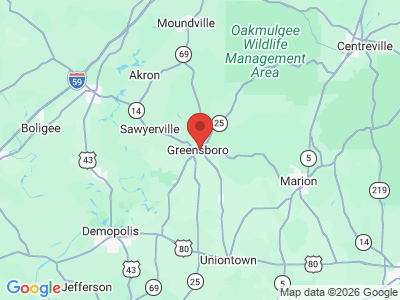
Comprising more than 660 square miles, Hale County is part of Alabama's Black Belt and lies in the west-central part of the state wholly within the Coastal Plain physiographic section. The landscape consists of rolling prairies and coastal plains dotted with oak and pine forests. Hale County is bordered by Tuscaloosa County to the north, Bibb and Perry Counties to the east, Marengo County to the south, and Greene County to the west. A small portion of the Warrior Coal Basin of the Warrior Coal Field lies in the northernmost part of Hale County.
Hale County Map
Comprising more than 660 square miles, Hale County is part of Alabama's Black Belt and lies in the west-central part of the state wholly within the Coastal Plain physiographic section. The landscape consists of rolling prairies and coastal plains dotted with oak and pine forests. Hale County is bordered by Tuscaloosa County to the north, Bibb and Perry Counties to the east, Marengo County to the south, and Greene County to the west. A small portion of the Warrior Coal Basin of the Warrior Coal Field lies in the northernmost part of Hale County.
The Black Warrior River and its lower tributaries flow throughout Hale County. The Black Warrior River System is the largest watershed wholly within Alabama's state boundaries and is unique in that it emanates from three sources: the Locust Fork, the Mulberry Fork, and the Sipsey Fork. The Black Warrior River is considered amongst the most critical watersheds in the nation and is home to several species of at-risk fish and mussels. There are no major interstate or U.S. highways that run through Hale County. Alabama State Route 69 runs north-south through the middle of the county, while State Route 14 runs east-west across the middle of Hale County. There are no public airports in Hale County.
Events and Places of Interest
 Black Warrior River
There are several recreational opportunities for visitors to Hale County. Moundville Archaeological Park is a 320-acre park that features 26 large prehistoric platform mounds. The park includes a reconstructed Indian village, the Jones Archaeological Museum, nature trails, campgrounds, and picnic sites on the banks of the Black Warrior River. The very northeast corner of Hale County is encompassed by Talladega National Forest, which covers 375,000 acres at the southern edge of the Appalachian Mountains. Rugged mountains, forests, waterfalls, and streams afford visitors various opportunities for recreational activity including camping, hiking, backpacking, fishing, and bird watching.
Black Warrior River
There are several recreational opportunities for visitors to Hale County. Moundville Archaeological Park is a 320-acre park that features 26 large prehistoric platform mounds. The park includes a reconstructed Indian village, the Jones Archaeological Museum, nature trails, campgrounds, and picnic sites on the banks of the Black Warrior River. The very northeast corner of Hale County is encompassed by Talladega National Forest, which covers 375,000 acres at the southern edge of the Appalachian Mountains. Rugged mountains, forests, waterfalls, and streams afford visitors various opportunities for recreational activity including camping, hiking, backpacking, fishing, and bird watching.
 Magnolia Grove
Known as Alabama's Catfish Capital, Greensboro is home to a variety of historical attractions. Because Greensboro managed to escape the Civil War relatively unscathed, a large number of antebellum homes and churches remain. The entire downtown district of the town is listed on the National Register of Historic Places and features nearly 150 nineteenth-century structures, 60 of which predate the Civil War. The Noel-Ramsey House, built between 1819 and 1821, is the only remaining residence of French settlers from nearby Demopolis's Vine and Olive Colony. A two-story Greek Revival house, Magnolia Grove was built around 1840 and sits among 15 acres of magnolia trees and formal gardens. The house was the boyhood home of Rr. Adm. Richmond Pearson Hobson, a naval hero in the Spanish-American War. The house now serves as a museum featuring family portraits, heirlooms, and furnishings from the 1830s to the early twentieth century. Original outbuildings include a kitchen and an enslaved family cottage. The Greensboro Opera House is a performance venue housed in a historic 1903 building.
Magnolia Grove
Known as Alabama's Catfish Capital, Greensboro is home to a variety of historical attractions. Because Greensboro managed to escape the Civil War relatively unscathed, a large number of antebellum homes and churches remain. The entire downtown district of the town is listed on the National Register of Historic Places and features nearly 150 nineteenth-century structures, 60 of which predate the Civil War. The Noel-Ramsey House, built between 1819 and 1821, is the only remaining residence of French settlers from nearby Demopolis's Vine and Olive Colony. A two-story Greek Revival house, Magnolia Grove was built around 1840 and sits among 15 acres of magnolia trees and formal gardens. The house was the boyhood home of Rr. Adm. Richmond Pearson Hobson, a naval hero in the Spanish-American War. The house now serves as a museum featuring family portraits, heirlooms, and furnishings from the 1830s to the early twentieth century. Original outbuildings include a kitchen and an enslaved family cottage. The Greensboro Opera House is a performance venue housed in a historic 1903 building.
 Oak Grove School
Located in Greensboro, visitors can tour the Safe House Black History Museum, which houses photos of Martin Luther King Jr., a collection of media sources on African American history, an 1860 slave-auction document, and cement imprints of the hands of Lewis Black. Black was the founder of the Hale County Civic Improvement League, one of the first civil-rights groups in the country. The Oak Grove School, a two-room school that served African American children, is located in the nearby town of Gallion. The school was built with funds donated by Julius Rosenwald, president of Sears and Roebuck, and now serves as a community heritage center.
Oak Grove School
Located in Greensboro, visitors can tour the Safe House Black History Museum, which houses photos of Martin Luther King Jr., a collection of media sources on African American history, an 1860 slave-auction document, and cement imprints of the hands of Lewis Black. Black was the founder of the Hale County Civic Improvement League, one of the first civil-rights groups in the country. The Oak Grove School, a two-room school that served African American children, is located in the nearby town of Gallion. The school was built with funds donated by Julius Rosenwald, president of Sears and Roebuck, and now serves as a community heritage center.
Additional Resources
- The Heritage of Hale County, Alabama. Clanton, Ala.: Heritage Publishing Consultants, 2001.