Elmore County
 Moccasin Gap on the Coosa River
Located in east-central Alabama, Elmore County is the third-fastest growing county in Alabama. Home to some of the most navigable and recreational waterways in the state, it is also scene to some of the most historic events in the Southeast. The Wetumpka Crater, estimated to be 83 million years old and located on the east side of the city of Wetumpka, is one of the most unique geological features in the state and the only identifited meteor crater in Alabama. It is almost five miles wide. Elmore County is governed by an elected five-member county commission.
Moccasin Gap on the Coosa River
Located in east-central Alabama, Elmore County is the third-fastest growing county in Alabama. Home to some of the most navigable and recreational waterways in the state, it is also scene to some of the most historic events in the Southeast. The Wetumpka Crater, estimated to be 83 million years old and located on the east side of the city of Wetumpka, is one of the most unique geological features in the state and the only identifited meteor crater in Alabama. It is almost five miles wide. Elmore County is governed by an elected five-member county commission.
- Founding Date: February 15, 1866
- Area: 622 square miles
- Population: 81,526 (2020 Census estimate)
- Major Waterways: Tallapoosa River, Coosa River
- Major Highways: U.S. 231, I-65
- County Seat: Wetumpka
- Largest City: Millbrook
History
 Elmore County Courthouse
Elmore County was created by an act of the Alabama State Legislature on February 15, 1866, from portions of Coosa, Autauga, and Montgomery Counties. It was named for Gen. John Archer Elmore, a veteran of the American Revolution and an early settler of Alabama. Elmore county is located in what once was the heart of Upper Creek territory. The present-day towns of Wetumpka and Tallassee, located on the banks of the Coosa and Tallapoosa Rivers, retain the names of the former Creek towns on those sites. Tuckabatchee, one of the principal towns of the Creek Nation, was also located in Elmore County, near the town of Tallassee. After the arrival of the French in Mobile in 1702, Jean-Baptiste Le Moyne, Sieur de Bienville, sent an expedition up the Alabama River to what is now southern Elmore County to establish Fort Toulouse, completed in 1717.
Elmore County Courthouse
Elmore County was created by an act of the Alabama State Legislature on February 15, 1866, from portions of Coosa, Autauga, and Montgomery Counties. It was named for Gen. John Archer Elmore, a veteran of the American Revolution and an early settler of Alabama. Elmore county is located in what once was the heart of Upper Creek territory. The present-day towns of Wetumpka and Tallassee, located on the banks of the Coosa and Tallapoosa Rivers, retain the names of the former Creek towns on those sites. Tuckabatchee, one of the principal towns of the Creek Nation, was also located in Elmore County, near the town of Tallassee. After the arrival of the French in Mobile in 1702, Jean-Baptiste Le Moyne, Sieur de Bienville, sent an expedition up the Alabama River to what is now southern Elmore County to establish Fort Toulouse, completed in 1717.
 Fort Toulouse
Settlers from the Carolinas and Georgia began pouring into present-day Elmore County during the late eighteenth and early nineteenth centuries, complicating the already strained relationship between the state and federal governments and the Creeks. In 1812, Shawnee chief Tecumseh led a faction of the Creeks known as the Red Sticks in an uprising that culminated in the defeat of the Creek Nation by Andrew Jackson's troops at the Battle of Horseshoe Bend in 1814. After the battle, the Creeks were forced to cede their land to the United States in the Treaty of Fort Jackson. Elmore County was home to Alabama's first governor, William Wyatt Bibb, who died shortly after being appointed to office.
Fort Toulouse
Settlers from the Carolinas and Georgia began pouring into present-day Elmore County during the late eighteenth and early nineteenth centuries, complicating the already strained relationship between the state and federal governments and the Creeks. In 1812, Shawnee chief Tecumseh led a faction of the Creeks known as the Red Sticks in an uprising that culminated in the defeat of the Creek Nation by Andrew Jackson's troops at the Battle of Horseshoe Bend in 1814. After the battle, the Creeks were forced to cede their land to the United States in the Treaty of Fort Jackson. Elmore County was home to Alabama's first governor, William Wyatt Bibb, who died shortly after being appointed to office.
After settlers flooded the area, it quickly became a highly productive agriculture and mercantile hub for east-central Alabama. Although no battles were fought in the county during the Civil War, in 1864 Confederate Chief of Ordnance Josiah Gorgas moved the Richmond Carbine Factory from Richmond, Virginia, to the Tallassee Manufacturing Mill along the Tallapoosa River in eastern Elmore County to evade Union troops. The mill was the only Confederate armory not destroyed during the war.
On April 27, 2011, a massive storm, causing numerous powerful tornadoes, struck the southeastern United States. More than 250 people were killed in Alabama, including six people in the community of Eclectic in Elmore County.
Major Cities and Demographics
According to 2020 Census estimates, Elmore County recorded a population of 81,526. Approximately 74.9 percent of respondents identified themselves as white, 21.1 percent as African American, 3.0 percent Hispanic, 2.0 percent as two or more races, 0.9 percent as Asian, and 0.3 percent as Native American. The county seat, Wetumpka, had a population of 8,282. Other population centers in the county include Millbrook, Eclectic, Coosada, Tallassee, Elmore, and Deatsville. The median household income was $62,324, compared with $52,035 for the state as a whole, and the per capita income was $29,585, compared with $28,934 for the state as a whole.
Economy
 Pea Vine Hay
During the early nineteenth century, present-day Elmore county enjoyed a lively trade among the French, British, and Creek Indians along the rivers. The town of Wetumpka, located at the confluence of the Coosa, Tallapoosa, and Alabama Rivers, became an important center of agricultural trade. As cotton became the dominant cash crop in Alabama prior to the Civil War, farmers began to cart their harvests to Wetumpka's warehouses, where they were shipped down the Alabama River for sale at Mobile. Because of its location and economic success, Wetumpka was a leading contender in the contest to become the new state capital in the 1840s but lost out to Montgomery by several votes. The Civil War and Reconstruction devastated the agricultural and shipping economy of Elmore County. During the early twentieth century, the economy of the county became closely linked to that of Montgomery as residents began to use U.S. highway 231 to commute to work in the Capital City.
Pea Vine Hay
During the early nineteenth century, present-day Elmore county enjoyed a lively trade among the French, British, and Creek Indians along the rivers. The town of Wetumpka, located at the confluence of the Coosa, Tallapoosa, and Alabama Rivers, became an important center of agricultural trade. As cotton became the dominant cash crop in Alabama prior to the Civil War, farmers began to cart their harvests to Wetumpka's warehouses, where they were shipped down the Alabama River for sale at Mobile. Because of its location and economic success, Wetumpka was a leading contender in the contest to become the new state capital in the 1840s but lost out to Montgomery by several votes. The Civil War and Reconstruction devastated the agricultural and shipping economy of Elmore County. During the early twentieth century, the economy of the county became closely linked to that of Montgomery as residents began to use U.S. highway 231 to commute to work in the Capital City.
 Train Ferry across the Tallapoosa River
In 1878, the Louisville & Nashville railroad completed a rail line to Elmore County, with a spur line to Prattville. The spur went through Millbrook, which quickly developed into a suburb for those wishing to escape the hectic atmosphere of Montgomery. In 1977, the city of Millbrook became a municipality and quickly developed into the largest city in the county. Prattville, the village developed by industrialist Daniel Pratt, is partially located in Elmore County, and its growth as a retail center over the past few decades also feeds the economy of the county. In December 2013, the Wind Creek Wetumpka Casino and Hotel complex opened near the city of Wetumpka. It was developed as a partnership between the Poarch Band of Creek Indians and Harrah's, the largest casino group in the country.
Train Ferry across the Tallapoosa River
In 1878, the Louisville & Nashville railroad completed a rail line to Elmore County, with a spur line to Prattville. The spur went through Millbrook, which quickly developed into a suburb for those wishing to escape the hectic atmosphere of Montgomery. In 1977, the city of Millbrook became a municipality and quickly developed into the largest city in the county. Prattville, the village developed by industrialist Daniel Pratt, is partially located in Elmore County, and its growth as a retail center over the past few decades also feeds the economy of the county. In December 2013, the Wind Creek Wetumpka Casino and Hotel complex opened near the city of Wetumpka. It was developed as a partnership between the Poarch Band of Creek Indians and Harrah's, the largest casino group in the country.
Employment
According to 2020 Census estimates, the workforce in Elmore County was divided among the following industrial categories:
- Educational services, and health care and social assistance (22.9 percent)
- Retail trade (13.2 percent)
- Public administration (11.3 percent)
- Manufacturing (9.7 percent)
- Arts, entertainment, recreation, and accommodation and food services (8.4 percent)
- Professional, scientific, management, and administrative and waste management services (8.2 percent)
- Construction (6.1 percent)
- Transportation and warehousing, and utilities (5.4 percent)
- Finance and insurance, and real estate, rental, and leasing (5.3 percent)
- Other services, except public administration (4.8 percent)
- Wholesale trade (2.7 percent)
- Information (1.1 percent)
- Agriculture, forestry, fishing and hunting, and extractive (1.0 percent)
Education
The Elmore County school system oversees 15 schools. In addition, Elmore County also contains four private schools.
Geography
 Elmore County Map
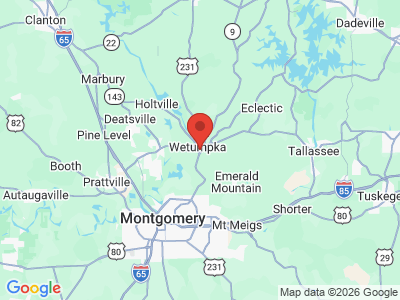
Comprising approximately 622 square miles, Elmore County lies in the east-central area of the state, wholly within the Piedmont physiographic section. It is bounded to the north by Coosa and Tallapoosa counties, to the east by Macon County, to the south by Montgomery County, and to the west by Autauga and Chilton counties.
Elmore County Map
Comprising approximately 622 square miles, Elmore County lies in the east-central area of the state, wholly within the Piedmont physiographic section. It is bounded to the north by Coosa and Tallapoosa counties, to the east by Macon County, to the south by Montgomery County, and to the west by Autauga and Chilton counties.
The Tallapoosa River runs along the eastern edge of the county, where it flows southwest before joining the Coosa south of Wetumpka. The Tallapoosa's tributaries, Tumkeehatchee and Chubbehatchee creeks, intersect the eastern half of the county. In 1926, Alabama Power dammed the Tallapoosa to create Lake Martin, which covers the northeastern corner of Elmore County. The Coosa River runs along the northwestern section of the county, where it flows south of Wetumpka before joining the Alabama River. In 1928, Alabama Power dammed the Coosa River to create Jordan Lake north of Wetumpka. U.S. 231, running north-south through the center of the county, is the area's major transportation route. In addition, I-65 runs through a small portion of the southwest corner near the towns of Millbrook and Prattville. Evans Airport in Wetumpka is the county's only public airport.
Events and Places of Interest
 Elmore County Museum
The waterways of Elmore County are some of the most visited recreational areas in the state. Lake Martin, on the Tallapoosa River, is one of the largest human-made lakes in the United States and offers fishing, boating, waterskiing, golf, camping, and swimming. Also located on Lake Martin is Kowaliga, the spot where Hank Williams is rumored to have written his hit song "Kaw-Liga." Jordan Lake on the Coosa River offers excellent fishing for spotted bass, largemouth bass, hybrid striped bass, bluegill, red-ear sunfish, and black and white crappie. Wetumpka and the Coosa River play host to the Coosa River Challenge, a competition similar to a triathlon that began in 2003 and regularly draws 150 to 200 adventure enthusiasts annually. The race starts at the 8.5-mile trail system of Swayback Bridge Trail and follows the Coosa River downstream, finishing in downtown Wetumpka. The Swayback Bridge Trail is also home to the annual mountain bike race Attack on Swayback. Wetumpka is also a haven for white-water sports enthusiasts, attracting paddlers from all over the country to the rapids around the Devil's Staircase and Moccasin Gap. The city hosts the annual Coosa River Whitewater Festival and was the site of the 2005 U.S. Freestyle Kayaking Nationals. In addition, each year the city of Wetumpka sponsors annual public tours of the crater in cooperation with local landowners and authorities. The Alabama Nature Center is an education facility that focuses on outdoor-based, hands-on activities for students, educators, and others interested in learning about Alabama's natural world. It is open to the general public on the third weekend of every month.
Elmore County Museum
The waterways of Elmore County are some of the most visited recreational areas in the state. Lake Martin, on the Tallapoosa River, is one of the largest human-made lakes in the United States and offers fishing, boating, waterskiing, golf, camping, and swimming. Also located on Lake Martin is Kowaliga, the spot where Hank Williams is rumored to have written his hit song "Kaw-Liga." Jordan Lake on the Coosa River offers excellent fishing for spotted bass, largemouth bass, hybrid striped bass, bluegill, red-ear sunfish, and black and white crappie. Wetumpka and the Coosa River play host to the Coosa River Challenge, a competition similar to a triathlon that began in 2003 and regularly draws 150 to 200 adventure enthusiasts annually. The race starts at the 8.5-mile trail system of Swayback Bridge Trail and follows the Coosa River downstream, finishing in downtown Wetumpka. The Swayback Bridge Trail is also home to the annual mountain bike race Attack on Swayback. Wetumpka is also a haven for white-water sports enthusiasts, attracting paddlers from all over the country to the rapids around the Devil's Staircase and Moccasin Gap. The city hosts the annual Coosa River Whitewater Festival and was the site of the 2005 U.S. Freestyle Kayaking Nationals. In addition, each year the city of Wetumpka sponsors annual public tours of the crater in cooperation with local landowners and authorities. The Alabama Nature Center is an education facility that focuses on outdoor-based, hands-on activities for students, educators, and others interested in learning about Alabama's natural world. It is open to the general public on the third weekend of every month.
Historic sites in Elmore County include the Elmore County Museum, a center of local and regional history and a research repository, and the Museum of Black History, which focuses on the histories of Elmore County families, the communities in which they lived, and their churches. Both are located in Wetumpka. Buildings listed on the National Register of Historic Places include Ellerslie (1818) in Millbrook, the Tallassee Commercial Historic District and Tallassee Mills in Tallassee, and a number of structures in Wetumpka, such as Fort Toulouse and the Alabama State Penitentiary.
Additional Resources
- Heritage of Elmore County, Alabama. Clanton, Ala.: Heritage Publishing Consultants Inc., 2002.
External Links
- Elmore County
- Elmore County School District
- Wetumpka Public Library
- City of Wetumpka
- City of Millbrook
- City of Tallassee
- Town of Eclectic
- Town of Elmore
- Town of Coosada
- Elmore County Economic Development Authority
- Millbrook Area Chamber of Commerce
- Wetumpka Area Chamber of Commerce
- National Register of Historic Places: Elmore County
- Alabama Wildlife Federation
- Fort Toulouse-Fort Jackson
- Elmore County Art Guild
- Coosa River Whitewater