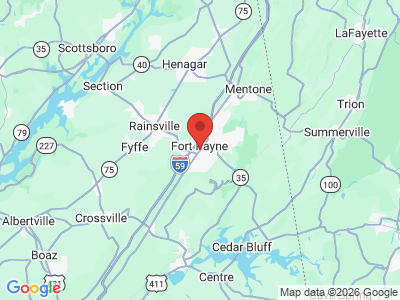
DeKalb County
 DeSoto Falls
Home of the famous gospel-country music duo the Louvin Brothers, the Grammy-winning country-music group Alabama, and the Flock Family of NASCAR fame, DeKalb County is located in the northeastern corner of the state. The county is also the home of some of the most scenic areas in the state, including the Little River Canyon and its many waterfalls. The county is governed by an elected five-member commission and includes 16 incorporated communities each governed by a mayor and city council.
DeSoto Falls
Home of the famous gospel-country music duo the Louvin Brothers, the Grammy-winning country-music group Alabama, and the Flock Family of NASCAR fame, DeKalb County is located in the northeastern corner of the state. The county is also the home of some of the most scenic areas in the state, including the Little River Canyon and its many waterfalls. The county is governed by an elected five-member commission and includes 16 incorporated communities each governed by a mayor and city council.
- Founding Date: January 9, 1836
- Area: 778 square miles
- Population: 71,430 (2020 Census estimate)
- Major Waterways: Big Wills Creek, Town Creek, Sauty Creek
- Major Highways: I-59, U.S. 11
- County Seat: Fort Payne
- Largest City: Fort Payne
History
 DeKalb County Courthouse
DeKalb County was created by an act of the state legislature on January 9, 1836, and is named for the Bavarian-born Revolutionary War hero, Johann von Robais, Baron de Kalb. Prior to European American settlement, the area was occupied by the Cherokees, most notably Sequoyah, who created the Cherokee syllabary at Wills Town. In 1835, DeKalb County became part of the lands ceded by the Cherokee Nation to the federal government in the Treaty of New Echota. A majority of the Cherokees opposed the signing of this treaty, however, and refused to leave. Pres. Andrew Jackson sent federal troops to forcibly remove the Indians to new lands in the west. Troops were ordered to build stockade forts in Alabama, Tennessee, and Georgia and force them from their lands in preparation for relocating them to Indian Teritory (now Oklahoma) in what became known as the Trail of Tears. Capt. John Payne was sent to Willstown Mission, present-day Fort Payne, to command the local garrison of soldiers and see to the construction of the stockade.
DeKalb County Courthouse
DeKalb County was created by an act of the state legislature on January 9, 1836, and is named for the Bavarian-born Revolutionary War hero, Johann von Robais, Baron de Kalb. Prior to European American settlement, the area was occupied by the Cherokees, most notably Sequoyah, who created the Cherokee syllabary at Wills Town. In 1835, DeKalb County became part of the lands ceded by the Cherokee Nation to the federal government in the Treaty of New Echota. A majority of the Cherokees opposed the signing of this treaty, however, and refused to leave. Pres. Andrew Jackson sent federal troops to forcibly remove the Indians to new lands in the west. Troops were ordered to build stockade forts in Alabama, Tennessee, and Georgia and force them from their lands in preparation for relocating them to Indian Teritory (now Oklahoma) in what became known as the Trail of Tears. Capt. John Payne was sent to Willstown Mission, present-day Fort Payne, to command the local garrison of soldiers and see to the construction of the stockade.
 Fort Payne Produce Stand, ca. 1880s
During the Civil War, DeKalb County, like many north Alabama counties, opposed secession. Though no major battles were fought in the county, the tiny town of Valley Head was home to a Union encampment during the campaign to seize Chattanooga. The county has had six county seats, with Fort Payne becoming the final and present one in 1876. The current courthouse is the third courthouse built since the 1870s.
Fort Payne Produce Stand, ca. 1880s
During the Civil War, DeKalb County, like many north Alabama counties, opposed secession. Though no major battles were fought in the county, the tiny town of Valley Head was home to a Union encampment during the campaign to seize Chattanooga. The county has had six county seats, with Fort Payne becoming the final and present one in 1876. The current courthouse is the third courthouse built since the 1870s.
On April 27, 2011, a massive storm, causing numerous powerful tornadoes, struck the southeastern United States. More than 250 people were killed in Alabama, including 33 people in DeKalb County.
Major Cities and Demographics
According to 2020 Census estimates, DeKalb County recorded a population of 71,430. Of that total, 92.7 percent of respondents identified themselves as white, 15.1 percent as Hispanic, 2.3 percent as two or more races, 2.0 percent as Native American, 1.9 percent as African American, 0.6 percent as Hawaiian or Pacific Islander, and 0.5 percent as Asian. The county seat of Fort Payne had a population of 14,063. Other population centers in the county include Fyffe, Rainsville, Hammondville, Pine Ridge, Henagar, Crossville, Lakeview, Shiloh, and Valley Head. The median household was $42,267, compared with $52,035 for the state as a whole, and the per capita income was $22,511, compared with $28,934 for the state..
Economy
 Sock Factory in Fort Payne
The first settlers in DeKalb County established homesteads in the fertile valleys, but many others settled in the surrounding hilly areas of Sand Mountain and Lookout Mountain. The primary crops were grain, corn, and cotton grown for domestic purposes. Many farmers also raised livestock. After the Civil War, the area economy received a boost when the Alabama and Chattanooga Railroad Company reached Birmingham in 1870. In 1877, the railroad was taken over by Alabama Great Southern. During the early twentieth century, the first of many hosiery factories moved to Fort Payne. Today, with more than 100 plants and 5,000 employees, Fort Payne bills itself as the "Sock Capital of the World."
Sock Factory in Fort Payne
The first settlers in DeKalb County established homesteads in the fertile valleys, but many others settled in the surrounding hilly areas of Sand Mountain and Lookout Mountain. The primary crops were grain, corn, and cotton grown for domestic purposes. Many farmers also raised livestock. After the Civil War, the area economy received a boost when the Alabama and Chattanooga Railroad Company reached Birmingham in 1870. In 1877, the railroad was taken over by Alabama Great Southern. During the early twentieth century, the first of many hosiery factories moved to Fort Payne. Today, with more than 100 plants and 5,000 employees, Fort Payne bills itself as the "Sock Capital of the World."
Employment
According to 2020 Census estimates, the workforce in DeKalb County was divided among the following industrial categories:
- Manufacturing (27.4 percent)
- Educational services, and health care and social assistance (18.5 percent)
- Retail trade (10.8 percent)
- Construction (7.2 percent)
- Transportation and warehousing, and utilities (6.4 percent)
- Other services, except public administration (5.2 percent)
- Arts, entertainment, recreation, and accommodation and food services (4.9 percent)
- Professional, scientific, management, and administrative and waste management services (4.9 percent)
- Finance and insurance, and real estate, rental, and leasing (4.3 percent)
- Public administration (3.4 percent)
- Agriculture, forestry, fishing and hunting, and extractive (2.8 percent)
- Wholesale trade (2.3 percent)
- Information (2.0 percent)
Education
The DeKalb County school system currently employs 532 teachers who serve more than 7,900 students in 14 schools. In addition, the Fort Payne City School System employs 163 teachers who serve more than 2,600 students in four schools.
Geography
 DeKalb County Map
Comprising approximately 778 square miles, DeKalb County lies in the northeastern area of the state, wholly within the Cumberland Plateau physiographic section. It is bounded to the north by Jackson County, to the east by the state of Georgia, to the south by Cherokee and Etowah counties, and to the west by Marshall County. A small portion of DeSoto State Park lies in the eastern part of the county.
DeKalb County Map
Comprising approximately 778 square miles, DeKalb County lies in the northeastern area of the state, wholly within the Cumberland Plateau physiographic section. It is bounded to the north by Jackson County, to the east by the state of Georgia, to the south by Cherokee and Etowah counties, and to the west by Marshall County. A small portion of DeSoto State Park lies in the eastern part of the county.
Although there are no major waterways in DeKalb County, several tributaries of the Tennessee River, including South Sauty, Big Wills, and Town creeks, intersect the area. Interstate 59 and U.S. 11, both running north-south through the center of the county, are the area's major highways. Fort Payne Municipal Airport is the county's only public airport.
Events and Places of Interest
 Snowboarding in Mentone
The county is famous for a unique "Sand Mountain" musical sound and a variety of famous musicians. The Louvin Brothers, who lived in the Henagar community, were among country music's most famous performing groups during the 1950s. Fort Payne is home to the Alabama Fan Club and Museum, which celebrates the history and achievements of the group Alabama, which was named Country Music Group of the Century by the Recording Industry Association of America. The museum houses the group's many awards as well as collections of items relating to their youth in Fort Payne.
Snowboarding in Mentone
The county is famous for a unique "Sand Mountain" musical sound and a variety of famous musicians. The Louvin Brothers, who lived in the Henagar community, were among country music's most famous performing groups during the 1950s. Fort Payne is home to the Alabama Fan Club and Museum, which celebrates the history and achievements of the group Alabama, which was named Country Music Group of the Century by the Recording Industry Association of America. The museum houses the group's many awards as well as collections of items relating to their youth in Fort Payne.
 Sequoyah Caverns
Cloudmont Ski Resort in Mentone, the only snow-ski resort in the state, features two 1,000-foot, beginner-intermediate slopes. DeKalb County's unique sandstone cliffs attract rock climbers from all over the Southeast, and DeSoto State Park features hiking, scenic waterfalls, and canyons. Little River Falls, located in Fort Payne, lies just upstream from the headwaters of Little River Canyon. In 1992 the waterfall became part of Little River Canyon National Preserve, one of the nation's newest national parks. Sequoyah Caverns, located in Valley Head, features unique reflective underground lakes known as "looking-glass" pools. High Falls Park near the community of Grove Oak is a county park that preserves a massive waterfall that stretches 300 feet across at high water. The park features a store, pavilions, and walking trails, including a footbridge across Town Creek.
Sequoyah Caverns
Cloudmont Ski Resort in Mentone, the only snow-ski resort in the state, features two 1,000-foot, beginner-intermediate slopes. DeKalb County's unique sandstone cliffs attract rock climbers from all over the Southeast, and DeSoto State Park features hiking, scenic waterfalls, and canyons. Little River Falls, located in Fort Payne, lies just upstream from the headwaters of Little River Canyon. In 1992 the waterfall became part of Little River Canyon National Preserve, one of the nation's newest national parks. Sequoyah Caverns, located in Valley Head, features unique reflective underground lakes known as "looking-glass" pools. High Falls Park near the community of Grove Oak is a county park that preserves a massive waterfall that stretches 300 feet across at high water. The park features a store, pavilions, and walking trails, including a footbridge across Town Creek.
Founded in 1908, the annual DeKalb County Fiddlers Convention features more than 10 categories in which contestants can register, including old-time fiddling, sacred harp music, banjos, and bluegrass. DeKalb County is the starting point for the annual Trail of Tears Motorcycle Trail, which commemorates the Cherokee removal to the west, and it also plays host to portions of the "world's longest yard sale," which runs along the Lookout Mountain scenic highway. Fyffe was the location of a mass UFO sighting in 1989, and the town hosts an annual UFO Day Festival.
Additional Resources
- Heritage of DeKalb County. Clanton, Ala.: Heritage Publishing Consultants, Inc., 1998.
- Historical Committee of Landmarks of DeKalb County, Inc. Landmarks: A Pictorial History of Dekalb County, Alabama. Collegedale, Tenn.: The College Press, 1971.
- Stewart, Margaret Estelle. Alabama's DeKalb County. Centre, Ala.: Stewart University Press, 1980.
External Links
- DeKalb County
- DeKalb County Schools
- City of Fort Payne
- City of Rainsville
- City of Henagar
- Town of Fyffe
- Town of Mentone
- Town of Shiloh
- Town of Valley Head
- Fort Payne Chamber of Commerce
- National Register of Historic Places: DeKalb County
- Alabama Fan Club and Museum
- Little River Canyon National Preserve
- Visit North Alabama
- High Falls Park