Conecuh County
 Old Paul Post Office
Located in south-central Alabama, Conecuh County was the site of a home for the widows and orphans of Alabama's Confederate soldiers. The county is governed by an elected five-member commission and includes three incorporated communities.
Old Paul Post Office
Located in south-central Alabama, Conecuh County was the site of a home for the widows and orphans of Alabama's Confederate soldiers. The county is governed by an elected five-member commission and includes three incorporated communities.
- Founding Date: February 13, 1818
- Area: 854 square miles
- Population: 12,219 (2020 Census estimate)
- Major Waterways: Sepulga River
- Major Highways: I-65, U.S. 31, U.S. 84
- County Seat: Evergreen
- Largest City: Evergreen
History
 Conecuh County Courthouse
Conecuh County was created by an act of the Alabama Territorial Legislature on February 13, 1818, and was named for the Creek term "koha anaka" meaning "near canebrakes." On July 27, 1813, the Battle of Burnt Corn Creek, one of the more significant battles of the Creek War of 1813-14, took place in what was then Conecuh County. In July 1813, Peter McQueen, a Creek warrior of the Red Stick faction, secured a cache of weapons from the British and Spanish at what is now Pensacola, Florida. U.S. troops ambushed McQueen and the Red Sticks on the banks of Burnt Corn Creek (for which the present town of Burnt Corn is named) but were then routed by a Red Stick counterattack. The Red Sticks considered the act a declaration of war and retaliated with the infamous Fort Mims Massacre. Although the actual site has not been located, most sources now place it in present-day Escambia County, which was part of Conecuh County until 1868.
Conecuh County Courthouse
Conecuh County was created by an act of the Alabama Territorial Legislature on February 13, 1818, and was named for the Creek term "koha anaka" meaning "near canebrakes." On July 27, 1813, the Battle of Burnt Corn Creek, one of the more significant battles of the Creek War of 1813-14, took place in what was then Conecuh County. In July 1813, Peter McQueen, a Creek warrior of the Red Stick faction, secured a cache of weapons from the British and Spanish at what is now Pensacola, Florida. U.S. troops ambushed McQueen and the Red Sticks on the banks of Burnt Corn Creek (for which the present town of Burnt Corn is named) but were then routed by a Red Stick counterattack. The Red Sticks considered the act a declaration of war and retaliated with the infamous Fort Mims Massacre. Although the actual site has not been located, most sources now place it in present-day Escambia County, which was part of Conecuh County until 1868.
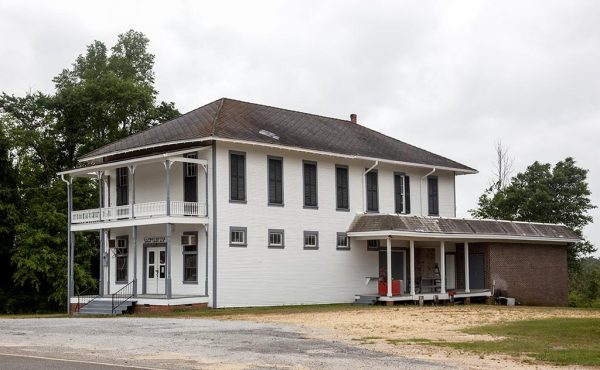 Lowery Store in Burnt Corn
The first settlers to Conecuh County arrived shortly after the battle and settled at present-day Bellville. The Sepulga River, one of the largest tributaries of the Conecuh River, was vital to the economic prosperity of the county. During the first half of the nineteenth century, settlers shipped corn, cotton, and timber down the river to Pensacola. In 1859, work began on the Montgomery and Pensacola Railroad, whose lines passed through the center of Conecuh County. Completed in 1861, it later became part of the Louisville and Nashville Railroad. In 1893, the Alabama Baptist State Convention opened the Louise Short Baptist Widows' and Orphans' Home for the destitute families of men killed in the Civil War. On June 14, 1923, it was moved to Troy and in 1938 was renamed the Alabama Baptist Children's Home.
Lowery Store in Burnt Corn
The first settlers to Conecuh County arrived shortly after the battle and settled at present-day Bellville. The Sepulga River, one of the largest tributaries of the Conecuh River, was vital to the economic prosperity of the county. During the first half of the nineteenth century, settlers shipped corn, cotton, and timber down the river to Pensacola. In 1859, work began on the Montgomery and Pensacola Railroad, whose lines passed through the center of Conecuh County. Completed in 1861, it later became part of the Louisville and Nashville Railroad. In 1893, the Alabama Baptist State Convention opened the Louise Short Baptist Widows' and Orphans' Home for the destitute families of men killed in the Civil War. On June 14, 1923, it was moved to Troy and in 1938 was renamed the Alabama Baptist Children's Home.
Major Cities and Demographics
According to 2020 Census estimates, Conecuh County recorded a population of 12,219. Approximately 50.5 percent of respondents identified themselves as white, 48.1 percent as African American, 0.7 as two or more races, 0.6 as Asian, 0.5 percent Hispanic, and 0.2 percent as Native American. The county seat, Evergreen, had an estimated population of 3,591. Other population centers in the county are Castleberry and Repton. The median household income was $35,444, as compared with $52,035 for the state as a whole, and per capita was $20,756, as compared with $28,934 for the state as a whole.
Economy

Early settlers used the Sepulga River to float the bales of cotton and bushels of corn that grew in abundance in the county. By the 1850s, 3,000 bales were shipped annually to Pensacola. The first grist and saw mills in the county were built around 1818. Timber was cut and transported on keelboats downriver for sale at Pensacola. Stock raising, particularly sheep, hogs, cattle, and goats, was also an important economic source during the nineteenth century. In the latter part of the nineteenth century, peanuts, sugarcane, and strawberries also became important supplemental crops. In 1859, work began on the Montgomery and Pensacola railroad, which was completed in 1861.
Employment
According to 2020 Census estimates, the workforce in Conecuh County was divided among the following industrial categories:
- Manufacturing (22.8 percent)
- Retail trade (15.0 percent)
- Educational services, and health care and social assistance (14.5 percent)
- Transportation and warehousing, and utilities (7.6 percent)
- Construction (6.6 percent)
- Public administration (6.3 percent)
- Arts, entertainment, recreation, and accommodation and food services (5.8 percent)
- Finance and insurance, and real estate, rental, and leasing (5.8 percent)
- Professional, scientific, management, and administrative and waste management services (4.3 percent)
- Agriculture, forestry, fishing and hunting, and extractive (3.6 percent)
- Other services, except public administration (3.1 percent)
- Wholesale trade (3.0 percent)
- Information (1.8 percent)
Education
The Conecuh County School System oversees eight schools.
Geography
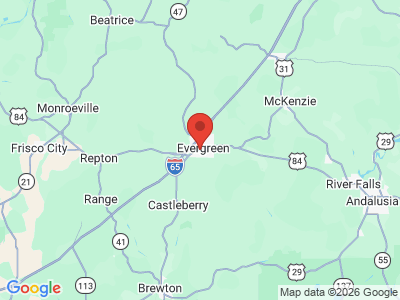
 Conecuh County Map
Comprising 854 square miles, Conecuh County lies in the south-central area of the state, wholly within the Coastal Plain physiographic section. Originally part of Monroe County, parts of Conecuh County were used in the formation of Butler and Escambia Counties. It is bounded to the north by Butler County, the east by Covington County, to the south by Escambia County, and to the west by Monroe County.
Conecuh County Map
Comprising 854 square miles, Conecuh County lies in the south-central area of the state, wholly within the Coastal Plain physiographic section. Originally part of Monroe County, parts of Conecuh County were used in the formation of Butler and Escambia Counties. It is bounded to the north by Butler County, the east by Covington County, to the south by Escambia County, and to the west by Monroe County.
The Sepulga River, a tributary of the Upper Conecuh River, runs through the northeastern part of the county. Burnt Corn Creek and Murder Creek, both tributaries of the Lower Conecuh River, traverse the western and southern portions of the county. Interstate 65, running north-south, is the county's major transportation route. Other major routes are U.S. 84, running east-west, and U.S. 31 running north-south. Middleton Field Airport is the county's only public airport.
Events and Places of Interest
The town of Castleberry holds an annual Strawberry Festival every April, which includes arts, crafts, live entertainment, and strawberries. The town of Evergreen holds the Conecuh County Sausage Festival each year in honor of the local sausage produced by the Conecuh Sausage Company. The Old Post Office in the unincorporated community of Paul was listed on the Alabama Register of Landmarks and Heritage in 2013.
Additional Resources
- Heritage of Conecuh County, Alabama. Clanton, Ala.: Heritage Publishing Consultants, Inc., 2002.
- People and Places of Conecuh County, Alabama, 1816-1860. Evergreen, Ala.: Conecuh County Historical Society, 1970.
- Riley, Benjamin Franklin. History of Conecuh County, Alabama. Blue Hill, Maine: Weekly Packet, 1964.