Baldwin County
 Fortifications at Blakeley
Located in south Alabama along the Gulf of Mexico and Bon Secour Bay, Baldwin County, is recognized as one of the premier tourism spots in Alabama. Noted Civil War sites in the county include Fort Morgan and Fort Blakeley. It is named for U.S. Senator Abraham Baldwin (1754-1807). Because of Baldwin County's proximity to the Gulf Coast, it was the site of some of the earliest European explorations and settlements in the South. Apple CEO Tim Cook was raised in the city of Robertsdale. The county is governed by a four-member county commission.
Fortifications at Blakeley
Located in south Alabama along the Gulf of Mexico and Bon Secour Bay, Baldwin County, is recognized as one of the premier tourism spots in Alabama. Noted Civil War sites in the county include Fort Morgan and Fort Blakeley. It is named for U.S. Senator Abraham Baldwin (1754-1807). Because of Baldwin County's proximity to the Gulf Coast, it was the site of some of the earliest European explorations and settlements in the South. Apple CEO Tim Cook was raised in the city of Robertsdale. The county is governed by a four-member county commission.
- Founding Date: December 21, 1809
- Area: 1,596 square miles
- Population: 231,767 (2020 Census estimate)
- Major Waterways: Bon Secour Bay, Tensaw River, Gulf of Mexico
- Major Highways: I-10, I-65, U.S. 31, U.S. 90, U.S. 98
- County Seat: Bay Minette
- Largest City: Fairhope
History
 Baldwin County Courthouse
Baldwin County was created by an act of the Mississippi Territorial Legislature on December 21, 1809, almost 10 years before Alabama became a state. Carved out of present-day Washington County, Baldwin is the largest county in Alabama. The area was once occupied by people of the Mississippian culture, who left large burial and shell mounds that can still be seen at the Bottle Creek archaeological site.
Baldwin County Courthouse
Baldwin County was created by an act of the Mississippi Territorial Legislature on December 21, 1809, almost 10 years before Alabama became a state. Carved out of present-day Washington County, Baldwin is the largest county in Alabama. The area was once occupied by people of the Mississippian culture, who left large burial and shell mounds that can still be seen at the Bottle Creek archaeological site.
From the mid-sixteenth century until the end of the eighteenth century, the area that would become Baldwin County changed hands among the Spanish, the French, and the British until the land was transferred to the United States. Baldwin County was included as part of the Mississippi Territory in 1789, with the town of McIntosh serving as county seat. Daphne became the county seat in 1868. In 1900, Daphne's courthouse records were stolen by representatives of the rival community of Bay Minette, and the Baldwin County seat of government remains there to this day.
 Fort Morgan
At the turn of the nineteenth century, Baldwin County was a hub of growing hostility between a faction of the Creek Indians and settlers, culminating in the Fort Mims Massacre in August 1813, in which more than 250 settlers, rival Creeks, and militia were killed. During the Civil War, the Confederate government extracted Baldwin County's valuable salt deposits located along the Gulf of Mexico. Fort Morgan, completed in 1834, was the site of a fierce battle in August 1864 in which Adm. David Farragut and his U.S. Army ships entered Mobile Bay to seal off Confederate blockade runners. The USS Tecumseh, a U.S. ironclad, was sunk by a mine during the fighting in a narrow inlet and still lies just off Fort Morgan. In April 1865, some 1,500 U.S. and 400 Confederate soldiers were killed or wounded in the Battle of Fort Blakely, named for an earthen fortification constructed on the bluffs above the Apalachee River where the town of Blakely once stood.
Fort Morgan
At the turn of the nineteenth century, Baldwin County was a hub of growing hostility between a faction of the Creek Indians and settlers, culminating in the Fort Mims Massacre in August 1813, in which more than 250 settlers, rival Creeks, and militia were killed. During the Civil War, the Confederate government extracted Baldwin County's valuable salt deposits located along the Gulf of Mexico. Fort Morgan, completed in 1834, was the site of a fierce battle in August 1864 in which Adm. David Farragut and his U.S. Army ships entered Mobile Bay to seal off Confederate blockade runners. The USS Tecumseh, a U.S. ironclad, was sunk by a mine during the fighting in a narrow inlet and still lies just off Fort Morgan. In April 1865, some 1,500 U.S. and 400 Confederate soldiers were killed or wounded in the Battle of Fort Blakely, named for an earthen fortification constructed on the bluffs above the Apalachee River where the town of Blakely once stood.
During the late nineteenth century and the early twentieth century, Baldwin County attracted Italian, German, Greek, and Eastern European settlers to the area. In November 1894, journalist Ernest Berry Gaston of Des Moines, Iowa, and 28 other settlers founded the utopian community of Fairhope on the cliff above Mobile Bay. In 1907, Marietta Johnson founded the progressive School of Organic Education in Fairhope. In 1901, Chicago businessman John Burton Foley purchased some 50,000 acres in Baldwin County and constructed the railroad station that now houses the Foley Railroad Museum. The city of Foley was named for him. During World War II, the community of Point Clear hosted the Point Clear Marine Training Command, a program to train U.S. Army Air Force maintenance crews in sea-faring and naval techniques.
Major Cities and Demographics
 Orange Beach
According to 2020 Census estimates, Baldwin County recorded a population of 231,767. Approximately 85.4 percent identified themselves as white, 8.8 percent as African American, 4.6 percent as Hispanic, 2.6 percent as two or more races, 0.9 percent as Asian, and 0.7 percent as Native American. The county seat, Bay Minette, had a recorded population of 9,297, and the largest city, Fairhope, had a population of 22,035. Other significant population centers include Daphne, Foley, Gulf Shores, Spanish Fort, Orange Beach, Robertsdale, and Loxley. The median household income was $61,756, compared with $52,035 for the state as a whole, and per capita income was $33,751, compared with $28,934 for the state.
Orange Beach
According to 2020 Census estimates, Baldwin County recorded a population of 231,767. Approximately 85.4 percent identified themselves as white, 8.8 percent as African American, 4.6 percent as Hispanic, 2.6 percent as two or more races, 0.9 percent as Asian, and 0.7 percent as Native American. The county seat, Bay Minette, had a recorded population of 9,297, and the largest city, Fairhope, had a population of 22,035. Other significant population centers include Daphne, Foley, Gulf Shores, Spanish Fort, Orange Beach, Robertsdale, and Loxley. The median household income was $61,756, compared with $52,035 for the state as a whole, and per capita income was $33,751, compared with $28,934 for the state.
Economy
 Pulpwood on the Styx River
During the eighteenth and nineteenth centuries, Baldwin County's economy consisted largely of agriculture and deerskin trading among the Creeks, settlers, and Europeans. Export houses operating out of Mobile shipped deerskins obtained from the Creeks to Europe and other continents. Land was extremely cheap, and settlers obtained large tracts of fertile land for growing indigo, tobacco, and rice. In addition, the open rangeland made cattle raising highly profitable, and the abundance of timber made turpentine, potash, and tar valuable exports.
Pulpwood on the Styx River
During the eighteenth and nineteenth centuries, Baldwin County's economy consisted largely of agriculture and deerskin trading among the Creeks, settlers, and Europeans. Export houses operating out of Mobile shipped deerskins obtained from the Creeks to Europe and other continents. Land was extremely cheap, and settlers obtained large tracts of fertile land for growing indigo, tobacco, and rice. In addition, the open rangeland made cattle raising highly profitable, and the abundance of timber made turpentine, potash, and tar valuable exports.
Employment
According to 2020 Census estimates, the workforce in Baldwin County was divided among the following industrial categories:
- Educational services, and health care and social assistance (19.3 percent)
- Manufacturing (14.0 percent)
- Retail trade (13.6 percent)
- Professional, scientific, management, administrative, and waste management services (10.7 percent)
- Arts, entertainment, recreation, and accommodation and food services (9.9 percent)
- Construction (8.0 percent)
- Finance and insurance, and real estate, rental, and leasing (7.6 percent)
- Public administration (5.3 percent)
- Transportation and warehousing and utilities (5.1 percent)
- Other services, except public administration (5.0 percent)
- Wholesale trade (2.7 percent)
- Agriculture, forestry, fishing and hunting, and extractive (1.8 percent)
- Information (1.1 percent)
Education
The Baldwin County Board of Education is the largest employer in the county, overseeing 45 campuses; none of the cities or towns have their own school district. The Marietta Johnson School of Organic Education is a historic private K-12 school based in Fairhope. Coastal Alabama Community College maintains campuses in Bay Minette, Fairhope, Gulf Shores, Foley, and Robertsdale, and the University of South Alabama has a satellite campus in Fairhope.
Geography
 Baldwin County Map
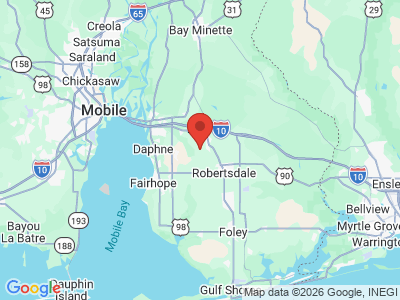
Comprising approximately 1,596 square miles, Baldwin County is located in the southernmost part of the state. It lies fully within the East Gulf Coastal Plain physiographic section. It is bounded to the west by Mobile County, to the northwest by Washington and Clarke Counties, to the north by Monroe County, to the northeast by Escambia County, Alabama, and to the east by Escambia County, Florida. The southern part of the county lies along the Gulf of Mexico, and the Tensaw River runs along the western edge of the county, where it feeds into Bon Secour Bay. Interstate 10, which runs east-west, and Interstate 65, which runs north-south, are Baldwin County's major transportation routes, and U.S 31, 90, and 98 serve as other major transportation arteries. Baldwin County has four municipal airports.
Baldwin County Map
Comprising approximately 1,596 square miles, Baldwin County is located in the southernmost part of the state. It lies fully within the East Gulf Coastal Plain physiographic section. It is bounded to the west by Mobile County, to the northwest by Washington and Clarke Counties, to the north by Monroe County, to the northeast by Escambia County, Alabama, and to the east by Escambia County, Florida. The southern part of the county lies along the Gulf of Mexico, and the Tensaw River runs along the western edge of the county, where it feeds into Bon Secour Bay. Interstate 10, which runs east-west, and Interstate 65, which runs north-south, are Baldwin County's major transportation routes, and U.S 31, 90, and 98 serve as other major transportation arteries. Baldwin County has four municipal airports.
Events and Places of Interest
 Dinosaur in the Woods
Given its location on the Gulf of Mexico, Baldwin County is a popular tourist destination. Every year, more than one million visitors flock to the white sandy beaches of Gulf Shores, Orange Beach, and Perdido Beach. Gulf State Park, located along the beaches of Gulf Shores, consists of 6,150 acres and two miles of sand beaches. The park has modern and primitive camping, cottages, a marina, hiking trails, fishing, picnic areas, and a pavilion. The park also is home to 900-acre Lake Shelby and an 18-hole championship golf course. The Grand Hotel Golf Resort and Spa, part of the Marriot Hotels Autograph Collection of boutique hotels, gives visitors access to beaches on Mobile Bay as well as restaurants, a pool complex, and a renovated and expanded historic hotel. The associated golf course, The Lakewood Club, is part of the Robert Trent Jones Golf Trail.
Dinosaur in the Woods
Given its location on the Gulf of Mexico, Baldwin County is a popular tourist destination. Every year, more than one million visitors flock to the white sandy beaches of Gulf Shores, Orange Beach, and Perdido Beach. Gulf State Park, located along the beaches of Gulf Shores, consists of 6,150 acres and two miles of sand beaches. The park has modern and primitive camping, cottages, a marina, hiking trails, fishing, picnic areas, and a pavilion. The park also is home to 900-acre Lake Shelby and an 18-hole championship golf course. The Grand Hotel Golf Resort and Spa, part of the Marriot Hotels Autograph Collection of boutique hotels, gives visitors access to beaches on Mobile Bay as well as restaurants, a pool complex, and a renovated and expanded historic hotel. The associated golf course, The Lakewood Club, is part of the Robert Trent Jones Golf Trail.
The Alabama Gulf Coast Zoo in Gulf Shores has been featured by the Animal Planet network in the series The Little Zoo that Could, which documents its struggles to rebuild after being damaged by successive hurricanes. Weeks Bay National Estuarine Research Reserve and the Bon Secour National Wildlife Refuge offer many opportunities for viewing wildlife; the latter is a stop on the Alabama Coastal Birding Trail.
 Shrimp Festival
For more than 50 years, fishermen and residents of Baldwin County have experienced what has become known as the "jubilee" phenomenon, during which time various types of aquatic animals, including crabs, flounder, and stingrays, migrate to shallow water, making it possible to simply pluck them all out of the water. Every October, Baldwin County hosts its Shrimp Festival, which attracts 200,000 visitors annually and features a variety of shrimp dishes, arts, crafts, and music. The nearby town of Elberta hosts the annual Elberta Sausage Festival, featuring German music, sausage, sauerkraut, and other German foods. The annual Interstate Mullett Toss and Gulf Coast's Greatest Beach Party, which takes place each April, includes the throwing of mullet fish across the Alabama-Florida state line to raise money for local boys and girls clubs. Each fall, the cities of Gulf Shores and Orange Beach in Alabama and Perdido Key and Pensacola in Florida host the Frank Brown International Songwriters Festival, which honors the late and long-time night watchman at the renowned Flora-Bama Lounge, a bar that straddles the state line. The city of Daphne hosts an annual Festa Italiana every March to celebrate the contributions made by Italian immigrants to the town's cultural heritage.
Shrimp Festival
For more than 50 years, fishermen and residents of Baldwin County have experienced what has become known as the "jubilee" phenomenon, during which time various types of aquatic animals, including crabs, flounder, and stingrays, migrate to shallow water, making it possible to simply pluck them all out of the water. Every October, Baldwin County hosts its Shrimp Festival, which attracts 200,000 visitors annually and features a variety of shrimp dishes, arts, crafts, and music. The nearby town of Elberta hosts the annual Elberta Sausage Festival, featuring German music, sausage, sauerkraut, and other German foods. The annual Interstate Mullett Toss and Gulf Coast's Greatest Beach Party, which takes place each April, includes the throwing of mullet fish across the Alabama-Florida state line to raise money for local boys and girls clubs. Each fall, the cities of Gulf Shores and Orange Beach in Alabama and Perdido Key and Pensacola in Florida host the Frank Brown International Songwriters Festival, which honors the late and long-time night watchman at the renowned Flora-Bama Lounge, a bar that straddles the state line. The city of Daphne hosts an annual Festa Italiana every March to celebrate the contributions made by Italian immigrants to the town's cultural heritage.
 Malbis Memorial Church
Baldwin County also has many historic sites and districts that attract thousands of visitors. Visitors interested in Civil War history can tour Fort Morgan State Historic Site, which houses some of the original buildings from the historic fort, completed in 1834, and visit the abandoned town of Blakeley, the site of the last battle of the Civil War, and Historic Blakeley State Park. The Baldwin County Heritage Museum, in Elberta, features exhibits on Baldwin County history from 1900 to 1950, and the Orange Beach Indian and Sea Museum is dedicated to the preservation of Gulf Coast maritime and Native American history as well as local history. The Foley Depot Museum, located in the 1909 L&N depot building, houses exhibits on the area's logging and railroad history, and the Holme's Medical Museum in Foley, contains exhibits relating to medical science and history and is housed in Baldwin County's first hospital, built in 1936.
Malbis Memorial Church
Baldwin County also has many historic sites and districts that attract thousands of visitors. Visitors interested in Civil War history can tour Fort Morgan State Historic Site, which houses some of the original buildings from the historic fort, completed in 1834, and visit the abandoned town of Blakeley, the site of the last battle of the Civil War, and Historic Blakeley State Park. The Baldwin County Heritage Museum, in Elberta, features exhibits on Baldwin County history from 1900 to 1950, and the Orange Beach Indian and Sea Museum is dedicated to the preservation of Gulf Coast maritime and Native American history as well as local history. The Foley Depot Museum, located in the 1909 L&N depot building, houses exhibits on the area's logging and railroad history, and the Holme's Medical Museum in Foley, contains exhibits relating to medical science and history and is housed in Baldwin County's first hospital, built in 1936.
 Swift-Coles Historic House
Old Methodist Church Museum in Daphne is one of oldest buildings in Baldwin County and focuses on the history of the city. The Old Weeks House, located in Bon Secour, is an 1803 Creole-style cottage located on a 1798 Spanish land grant in what is now known as the Weeks Settlement. Spanish Cemetery, located in Lillian, is one of nation's oldest landmarks, founded in 16th century. The Malbis Memorial Church is a neo-Byzantine-style Greek Orthodox church built to honor emigrant monk Jason Malbis; it is located in the town of Malbis, also named for him. The Swift-Coles Historic Home in Bon Secour was built in 1882 and listed on the National Register of Historic Places in 2016.
Swift-Coles Historic House
Old Methodist Church Museum in Daphne is one of oldest buildings in Baldwin County and focuses on the history of the city. The Old Weeks House, located in Bon Secour, is an 1803 Creole-style cottage located on a 1798 Spanish land grant in what is now known as the Weeks Settlement. Spanish Cemetery, located in Lillian, is one of nation's oldest landmarks, founded in 16th century. The Malbis Memorial Church is a neo-Byzantine-style Greek Orthodox church built to honor emigrant monk Jason Malbis; it is located in the town of Malbis, also named for him. The Swift-Coles Historic Home in Bon Secour was built in 1882 and listed on the National Register of Historic Places in 2016.
Additional Resources
- Comings, Lydia Jane Newcomb. A Brief History of Baldwin County. Fairhope, Ala.: Baldwin County Historical Society, 1928.
- Heritage of Baldwin County, Alabama. Clanton, Ala.: Heritage Publishing Consultants, 2001.
- Nuzam, Kay. A History of Baldwin County. Fairhope, Ala.: Page & Palette, 1971.
External Links
- Baldwin County
- Baldwin County Public Schools
- Baldwin County Library Cooperative
- North Baldwin County Chamber of Commerce
- South Baldwin Chamber of Commerce
- Baldwin County Alabama Economic Development Alliance
- National Register of Historic Places: Baldwin County
- City of Bay Minette
- City of Daphne
- Town of Elberta
- City of Fairhope
- City of Foley
- City of Gulf Shores
- City of Orange Beach
- Town of Perdido Beach
- City of Robertsdale
- City of Spanish Fort
- Coastal Alabama Community College
- Baldwin County Heritage Museum
- Orange Beach Indian and Sea Museum
- Alabama Birding Trails: Coastal Birding Trail
- Alabama Gulf Coast Zoo
- Robert Trent Jones Golf Trail: Grand Hotel
- Historic Blakeley State Park
- Meaher State Park
- Gulf State Park
- Fort Morgan
- Foley Railroad Museum
- Swift-Coles Historic Home