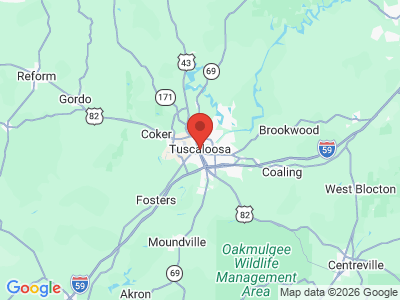
Tuscaloosa County
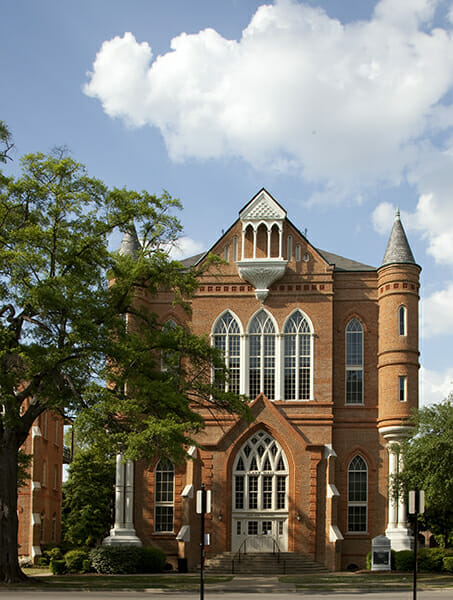 Clark Hall
Located in the west-central part of the state and home to the state's largest university, University of Alabama, Tuscaloosa County is the birthplace of "Queen of the Blues" Dinah Washington (1924-1963), one of the most influential vocalists of the twentieth century, and National Football League star John Stallworth of the Pittsburgh Steelers. The county was also home to arguably the most celebrated college football coach of the twentieth century, Paul "Bear" Bryant, as well as the state's first woman Alabama's governor, Lurleen Wallace. The city of Tuscaloosa served as the state capital from 1826 to 1845. Tuscaloosa County is governed by an elected five-member commission and includes the incorporated cities of Coaling, Northport, and Tuscaloosa.
Clark Hall
Located in the west-central part of the state and home to the state's largest university, University of Alabama, Tuscaloosa County is the birthplace of "Queen of the Blues" Dinah Washington (1924-1963), one of the most influential vocalists of the twentieth century, and National Football League star John Stallworth of the Pittsburgh Steelers. The county was also home to arguably the most celebrated college football coach of the twentieth century, Paul "Bear" Bryant, as well as the state's first woman Alabama's governor, Lurleen Wallace. The city of Tuscaloosa served as the state capital from 1826 to 1845. Tuscaloosa County is governed by an elected five-member commission and includes the incorporated cities of Coaling, Northport, and Tuscaloosa.
- Founding Date: February 6, 1818
- Area: 1,336 square miles
- Population: 208,854 (2020 Census estimate)
- Major Waterways: Black Warrior River, Tombigbee River
- Major Highways: Interstate 20/59, U.S. 43, U.S. 82, U.S. 11
- County Seat: Tuscaloosa
- Largest City: Tuscaloosa
History
 Tuscaloosa County Courthouse
Tuscaloosa County is one of the oldest counties in Alabama. The Alabama General Assembly created Tuscaloosa County on February 6, 1818, from lands ceded by the Creeks and Choctaws. The county name mostly likely derives from Tuskaloosa, a Mississippian chieftain who was killed in battle by forces commanded by Spanish explorer Hernando de Soto in 1540. The county's earliest settlers came from Virginia, the Carolinas, and Georgia. Some of the earliest towns included Newton, Northport, Holt, Coaling, and Tuscaloosa. The city of Tuscaloosa was designated the state capitol in 1826 and served in that capacity until 1845, when the seat of government was moved to the more centrally located Montgomery. While Tuscaloosa served as the state capitol, a charter for the establishment of the first public university was issued in 1827. In 1831, the University of Alabama officially opened its doors with an enrollment of 52 students.
Tuscaloosa County Courthouse
Tuscaloosa County is one of the oldest counties in Alabama. The Alabama General Assembly created Tuscaloosa County on February 6, 1818, from lands ceded by the Creeks and Choctaws. The county name mostly likely derives from Tuskaloosa, a Mississippian chieftain who was killed in battle by forces commanded by Spanish explorer Hernando de Soto in 1540. The county's earliest settlers came from Virginia, the Carolinas, and Georgia. Some of the earliest towns included Newton, Northport, Holt, Coaling, and Tuscaloosa. The city of Tuscaloosa was designated the state capitol in 1826 and served in that capacity until 1845, when the seat of government was moved to the more centrally located Montgomery. While Tuscaloosa served as the state capitol, a charter for the establishment of the first public university was issued in 1827. In 1831, the University of Alabama officially opened its doors with an enrollment of 52 students.
 Lime Cola Bottling Plant
Tuscaloosa was designated as the county seat of Tuscaloosa County in 1819, and in 1822, the county seat was moved to Newton, just a few miles from Tuscaloosa. Within a few short years, Newton was incorporated into Tuscaloosa, and Tuscaloosa again became the county seat in 1826. Many of the original structures, including the courthouse, were destroyed in a tornado that swept through in the 1840s. The present courthouse, a modern brick structure, was built in 1964 and has undergone several renovations and additions.
Lime Cola Bottling Plant
Tuscaloosa was designated as the county seat of Tuscaloosa County in 1819, and in 1822, the county seat was moved to Newton, just a few miles from Tuscaloosa. Within a few short years, Newton was incorporated into Tuscaloosa, and Tuscaloosa again became the county seat in 1826. Many of the original structures, including the courthouse, were destroyed in a tornado that swept through in the 1840s. The present courthouse, a modern brick structure, was built in 1964 and has undergone several renovations and additions.
During the 1960s, Tuscaloosa was the site of a violent attack by police on civil rights protestors at the First African Baptist Church. The event was the culmination of the Tuscaloosa Campaign for integrating the city, which began on March 8, 1964, under the guidance of Martin Luther King Jr. The Tuscaloosa Citizens for Action Committee held mass meetings at the church throughout the spring, and on June 9, approximately 600 people met at the church to march. They were attacked by dozens of police officers and some 200 white citizens, and 100 protestors were arrested and 33 were admitted to the hospital on what became known as Bloody Tuesday.
On April 27, 2011, a massive storm, causing numerous powerful tornadoes, struck the southeastern United States. More than 250 people were killed in Alabama, including 39 people in Tuscaloosa and surrounding communities.
Major Cities and Demographics
 Kentuck Arts Center
According to 2020 Census estimates, the population of Tuscaloosa County was 208,854. Of that total, 63.3 percent of respondents identified themselves as white, 32.2 percent as African American, 3.8 percent as Hispanic, 1.7 percent as two or more races, 1.6 percent as Asian, and 0.2 percent as American Indian. The county seat Tuscaloosa is the largest city in Tuscaloosa County, with an estimated population of 100,633. Other significant population centers in the county include Northport, Holt, Coker, Lake View, Brookwood, and Coaling. The median household income was $54,283, compared with $52,035 for the state as a whole, and the per capita income was $27,609 compared with $28,934 for the state as a whole.
Kentuck Arts Center
According to 2020 Census estimates, the population of Tuscaloosa County was 208,854. Of that total, 63.3 percent of respondents identified themselves as white, 32.2 percent as African American, 3.8 percent as Hispanic, 1.7 percent as two or more races, 1.6 percent as Asian, and 0.2 percent as American Indian. The county seat Tuscaloosa is the largest city in Tuscaloosa County, with an estimated population of 100,633. Other significant population centers in the county include Northport, Holt, Coker, Lake View, Brookwood, and Coaling. The median household income was $54,283, compared with $52,035 for the state as a whole, and the per capita income was $27,609 compared with $28,934 for the state as a whole.
Economy
 Mercedes-Benz Production Line
Farming was the prevailing occupation in Tuscaloosa County throughout the nineteenth century, and the most significant agricultural crops were wheat, corn, and oats. Tuscaloosa County also sits atop the Warrior Coal Field, and coal mining was important to the county's economy as well. Extensive forests in the northern part of the county brought timber industries to the county during the early to mid-nineteenth century as well. With the introduction of hydroelectric power in the early twentieth century, industrial growth boomed. Today, the county's economy is diverse and expanding, especially along the Interstate 20/59 Industrial Corridor, where automotive parts, electronics, plastics, wood products, food products, and chemicals are manufactured and produced. Healthcare and education account for roughly 30 percent of the non-agricultural workforce, and Tuscaloosa County has drawn major investments from companies in Germany and Japan.
Mercedes-Benz Production Line
Farming was the prevailing occupation in Tuscaloosa County throughout the nineteenth century, and the most significant agricultural crops were wheat, corn, and oats. Tuscaloosa County also sits atop the Warrior Coal Field, and coal mining was important to the county's economy as well. Extensive forests in the northern part of the county brought timber industries to the county during the early to mid-nineteenth century as well. With the introduction of hydroelectric power in the early twentieth century, industrial growth boomed. Today, the county's economy is diverse and expanding, especially along the Interstate 20/59 Industrial Corridor, where automotive parts, electronics, plastics, wood products, food products, and chemicals are manufactured and produced. Healthcare and education account for roughly 30 percent of the non-agricultural workforce, and Tuscaloosa County has drawn major investments from companies in Germany and Japan.
Employment
According to 2020 Census estimates, the workforce in Tuscaloosa County was divided among the following industrial categories:
- Educational services, and health care and social assistance (29.1 percent)
- Manufacturing (14.7 percent)
- Retail trade (11.1 percent)
- Arts, entertainment, recreation, and accommodation and food services (9.5 percent)
- Professional, scientific, management, and administrative and waste management services (7.8 percent)
- Construction (7.2 percent)
- Finance and insurance, and real estate, rental, and leasing (4.4 percent)
- Transportation and warehousing, and utilities (4.4 percent)
- Other services, except public administration (4.3 percent)
- Public administration (3.2 percent)
- Wholesale trade (1.9 percent)
- Information (1.2 percent)
- Agriculture, forestry, fishing and hunting, and extractive (1.1 percent)
Education
 Stillman College
The Tuscaloosa County school system oversees 30 primary and secondary schools, and the Tuscaloosa city schools oversee 20 primary and secondary schools. There are three institutions of higher education in Tuscaloosa city. The University of Alabama is the state's major research university and Alabama's first public college. The county is also home to Stillman College, a historically black, four-year liberal-arts instutution, and Shelton State Community College, a two-year institution offering academic and technical degree programs.
Stillman College
The Tuscaloosa County school system oversees 30 primary and secondary schools, and the Tuscaloosa city schools oversee 20 primary and secondary schools. There are three institutions of higher education in Tuscaloosa city. The University of Alabama is the state's major research university and Alabama's first public college. The county is also home to Stillman College, a historically black, four-year liberal-arts instutution, and Shelton State Community College, a two-year institution offering academic and technical degree programs.
Geography
 Tuscaloosa County Map
Comprising 1,336 square miles in west-central Alabama, Tuscaloosa County is the second largest county in area in the state. The county straddles the Cumberland Plateau and East Gulf Coastal Plain physiographic sections of the Atlantic Plain region, resulting in a diverse geography that is forested and hilly in the northeast and low-lying and occasionally swampy in the southwest. The county is bordered by Fayette and Walker Counties to the north, Jefferson and Bibb Counties to the east, Hale County to the south, Greene County to the southwest, and Pickens County to the west.
Tuscaloosa County Map
Comprising 1,336 square miles in west-central Alabama, Tuscaloosa County is the second largest county in area in the state. The county straddles the Cumberland Plateau and East Gulf Coastal Plain physiographic sections of the Atlantic Plain region, resulting in a diverse geography that is forested and hilly in the northeast and low-lying and occasionally swampy in the southwest. The county is bordered by Fayette and Walker Counties to the north, Jefferson and Bibb Counties to the east, Hale County to the south, Greene County to the southwest, and Pickens County to the west.
The Black Warrior River system is the largest watershed wholly within Alabama's boundaries and emanates from three sources: Locust Fork, Mulberry Fork, and the Sipsey Fork. The Mulberry Fork River and its tributaries flow throughout Tuscaloosa County. Near the city of Tuscaloosa, the Black Warrior River flows across the fall line, a site at the juncture of two geologically distinct continental landforms that in Alabama separate the elevated and hilly Cumberland Plateau from the flat East Gulf Coastal Plain. The Upper Tombigbee Watershed drains portions of the western half of Tuscaloosa County, and the Tombigbee River is considered vitally important in terms of ecological diversity. Although the river has a high level of aquatic biodiversity because it remained relatively free from major changes for a long period of time, many of the fish and mussel species are currently at-risk.
Interstate 20/59 is one of Tuscaloosa County's main transportation routes, running southwest-northeast. U.S. Highway 11 runs along Interstate 20/59. U.S. Highway 43 runs north-south through the middle of the county, and U.S. Highway 82 runs east–west, bisecting Tuscaloosa County. Tuscaloosa Regional Airport is the only airport in Tuscaloosa County and is used mostly for air freight and private air traffic.
Events and Places of Interest
 Historic Furnaces at Tannehill
There are many recreational opportunities for visitors to Tuscaloosa County. Lake Lurleen State Park, named for Governor Lurleen Wallace, is located about 10 minutes from downtown Tuscaloosa and offers 1,600 acres for camping and hiking and a 250-acre lake for swimming and fishing. Located 15 miles south of Tuscaloosa is Moundville Archaeological Park, part of the Alabama Museum of Natural History, and is the site of a Mississippian settlement. The 320-acre park includes nature trails, Native American village reconstructions, and a museum that houses artifacts and documents relating to Native American cultures in the area. A portion of Tannehill Ironworks Historical State Park, built around the pre-Civil War Tannehill Iron Works, spreads across the wooded hills of eastern Tuscaloosa County, although most of the park is located in neighboring Jefferson County. The park contains a monument to the Confederacy and offers camping, hiking, golfing, hiking, and swimming. Special events at the park include an annual re-eanactment of a Civil War battle and monthly trade days. Other outdoor recreational areas in Tuscaloosa County include Lake Tuscaloosa, Holt Lake, and Lake Nichol. In addition, the Tuscaloosa County Park and Recreation Authority operates 31 small public parks totaling 1,700 acres.
Historic Furnaces at Tannehill
There are many recreational opportunities for visitors to Tuscaloosa County. Lake Lurleen State Park, named for Governor Lurleen Wallace, is located about 10 minutes from downtown Tuscaloosa and offers 1,600 acres for camping and hiking and a 250-acre lake for swimming and fishing. Located 15 miles south of Tuscaloosa is Moundville Archaeological Park, part of the Alabama Museum of Natural History, and is the site of a Mississippian settlement. The 320-acre park includes nature trails, Native American village reconstructions, and a museum that houses artifacts and documents relating to Native American cultures in the area. A portion of Tannehill Ironworks Historical State Park, built around the pre-Civil War Tannehill Iron Works, spreads across the wooded hills of eastern Tuscaloosa County, although most of the park is located in neighboring Jefferson County. The park contains a monument to the Confederacy and offers camping, hiking, golfing, hiking, and swimming. Special events at the park include an annual re-eanactment of a Civil War battle and monthly trade days. Other outdoor recreational areas in Tuscaloosa County include Lake Tuscaloosa, Holt Lake, and Lake Nichol. In addition, the Tuscaloosa County Park and Recreation Authority operates 31 small public parks totaling 1,700 acres.
 AMNH Main Hall
Tuscaloosa County is home to a number of museums, cultural centers, and historic sites, several of which are commemorated on the Tuscaloosa Civil Rights Trail. The Alabama Museum of Natural History, located in Smith Hall on the University of Alabama campus, displays fossils, rocks, and minerals. The Mildred Westervelt Warner Transportation Museum celebrates role that transportation has played in Tuscaloosa's history and culture. The Murphy African-American Museum at the Murphy-Collins House in Tuscaloosa was home to William J. Murphy, the first licensed African American mortician in Alabama, and features Murphy family memorabilia as well as other artifacts representative of the lifestyle of affluent African Americans at the turn of the century. Celebrating more than 100 years of Crimson Tide football and multiple national championships, the Paul W. Bryant Museum on the University of Alabama campus houses a re-creation of Bear Bryant's office along with other football memorabilia. The Children's Hands-On Museum provides educational experience for children of all ages through hands-on exhibits, programs, and special events.
AMNH Main Hall
Tuscaloosa County is home to a number of museums, cultural centers, and historic sites, several of which are commemorated on the Tuscaloosa Civil Rights Trail. The Alabama Museum of Natural History, located in Smith Hall on the University of Alabama campus, displays fossils, rocks, and minerals. The Mildred Westervelt Warner Transportation Museum celebrates role that transportation has played in Tuscaloosa's history and culture. The Murphy African-American Museum at the Murphy-Collins House in Tuscaloosa was home to William J. Murphy, the first licensed African American mortician in Alabama, and features Murphy family memorabilia as well as other artifacts representative of the lifestyle of affluent African Americans at the turn of the century. Celebrating more than 100 years of Crimson Tide football and multiple national championships, the Paul W. Bryant Museum on the University of Alabama campus houses a re-creation of Bear Bryant's office along with other football memorabilia. The Children's Hands-On Museum provides educational experience for children of all ages through hands-on exhibits, programs, and special events.
 Kentuck Arts Festival
Other places and events of interest include the Kentuck Art Center in Northport. The gallery features rotating monthly exhibits of regional artists and hosts the annual Kentuck Arts Festival. At the Mercedes-Benz Visitor's Center in Vance, visitors can tour the plant and trace the history of Mercedes-Benz from 1886 to the present. Tuscaloosa County is home to many historic buildings, including the Jemison-Van de Graaff Mansion, the Old Tavern, the Historic Drish House, and the Battle-Friedman House in Tuscaloosa and the Denny Chimes Tower and Gorgas House on the campus of the University of Alabama.
Kentuck Arts Festival
Other places and events of interest include the Kentuck Art Center in Northport. The gallery features rotating monthly exhibits of regional artists and hosts the annual Kentuck Arts Festival. At the Mercedes-Benz Visitor's Center in Vance, visitors can tour the plant and trace the history of Mercedes-Benz from 1886 to the present. Tuscaloosa County is home to many historic buildings, including the Jemison-Van de Graaff Mansion, the Old Tavern, the Historic Drish House, and the Battle-Friedman House in Tuscaloosa and the Denny Chimes Tower and Gorgas House on the campus of the University of Alabama.
Additional Resources
- The Heritage of Tuscaloosa County, Alabama. Clanton, Ala.: Heritage Publishing Consultants, 1999.
External Links
- Tuscaloosa County
- Tuscaloosa County School System
- City of Tuscaloosa
- City of Northport
- City of Brookwood
- Town of Coaling
- Town of Coker
- Town of Lake View
- Tuscaloosa Public Library
- Chamber of Commerce of West Alabama
- National Register of Historic Places: Tuscaloosa County
- University of Alabama
- Stillman College
- Shelton State Community College
- Moundville Archaeological Park
- Lake Lurleen State Park
- Tannehill Ironworks Historical State Park
- Alabama Museum of Natural History
- Paul W. Bryant Museum
- Mildred Westervelt Warner Transportation Museum
- Historic Tuscaloosa
- Children's Hands-On Museum of Tuscaloosa
- Jemison-Van de Graaff Mansion
- Old Tavern Museum
- Gorgas House Museum
- Kentuck Art Center and Festival