Winston County
 Pat Buttram
Located in the northwest part of Alabama, Winston County is a mountainous county that supported Unionism during the Civil War and attempted to declare itself the Free State of Winston. Frank M. Johnson Jr. (1918-1999), a pioneering Alabama judge whose decisions helped end segregation in a number of landmark rulings, was born in Haleyville. Actor Pat Buttram and author Gustav Hasford were both born in Winston County as well. Winston County is governed by an elected four-member county commission and includes six incorporated communities.
Pat Buttram
Located in the northwest part of Alabama, Winston County is a mountainous county that supported Unionism during the Civil War and attempted to declare itself the Free State of Winston. Frank M. Johnson Jr. (1918-1999), a pioneering Alabama judge whose decisions helped end segregation in a number of landmark rulings, was born in Haleyville. Actor Pat Buttram and author Gustav Hasford were both born in Winston County as well. Winston County is governed by an elected four-member county commission and includes six incorporated communities.
- Founding Date: February 12, 1850
- Area: 614 square miles
- Population: 23,712 (2020 Census estimate)
- Major Waterways: Black Warrior River
- Major Highways: U.S. 278
- County Seat: Double Springs
- Largest City: Haleyville
History
 Winston County Courthouse
Winston County was created by the Alabama General Assembly on February 12, 1850, from land taken from the northern portion of Walker County. The county was originally known as Hancock County, named for John Hancock, governor of Massachusetts and famous signer of the Declaration of Independence. In 1858, the county's name was changed to Winston County in honor of John A. Winston (1812-1871), the first governor of Alabama to be born in the state. In 1877, the eastern portion of Winston County was carved out to create Cullman County. The earliest settlers came to Winston County from Tennessee, the Carolinas, Georgia, and Virginia. Some of the first towns included Houston (now known as Lynn), Addison, Double Springs, and Haleyville.
Winston County Courthouse
Winston County was created by the Alabama General Assembly on February 12, 1850, from land taken from the northern portion of Walker County. The county was originally known as Hancock County, named for John Hancock, governor of Massachusetts and famous signer of the Declaration of Independence. In 1858, the county's name was changed to Winston County in honor of John A. Winston (1812-1871), the first governor of Alabama to be born in the state. In 1877, the eastern portion of Winston County was carved out to create Cullman County. The earliest settlers came to Winston County from Tennessee, the Carolinas, Georgia, and Virginia. Some of the first towns included Houston (now known as Lynn), Addison, Double Springs, and Haleyville.
 John A. Winston
Winston County gained notoriety during the Civil War because the residents of the county did not want to join the Confederacy. The county had no large plantations and virtually no enslaved labor. During the war, the county suffered a number of raids by Confederate soldiers, who considered the residents of Winston to be traitors to the Southern cause. Leaders of Winston County met at Looney's Tavern in Double Springs, where they attempted to declare the independent Republic of Winston and made plans to secede from the Confederacy. Though the secession never occurred, Winston County continues to be referred to as the "Free State of Winston."
John A. Winston
Winston County gained notoriety during the Civil War because the residents of the county did not want to join the Confederacy. The county had no large plantations and virtually no enslaved labor. During the war, the county suffered a number of raids by Confederate soldiers, who considered the residents of Winston to be traitors to the Southern cause. Leaders of Winston County met at Looney's Tavern in Double Springs, where they attempted to declare the independent Republic of Winston and made plans to secede from the Confederacy. Though the secession never occurred, Winston County continues to be referred to as the "Free State of Winston."
Houston served as the first county seat, although little is known about the courthouse(s) there. In 1883, the county seat was moved to the more centrally located Double Springs. The first wooden courthouse burned in 1891. The main section of the present stone courthouse was completed shortly thereafter in 1894. Several additions have since been made to the courthouse, which remains in service to the residents of Winston County.
Major Cities and Demographics
 Haleyville 911 Mug
According to 2020 Census estimates, the population of Winston County was 23,712. Of that total, 95.6 percent of respondents identified themselves as white, 3.1 percent as Hispanic, 1.8 percent as two or more races, 0.8 percent as African American, 0.4 percent as Asian, 0.3 as American Indian, and 0.1 as Native Hawaiian and Other Pacific Islander. The largest city in Winston County is Haleyville, with an estimated population of 4,139. The county seat Double Springs had an estimated population of 1,477. Other significant population centers include Double Springs, Natural Bridge, Lynn, and Addison. The median household income was $40,991, compared with $52,035 for the state as a whole, and the per capita income was $23,269, compared with $28,934 for the state as a whole.
Haleyville 911 Mug
According to 2020 Census estimates, the population of Winston County was 23,712. Of that total, 95.6 percent of respondents identified themselves as white, 3.1 percent as Hispanic, 1.8 percent as two or more races, 0.8 percent as African American, 0.4 percent as Asian, 0.3 as American Indian, and 0.1 as Native Hawaiian and Other Pacific Islander. The largest city in Winston County is Haleyville, with an estimated population of 4,139. The county seat Double Springs had an estimated population of 1,477. Other significant population centers include Double Springs, Natural Bridge, Lynn, and Addison. The median household income was $40,991, compared with $52,035 for the state as a whole, and the per capita income was $23,269, compared with $28,934 for the state as a whole.
Economy
 Southern Energy Homes
Like much of Alabama, farming was the prevailing occupation of Winston County until the early twentieth century. Although Winston County did not have large plantations, small subsistence farming occurred throughout the county. Row crops and cotton farming were eventually replaced by cattle farms and chicken production. By the late nineteenth and early twentieth centuries, small factories tied to local timbering were established. Centered around the industrial Corridor X, Winston County's economy continues to focus on the timber industry.
Southern Energy Homes
Like much of Alabama, farming was the prevailing occupation of Winston County until the early twentieth century. Although Winston County did not have large plantations, small subsistence farming occurred throughout the county. Row crops and cotton farming were eventually replaced by cattle farms and chicken production. By the late nineteenth and early twentieth centuries, small factories tied to local timbering were established. Centered around the industrial Corridor X, Winston County's economy continues to focus on the timber industry.
Employment
According to 2020 Census estimates, the workforce in Winston County was divided among the following industrial categories:
- Manufacturing (20.7 percent)
- Educational services, and health care and social assistance (17.1 percent)
- Retail trade (15.5 percent)
- Transportation and warehousing, and utilities (12.0 percent)
- Construction (9.0 percent)
- Other services, except public administration (4.7 percent)
- Arts, entertainment, recreation, and accommodation and food services (4.5 percent)
- Finance and insurance, and real estate, rental, and leasing (4.1 percent)
- Public administration (4.0 percent)
- Professional, scientific, management, and administrative and waste management services (3.2 percent)
- Wholesale trade (2.3 percent)
- Information (1.5 percent)
- Agriculture, forestry, fishing and hunting, and extractive (1.4 percent)
Education
The Winston County Public School System oversees 11 primary and secondary schools. Haleyville Public Schools oversees three primary and secondary schools.
Geography
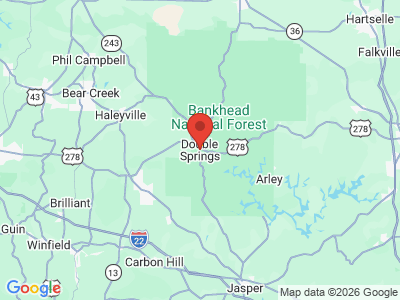
 Winston County Map
Comprising 614 square miles, Winston County is located in the foothills of the Appalachian Mountains in northwest Alabama. It is part of the Cumberland Plateau physiographic section, and its terrain varies from low, rolling hills covered with evergreens to spectacular gorges, rock bluffs, and hardwood forests. Much of Winston County sits on the Warrior Coal Field, and the county's soils are a mixture of plateau and coastal soils. Winston County is bordered by Franklin and Lawrence Counties to the north, Cullman County to the east, Walker County to the south, and Marion County to the west.
Winston County Map
Comprising 614 square miles, Winston County is located in the foothills of the Appalachian Mountains in northwest Alabama. It is part of the Cumberland Plateau physiographic section, and its terrain varies from low, rolling hills covered with evergreens to spectacular gorges, rock bluffs, and hardwood forests. Much of Winston County sits on the Warrior Coal Field, and the county's soils are a mixture of plateau and coastal soils. Winston County is bordered by Franklin and Lawrence Counties to the north, Cullman County to the east, Walker County to the south, and Marion County to the west.
The Black Warrior River and its tributaries flow throughout Winston County. Tributaries of both the Mulberry Fork and the Sipsey Fork flow through the county. Although the species diversity of the Mulberry Fork is relatively low compared with other water systems in the state, the Sipsey Fork is home to nearly 80 species of fish and is Alabama's only National Wild and Scenic River System. A large portion of Winston County is part of the William B. Bankhead National Forest, offering scenic views and outdoor recreational opportunities.
Winston County's main transportation route is U.S. Highway 278, which runs east-west through the middle of the county. The county has two airports: Double Springs-Winston County Airport and Posey Field, located in Kinlock Spring.
Events and Places of Interest
 Natural Bridge
There are a number of recreational opportunities for visitors to Winston County. The William B. Bankhead National Forest, named for the distinguished Alabama politician, offers a range of outdoor activities in which to take part. Visitors can hike, fish, boat, or camp in the forest as well as picnic in any one of four recreational areas. Within the boundaries of the forest lies the Sipsey Wilderness, Alabama's first national wilderness area. Known as "The Land of a Thousand Waterfalls," the 25,000-acre wilderness park affords visitors opportunities to hike, horseback ride, boat, fish, swim, and canoe. Another popular outdoor attraction in Winston County is Natural Bridge Park. Thousands of years old, the Natural Bridge is a double-span, 60-foot-high, sandstone geologic feature and is believed to be the longest natural bridge east of the Rocky Mountains. A number of nature paths and picnic areas surround the bridge and are open to the public.
Natural Bridge
There are a number of recreational opportunities for visitors to Winston County. The William B. Bankhead National Forest, named for the distinguished Alabama politician, offers a range of outdoor activities in which to take part. Visitors can hike, fish, boat, or camp in the forest as well as picnic in any one of four recreational areas. Within the boundaries of the forest lies the Sipsey Wilderness, Alabama's first national wilderness area. Known as "The Land of a Thousand Waterfalls," the 25,000-acre wilderness park affords visitors opportunities to hike, horseback ride, boat, fish, swim, and canoe. Another popular outdoor attraction in Winston County is Natural Bridge Park. Thousands of years old, the Natural Bridge is a double-span, 60-foot-high, sandstone geologic feature and is believed to be the longest natural bridge east of the Rocky Mountains. A number of nature paths and picnic areas surround the bridge and are open to the public.
 Old Winston County Jail
Each June, the city of Haleyville hosts the annual 911 Festival. The festival celebrates the area where the first 911 call was made. The annual celebration features food, music, rides, and games as well as a BBQ cook-off and arts and crafts show. Also of interest to visitors to Winston County is the Free State Lady, a reproduction riverboat that hosts sightseeing excursions on nearby Smith Lake. Finally, as a member of the Northwest Alabama Arts Council, Winston County sponsors and periodically hosts the Jerry Brown Arts Festival, named in honor of Heritage Art recipient and noted folk potter Jerry Brown (1942-2016). The council is a voluntary organization formed to promote the exploration of local artists and their work within a four-county area in northwest Alabama.
Old Winston County Jail
Each June, the city of Haleyville hosts the annual 911 Festival. The festival celebrates the area where the first 911 call was made. The annual celebration features food, music, rides, and games as well as a BBQ cook-off and arts and crafts show. Also of interest to visitors to Winston County is the Free State Lady, a reproduction riverboat that hosts sightseeing excursions on nearby Smith Lake. Finally, as a member of the Northwest Alabama Arts Council, Winston County sponsors and periodically hosts the Jerry Brown Arts Festival, named in honor of Heritage Art recipient and noted folk potter Jerry Brown (1942-2016). The council is a voluntary organization formed to promote the exploration of local artists and their work within a four-county area in northwest Alabama.
Additional Resources
- The Heritage of Winston County, Alabama. Clanton, Ala.: Heritage Publishing Consultants, 1998.
- Thompson, Wesley S. Free State of Winston: A History of Winston County, Alabama. Winfield, Ala.: Pareil Press, 1968.