Wilcox County
 Gee's Bend Quilt Mural Trail
Located in the southwestern part of the state, Wilcox County is home to the nationally renowned Gee's Bend Quilting Collective and the Freedom Quilting Bee. Pine Apple in Wilcox County was also the birthplace and boyhood home of Kenneth R. Giddens (1908-1993), who founded several TV and radio stations in Mobile before becoming the longest-running director of Voice of America (1969-1977). The county is governed by an elected six-member commission.
Gee's Bend Quilt Mural Trail
Located in the southwestern part of the state, Wilcox County is home to the nationally renowned Gee's Bend Quilting Collective and the Freedom Quilting Bee. Pine Apple in Wilcox County was also the birthplace and boyhood home of Kenneth R. Giddens (1908-1993), who founded several TV and radio stations in Mobile before becoming the longest-running director of Voice of America (1969-1977). The county is governed by an elected six-member commission.
- Founding Date: December 13, 1819
- Area: 883 square miles
- Population: 10,552 (2020 Census estimate)
- Major Waterways: Alabama River
- Major Highways: No interstate or state highways
- County Seat: Camden
- Largest City: Camden
History
 Wilcox County Courthouse
Wilcox County was created by an act of the Alabama Territorial Legislature on December 13, 1819. The county was created from portions of Dallas and Monroe counties, which in turn were created from Creek Indian lands acquired by the United States in the 1814 Treaty of Fort Jackson. Most of the earliest settlers came from Georgia, the Carolinas, and Tennessee. Wilcox County was named for Lt. Joseph M. Wilcox, an army officer from Connecticut who fought and died in the Creek War of 1813-14. Some of the first towns in Wilcox County were Pine Hill, Pine Apple, Oak Hill, and Camden (formerly known as Barboursville).
Wilcox County Courthouse
Wilcox County was created by an act of the Alabama Territorial Legislature on December 13, 1819. The county was created from portions of Dallas and Monroe counties, which in turn were created from Creek Indian lands acquired by the United States in the 1814 Treaty of Fort Jackson. Most of the earliest settlers came from Georgia, the Carolinas, and Tennessee. Wilcox County was named for Lt. Joseph M. Wilcox, an army officer from Connecticut who fought and died in the Creek War of 1813-14. Some of the first towns in Wilcox County were Pine Hill, Pine Apple, Oak Hill, and Camden (formerly known as Barboursville).
 Moore Academy
The first county seat was located in Canton Bend on the Alabama River, a few miles west of present-day Camden. The first courthouse was a two-story wooden building that is no longer in existence. In 1833, the county seat was moved from Canton Bend to Barboursville, named for Sen. Philip B. Barbour of Virginia. A two-story wooden building served as the county courthouse. Barboursville was later renamed Camden by physician John D. Caldwell in honor of his hometown of Camden, South Carolina. Incorporated in 1841, Camden became a commercial and political center by the 1850s. In 1857, the first Camden courthouse was torn down, and a new Greek Revival courthouse was built in its place. After the Civil War, the Wilcox County courthouse was dedicated in honor of Enoch Hooper Cook, a local Confederate veteran whose six sons died in action during the war. The courthouse continues to serve as the county today.
Moore Academy
The first county seat was located in Canton Bend on the Alabama River, a few miles west of present-day Camden. The first courthouse was a two-story wooden building that is no longer in existence. In 1833, the county seat was moved from Canton Bend to Barboursville, named for Sen. Philip B. Barbour of Virginia. A two-story wooden building served as the county courthouse. Barboursville was later renamed Camden by physician John D. Caldwell in honor of his hometown of Camden, South Carolina. Incorporated in 1841, Camden became a commercial and political center by the 1850s. In 1857, the first Camden courthouse was torn down, and a new Greek Revival courthouse was built in its place. After the Civil War, the Wilcox County courthouse was dedicated in honor of Enoch Hooper Cook, a local Confederate veteran whose six sons died in action during the war. The courthouse continues to serve as the county today.
Major Cities and Demographics
 Pine Hill Depot Museum
According to 2020 Census estimates, the population of Wilcox County was 10,552. Of that total, 70.3 percent of respondents identified themselves as African American, 27.2 as white, 2.4 percent as two or more races, 0.5 percent as Hispanic, and 0.1 percent as American Indian. The county seat Camden is the largest city in Wilcox, with an estimated population of 2,045. Pine Hill and Yellow Bluff are the only other significant population centers. The median household income was $35,063, compared with $52,035 for the state as a whole, and the per capita income was $19,031, compared with $28,934 for the state as a whole.
Pine Hill Depot Museum
According to 2020 Census estimates, the population of Wilcox County was 10,552. Of that total, 70.3 percent of respondents identified themselves as African American, 27.2 as white, 2.4 percent as two or more races, 0.5 percent as Hispanic, and 0.1 percent as American Indian. The county seat Camden is the largest city in Wilcox, with an estimated population of 2,045. Pine Hill and Yellow Bluff are the only other significant population centers. The median household income was $35,063, compared with $52,035 for the state as a whole, and the per capita income was $19,031, compared with $28,934 for the state as a whole.
Economy
 Paper Mill in Wilcox County
Like so much of Alabama, farming was the prevailing occupation of Wilcox County until well into the twentieth century. As part of the Black Belt, cotton was Wilcox County's main agricultural product in the nineteenth century. With more than 50 boat landings on the Alabama River, Wilcox County was an important transportation site as well. Paddlewheel steamers took cotton and other agricultural products as well as passengers up and down the Alabama River. By the early to mid-twentieth century, farmers had diversified into corn, sweet potatoes, and livestock. Wilcox County received a significant economic boost in the 1930s with the completion of the T. Lee Long Bridge over the Alabama River, making transportation more efficient. When the Millers Ferry Lock and Dam was completed in the 1960s, the resulting hydroelectric power allowed for the growth of large industries in the county, such as the MacMillan Bloedel Paper Mill (now owned by International Paper) in Pine Hill. Today, the principal products and industries of Wilcox County center around timber. Although Wilcox County has attempted to move towards a more industrialized economy, it has done so slowly and with limited success. The county remains largely rural and agricultural.
Paper Mill in Wilcox County
Like so much of Alabama, farming was the prevailing occupation of Wilcox County until well into the twentieth century. As part of the Black Belt, cotton was Wilcox County's main agricultural product in the nineteenth century. With more than 50 boat landings on the Alabama River, Wilcox County was an important transportation site as well. Paddlewheel steamers took cotton and other agricultural products as well as passengers up and down the Alabama River. By the early to mid-twentieth century, farmers had diversified into corn, sweet potatoes, and livestock. Wilcox County received a significant economic boost in the 1930s with the completion of the T. Lee Long Bridge over the Alabama River, making transportation more efficient. When the Millers Ferry Lock and Dam was completed in the 1960s, the resulting hydroelectric power allowed for the growth of large industries in the county, such as the MacMillan Bloedel Paper Mill (now owned by International Paper) in Pine Hill. Today, the principal products and industries of Wilcox County center around timber. Although Wilcox County has attempted to move towards a more industrialized economy, it has done so slowly and with limited success. The county remains largely rural and agricultural.
Employment
According to 2020 Census estimates, the workforce in Wilcox County was divided among the following industrial categories:
- Manufacturing (22.5 percent)
- Educational services, and health care and social assistance (20.6 percent)
- Retail trade (9.9 percent)
- Construction (8.3 percent)
- Arts, entertainment, recreation, and accommodation and food services (7.4 percent)
- Public administration (7.3 percent)
- Agriculture, forestry, fishing and hunting, and extractive (5.9 percent)
- Other services, except public administration (5.7 percent)
- Transportation and warehousing, and utilities (5.5 percent)
- Professional, scientific, management, and administrative and waste management services (4.2 percent)
- Finance and insurance, and real estate, rental, and leasing (2.0 percent)
- Wholesale trade (0.5 percent)
- Information (0.2 percent)
Education
The Wilcox County School System oversees 10 primary and secondary schools.
Geography
 Wilcox County Map
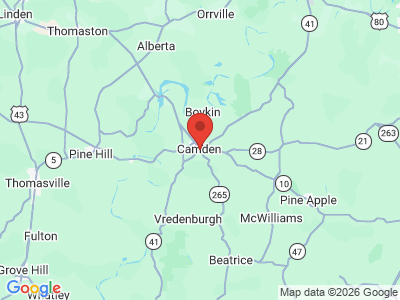
Comprising 883 square miles, Wilcox County is part of Alabama's Black Belt and lies in the southwestern part of the state. The county is part of the Coastal Plain physiographic section and consists of rolling prairies and coastal plains. Pine forests grow along the shoreline of the Alabama River and its tributaries. Wilcox County is bordered by Dallas County to the northeast, Lowndes and Butler Counties to the east, Monroe County to the south, Clarke County to the southwest, and Marengo County to the northwest.
Wilcox County Map
Comprising 883 square miles, Wilcox County is part of Alabama's Black Belt and lies in the southwestern part of the state. The county is part of the Coastal Plain physiographic section and consists of rolling prairies and coastal plains. Pine forests grow along the shoreline of the Alabama River and its tributaries. Wilcox County is bordered by Dallas County to the northeast, Lowndes and Butler Counties to the east, Monroe County to the south, Clarke County to the southwest, and Marengo County to the northwest.
The Alabama River and its middle tributaries flow throughout Wilcox County. The Alabama River combines Alabama's eastern and western rivers. More than 144 species of fish have been identified in the Alabama River. The river provides both economic and recreational opportunities for Wilcox County. The Roland Cooper State Park and the William Dannelly Reservoir provide scenic views and recreational opportunities as well. Both the park and the reservoir are located on the Alabama River.
Although there are no major interstate or state highways in Wilcox County, several county roads connect Wilcox County to other areas. Meeting in the city of Camden, county roads 48, 28, and 21 run throughout Wilcox County. Two airports service Wilcox County: Camden Municipal Airport in Camden and Pine Hill Municipal Airport in Pine Hill.
Events and Places of Interest
 Roland Cooper State Park
There are several recreational opportunities for visitors to Wilcox County. Roland Cooper State Park is located on the Alabama River, six miles north of Camden. The park features a nine-hole golf course, rental cabins, and camping facilities. Visitors to the park can hike its many trails and hunt game animals such as whitetail deer, wild turkeys, and feral hogs. Lake Dannelly (also known as Millers Ferry Lake) on the Alabama River is recognized as one of the best bass fishing lakes in the state and offers visitors the opportunity to participate in a number of water sports. Wilcox County also has more miles of riverfront than any other county in southern Alabama, offering a variety of scenic views and outdoor recreational opportunities. Bridgeport Beach near Camden offers swimming, fishing, biking, and picnicking facilities.
Roland Cooper State Park
There are several recreational opportunities for visitors to Wilcox County. Roland Cooper State Park is located on the Alabama River, six miles north of Camden. The park features a nine-hole golf course, rental cabins, and camping facilities. Visitors to the park can hike its many trails and hunt game animals such as whitetail deer, wild turkeys, and feral hogs. Lake Dannelly (also known as Millers Ferry Lake) on the Alabama River is recognized as one of the best bass fishing lakes in the state and offers visitors the opportunity to participate in a number of water sports. Wilcox County also has more miles of riverfront than any other county in southern Alabama, offering a variety of scenic views and outdoor recreational opportunities. Bridgeport Beach near Camden offers swimming, fishing, biking, and picnicking facilities.
 Wilcox Female Institute
Visitors to Camden can take a self-guided walking tour of the city and its historic buildings and monuments. The Wilcox Female Institute in Camden was organized in 1847-1850 as a boarding school for girls. When the institute closed in 1910, the building was used as part of the Wilcox County High School until the 1960s. Gaining the deed in 1976, the Wilcox Historical Society now uses the building as its official headquarters. The Dale Masonic Lodge (originally located in Dale Town) was built in 1827 and moved to Camden in the 1840s. Union troops camped in the lodge while passing through Camden in 1865. Built in 1849, the Camden Associate Reformed Presbyterian Church is the only antebellum church in Camden. Visitors to Camden can also visit the Confederate Memorial Statue, the Camden Cemetery, and the Wilcox County Courthouse.
Wilcox Female Institute
Visitors to Camden can take a self-guided walking tour of the city and its historic buildings and monuments. The Wilcox Female Institute in Camden was organized in 1847-1850 as a boarding school for girls. When the institute closed in 1910, the building was used as part of the Wilcox County High School until the 1960s. Gaining the deed in 1976, the Wilcox Historical Society now uses the building as its official headquarters. The Dale Masonic Lodge (originally located in Dale Town) was built in 1827 and moved to Camden in the 1840s. Union troops camped in the lodge while passing through Camden in 1865. Built in 1849, the Camden Associate Reformed Presbyterian Church is the only antebellum church in Camden. Visitors to Camden can also visit the Confederate Memorial Statue, the Camden Cemetery, and the Wilcox County Courthouse.
 Gee's Bend Ferry in Camden
In recent decades, the small, rural community of Gee's Bend has received much attention. Nestled into a curve of the Alabama River, Gee's Bend was once the site of large cotton plantations owned by Joseph Gee and Mark Pettway. After the Civil War, freed people took the name Pettway, became tenant farmers for the Pettway family, and founded a community that remained completely isolated until the 1930s. The women of Gee's Bend developed a distinctive, sophisticated quilting style that they have passed on for at least six generations to the present day. In 2002, the Museum of Fine Arts in Houston presented an exhibition of 70 quilts from Gee's Bend. Two companion books were published as accompaniments to the exhibition. The exhibit garnered much praise and has since traveled throughout the United States. In 2003, the living quilters of Gee's Bend founded the Gee's Bend Quilters Collective to sell and market their quilts. Visitors to the town can take the newly opened Gee's Bend Ferry from Camden to Gee's Bend.
Gee's Bend Ferry in Camden
In recent decades, the small, rural community of Gee's Bend has received much attention. Nestled into a curve of the Alabama River, Gee's Bend was once the site of large cotton plantations owned by Joseph Gee and Mark Pettway. After the Civil War, freed people took the name Pettway, became tenant farmers for the Pettway family, and founded a community that remained completely isolated until the 1930s. The women of Gee's Bend developed a distinctive, sophisticated quilting style that they have passed on for at least six generations to the present day. In 2002, the Museum of Fine Arts in Houston presented an exhibition of 70 quilts from Gee's Bend. Two companion books were published as accompaniments to the exhibition. The exhibit garnered much praise and has since traveled throughout the United States. In 2003, the living quilters of Gee's Bend founded the Gee's Bend Quilters Collective to sell and market their quilts. Visitors to the town can take the newly opened Gee's Bend Ferry from Camden to Gee's Bend.
Wilcox County boasts a number of historic buildings, many of which can be seen each May during Pine Apple's annual Front Porch Tour. Numerous historic homes listed on the National Register of Historic Places are opened to the public during this event, including the Moore Academy founded in 1883 by author and historian John Trotwood Moore. Also listed on the register is Snow Hill Institute, founded as a private school for African Americans by William J. Edwards in 1893. Black Belt Treasures, located in Camden, is a non-profit economic development program, marketing high quality products from the Black Belt region. Visitors can view and purchase such diverse items as artwork, pottery, woodwork, baskets, and jewelry.
Additional Resources
- The Heritage of Wilcox County, Alabama. Clanton, Ala.: Heritage Publishing Consultants, 2002.