Lawrence County
 Jesse Owens Museum
Located in northwest Alabama, Lawrence County was the birthplace and boyhood home of Olympian Jesse Owens, who lived in the community of Oakville. The county is also home to large prehistoric earthen mounds constructed by Native Americans of the Mississippian tradition. The county is governed by an elected five-member commission and includes the incorporated communities of Moulton.
Jesse Owens Museum
Located in northwest Alabama, Lawrence County was the birthplace and boyhood home of Olympian Jesse Owens, who lived in the community of Oakville. The county is also home to large prehistoric earthen mounds constructed by Native Americans of the Mississippian tradition. The county is governed by an elected five-member commission and includes the incorporated communities of Moulton.
- Founding Date: February 6, 1818
- Area: 693 square miles
- Population: 32,969 (2020 Census estimate)
- Major Waterways: Tennessee River, Black Warrior River
- Major Highways: U.S. 72
- County Seat: Moulton
- Largest City: Moulton
History
 Lawrence County Courthouse
Originally part of Blount County, Lawrence County was created by an act of the Alabama Territorial Legislature on February 6, 1818, nearly one year before Alabama became a state. The county was created from former Chickasaw lands ceded to the United States in the Treaty of Fort Jackson in 1814 as well as the Turkey Town Treaty of 1816. Lawrence County was named for Capt. James Lawrence, a naval war hero from Vermont who fought in the War of 1812. The earliest settlers came to the county from Georgia, Tennessee, and the Carolinas, and later settlers came from Kentucky and Virginia. Some of the first settlements and towns included Melton's Bluff (no longer in existence), Oakville, Town Creek, and Moulton.
Lawrence County Courthouse
Originally part of Blount County, Lawrence County was created by an act of the Alabama Territorial Legislature on February 6, 1818, nearly one year before Alabama became a state. The county was created from former Chickasaw lands ceded to the United States in the Treaty of Fort Jackson in 1814 as well as the Turkey Town Treaty of 1816. Lawrence County was named for Capt. James Lawrence, a naval war hero from Vermont who fought in the War of 1812. The earliest settlers came to the county from Georgia, Tennessee, and the Carolinas, and later settlers came from Kentucky and Virginia. Some of the first settlements and towns included Melton's Bluff (no longer in existence), Oakville, Town Creek, and Moulton.
 Capt. James Lawrence
Melton's Bluff served as the temporary county seat until 1820, when the more centrally located Moulton became the permanent county seat. The first courthouse was a log cabin that was destroyed by fire in 1859. The second courthouse was a two-story, brick building that contained four offices, two jury rooms, and a courtroom. The building was used as a hospital during the Civil War. In 1936, the second courthouse was torn down to make way for the current courthouse, which is larger and more modern and has undergone several renovations since 1936. In 1871, part of Lawrence County west of Town Creek voted to separate itself from the county because the county government would not build bridges connecting Town Creek to the rest of the county, thus making it difficult for those people living west of Town Creek to get to Moulton for county business. Eventually, this area became part of Colbert County.
Capt. James Lawrence
Melton's Bluff served as the temporary county seat until 1820, when the more centrally located Moulton became the permanent county seat. The first courthouse was a log cabin that was destroyed by fire in 1859. The second courthouse was a two-story, brick building that contained four offices, two jury rooms, and a courtroom. The building was used as a hospital during the Civil War. In 1936, the second courthouse was torn down to make way for the current courthouse, which is larger and more modern and has undergone several renovations since 1936. In 1871, part of Lawrence County west of Town Creek voted to separate itself from the county because the county government would not build bridges connecting Town Creek to the rest of the county, thus making it difficult for those people living west of Town Creek to get to Moulton for county business. Eventually, this area became part of Colbert County.
On April 27, 2011, a massive long-lasting storm, causing numerous powerful tornadoes, struck the southeastern United States. More than 250 people were killed in Alabama, including 14 people in the Lawrence County communities of Chaleybeate (3), Hillsboro (1), Langtown (2), Mt. Moriah (2), Moulton (1), and Mount Hope (5).
Major Cities and Demographics
According to 2020 Census estimates, the population of Lawrence County was 32,969. Of that total, 78.2 percent of respondents identified themselves as white, 10.7 percent as African American, 4.4 as two or more races, 6.0 percent as American Indian, 2.3 percent as Hispanic, 0.1 percent as Native Hawaiian and Other Pacific Islander, and 0.1 percent as Asian. The county seat Moulton is the largest city in Lawrence County with an estimated population of 3,237. Other significant population centers include Courtland, Hillsboro, North Courtland, and Town Creek. The median household income was $47,125, compared with $52,035 for the state as a whole, and the per capita income was $24,779, compared with $28,934 for the state as a whole.
Economy
 Lock at Wheeler Dam
Early settlers began farming the fertile lands bordering the Tennessee River, which was the only part of the county level enough for large-scale cotton production. The hilly interior of the county was generally populated by small landholders and was accessible by abundant small creeks. Some farmers raised cattle, hogs, and sheep as well. During the 1930s the Tennessee Valley Authority constructed a series of locks and dams on the Tennessee River, making electricity widely available and inexpensive. This caused a shift in Lawrence County's economy from agriculture and forestry to industry and manufacturing.
Lock at Wheeler Dam
Early settlers began farming the fertile lands bordering the Tennessee River, which was the only part of the county level enough for large-scale cotton production. The hilly interior of the county was generally populated by small landholders and was accessible by abundant small creeks. Some farmers raised cattle, hogs, and sheep as well. During the 1930s the Tennessee Valley Authority constructed a series of locks and dams on the Tennessee River, making electricity widely available and inexpensive. This caused a shift in Lawrence County's economy from agriculture and forestry to industry and manufacturing.
Employment
According to 2020 Census estimates, the workforce in Lawrence County was divided among the following industrial categories:
- Manufacturing (24.1 percent)
- Educational services, and health care and social assistance (22.8 percent)
- Retail trade (11.8 percent)
- Construction (8.3 percent)
- Transportation and warehousing, and utilities (6.6 percent)
- Professional, scientific, management, and administrative and waste management services (5.6 percent)
- Arts, entertainment, recreation, and accommodation and food services (4.7 percent)
- Finance and insurance, and real estate, rental, and leasing (4.3 percent)
- Other services, except public administration (3.6 percent)
- Wholesale trade (3.4 percent)
- Public administration (2.7 percent)
- Agriculture, forestry, fishing and hunting, and extractive (1.1 percent)
- Information (1.0 percent)
Education
The Lawrence County School System oversees 16 primary and secondary schools. There are three private schools.
Geography
 Lawrence County Map
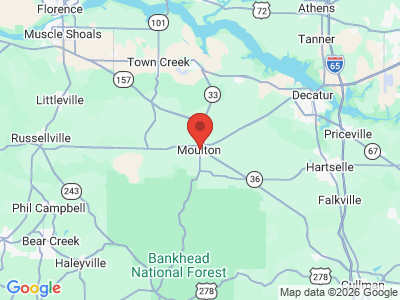
Lawrence County encompasses nearly 700 square miles. The northern three-quarters of the county is located within the Highland Rim physiographic section, whereas the southern one-quarter of the county is located within the Cumberland Plateau physiographic section. A portion of the Plateau Coal Region of the Warrior Coal Field sits in the southern part of the county. Lawrence County is bordered by Lauderdale and Limestone Counties and the Tennessee River to the north, Morgan County to the east, Winston County to the south, Franklin County on the west, and Colbert County and Town Creek to the northwest.
Lawrence County Map
Lawrence County encompasses nearly 700 square miles. The northern three-quarters of the county is located within the Highland Rim physiographic section, whereas the southern one-quarter of the county is located within the Cumberland Plateau physiographic section. A portion of the Plateau Coal Region of the Warrior Coal Field sits in the southern part of the county. Lawrence County is bordered by Lauderdale and Limestone Counties and the Tennessee River to the north, Morgan County to the east, Winston County to the south, Franklin County on the west, and Colbert County and Town Creek to the northwest.
The county is dotted with oak and pine forests, and the landscape consists of limestone valleys and uplands as well as some level plains. The Tennessee River and Wheeler Lake run along the northern border of Lawrence County, and the river's tributaries fan out throughout the county. The Tennessee River is considered to be among the most biologically diverse rivers in the entire United States, with many fish and mussel species at risk. The river offers a range of economic and recreational opportunities for Lawrence County. Several minor tributaries of the Black Warrior River dip into the southern part of the county.
U.S. Highway 72 is Lawrence County's main transportation route and connects the county to the economic hub of Huntsville. U.S. Highway 72 runs east-west through the northern part of the county. The Lawrence County Airport in Courtland is the county's only public airport.
Events and Places of Interest
 Bankhead National Forest
There are a number of recreational opportunities available in Lawrence County. The southern portion of the county includes part of the William B. Bankhead National Forest, which has 180,000 acres of bluffs, canyons, waterfalls, and lakes. Four recreational areas within the forest afford visitors the opportunity to hike, camp, swim, and horseback ride. A 2,500-acre portion of the Joe Wheeler State Park sits on the northern border of the county. Visitors to the park can take part in a number of activities including camping, tennis, boating, swimming, picnicking, and hiking. Other outdoor recreational areas in Lawrence County include the Doublehead Resort and Lodge, the Mallard Creek Recreational Area, and city parks located in Moulton, Courtland, and Town Creek.
Bankhead National Forest
There are a number of recreational opportunities available in Lawrence County. The southern portion of the county includes part of the William B. Bankhead National Forest, which has 180,000 acres of bluffs, canyons, waterfalls, and lakes. Four recreational areas within the forest afford visitors the opportunity to hike, camp, swim, and horseback ride. A 2,500-acre portion of the Joe Wheeler State Park sits on the northern border of the county. Visitors to the park can take part in a number of activities including camping, tennis, boating, swimming, picnicking, and hiking. Other outdoor recreational areas in Lawrence County include the Doublehead Resort and Lodge, the Mallard Creek Recreational Area, and city parks located in Moulton, Courtland, and Town Creek.
The Jesse Owens Memorial Park and Museum in Oakville is a popular attraction. An eight-foot, one-ton bronze statue of Owens sits at the center of the park, which includes a visitors center, a museum, an Olympic-sized track, a walking trail, and replicas of the 1936 Olympic torch and Owens' boyhood home. Each year on the third Saturday in May, Moulton hosts the Jesse Owens Memorial Run, which attracts 2,000 runners for 10K, one-mile, and two-mile runs.
 Wheeler House
The Oakville Indian Mounds are another popular attraction in the county. The complex features a 2,000-year-old Woodland period mound, a Copena period burial mound, and a museum modeled after a traditional seven-sided Cherokee Council House. The museum contains a 12-foot wooden statue of Sequoyah as well as thousands of artifacts. In Hillsboro, visitors can tour Pond Spring, the plantation and home of Confederate general Joe Wheeler. The property is run by the Alabama Historical Commission, and the home contains original furniture, china, uniforms, military medals, portraits, Civil War memorabilia, and other family items. An old log house and the family cemetery reside on the surrounding grounds.
Wheeler House
The Oakville Indian Mounds are another popular attraction in the county. The complex features a 2,000-year-old Woodland period mound, a Copena period burial mound, and a museum modeled after a traditional seven-sided Cherokee Council House. The museum contains a 12-foot wooden statue of Sequoyah as well as thousands of artifacts. In Hillsboro, visitors can tour Pond Spring, the plantation and home of Confederate general Joe Wheeler. The property is run by the Alabama Historical Commission, and the home contains original furniture, china, uniforms, military medals, portraits, Civil War memorabilia, and other family items. An old log house and the family cemetery reside on the surrounding grounds.
Not far from the Wheeler home, visitors can tour the historic town of Courtland, which was named to the National Register of Historic Places. The town's structures offer visitors a range of architectural styles that span nearly two centuries. Visitors can take part in a self-guided driving tour of the district, or they can join a guided walking tour every Saturday between Memorial Day and the Fourth of July.
Additional Resources
- The Heritage of Lawrence County, Alabama. Clanton, Ala.: Heritage Publishing Consultants, 1998.
- Mullican, Anna Lynn. Images of America Series: Lawrence County. Charleston, S.C.: Arcadia Publishing, 2022.