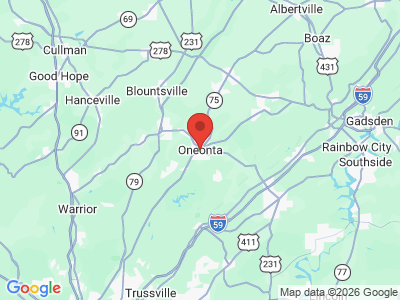
Blount County
 Swann Covered Bridge
Located in northeastern Alabama, within the Birmingham metro area, Blount County is known for its natural beauty and abundance of outdoor attractions, including rock climbing and kayaking on the rapids on tributaries of the Black Warrior River. Blount County's proximity to Birmingham makes it one of the fastest-growing counties in Alabama.
Swann Covered Bridge
Located in northeastern Alabama, within the Birmingham metro area, Blount County is known for its natural beauty and abundance of outdoor attractions, including rock climbing and kayaking on the rapids on tributaries of the Black Warrior River. Blount County's proximity to Birmingham makes it one of the fastest-growing counties in Alabama.
- Founding Date: February 6, 1818
- Area: 643 square miles
- Population: 59,134 (2020 Census estimate)
- Major Waterways: Locust Fork and Mulberry Fork of the Black Warrior River
- Major Highways: I-65, U.S.31, U.S. 231, U.S. 278
- County Seat: Oneonta
- Largest City: Oneonta
History
 Willie Blount
Blount County was created by an act of the Territorial Legislature on February 6, 1818, almost two years before Alabama became a state. Sections of Blount County later became part of Jefferson, Marshall, Walker, and Cullman Counties. The county was named for Gov. Willie Blount of Tennessee, who sent Andrew Jackson with troops to Alabama during the Creek War of 1813-14. Many of Jackson's men became the first settlers of the county and established a trading post at present-day Blountsville. One of the earliest settlers of the area was George Powell, who became one of the first surveyors of Alabama and later authored the first historical account of Blount County.
Willie Blount
Blount County was created by an act of the Territorial Legislature on February 6, 1818, almost two years before Alabama became a state. Sections of Blount County later became part of Jefferson, Marshall, Walker, and Cullman Counties. The county was named for Gov. Willie Blount of Tennessee, who sent Andrew Jackson with troops to Alabama during the Creek War of 1813-14. Many of Jackson's men became the first settlers of the county and established a trading post at present-day Blountsville. One of the earliest settlers of the area was George Powell, who became one of the first surveyors of Alabama and later authored the first historical account of Blount County.
During the first half of the nineteenth century, Blount Springs became a well-known vacation resort for wealthy southerners attracted by the area's mineral springs. The county gained notoriety during the Civil War when in May 1863 Confederate general Nathan Bedford Forrest attacked Union colonel Abel Streight's forces as they attempted to cross the Locust Fork. During the raid, two local sisters, Celia and Winnie Mae Murphree, allegedly captured three Union soldiers at gunpoint while they slept and delivered them to Forrest. During the 1880s, Blount County became a major iron-producing area that helped fuel the steel industry in neighboring Birmingham. In 1937, J. Breck Musgrove made history when he opened Alabama's only underground "speakeasy" nightclub and casino at Bangor Cave in Blount County. Occupying the front of the cave, the illegal club attracted dancers, gamblers, and criminals before Gov. Bibb Graves ordered it closed.
Major Cities and Demographics
 Chamblee Cabin
According to 2020 Census estimates, Blount County recorded a population of 59,134. Approximately 94.0 percent of respondents identified themselves as white, 9.3 percent as Hispanic, 2.2 percent as two or more races, 1.4 percent as African American, 0.4 percent as Asian, 0.1 percent as Hawaiian or Pacific Islander, and 0.1 percent as Native American. The county seat, Oneonta, had a population of 6,550. Other significant population centers include Blountsville, Rosa, Snead, Susan Moore, Warrior, Hayden, County Line, Nectar, and Garden City. The median household income in Blount County was $48,922, as compared with $52,035 for the state as a whole and the per capita income was $25,457, as compared with $28,934 for the state as a whole.
Chamblee Cabin
According to 2020 Census estimates, Blount County recorded a population of 59,134. Approximately 94.0 percent of respondents identified themselves as white, 9.3 percent as Hispanic, 2.2 percent as two or more races, 1.4 percent as African American, 0.4 percent as Asian, 0.1 percent as Hawaiian or Pacific Islander, and 0.1 percent as Native American. The county seat, Oneonta, had a population of 6,550. Other significant population centers include Blountsville, Rosa, Snead, Susan Moore, Warrior, Hayden, County Line, Nectar, and Garden City. The median household income in Blount County was $48,922, as compared with $52,035 for the state as a whole and the per capita income was $25,457, as compared with $28,934 for the state as a whole.
Economy
 Warrior Coal Field Train
During the nineteenth century, farming was the prevailing occupation in Blount County, with cotton, corn, and wheat being the major crops. After the Civil War, iron ore mined in Blount County helped feed the industrialization boom in Birmingham. In 1889, Henry F. DeBardeleben and James Sloss purchased Champion Mines and brought the Louisville and Nashville Railroad to the area. From 1925 to 1967, the mine supplied raw materials to the Woodward, TCI, and Sloss furnaces in Birmingham and the Republic Furnace in Gadsden. The decline of the steel industry in Birmingham during the 1970s affected Blount County as well, and thousands of residents lost jobs.
Warrior Coal Field Train
During the nineteenth century, farming was the prevailing occupation in Blount County, with cotton, corn, and wheat being the major crops. After the Civil War, iron ore mined in Blount County helped feed the industrialization boom in Birmingham. In 1889, Henry F. DeBardeleben and James Sloss purchased Champion Mines and brought the Louisville and Nashville Railroad to the area. From 1925 to 1967, the mine supplied raw materials to the Woodward, TCI, and Sloss furnaces in Birmingham and the Republic Furnace in Gadsden. The decline of the steel industry in Birmingham during the 1970s affected Blount County as well, and thousands of residents lost jobs.
Employment
According to 2020 Census estimates, the workforce in present-day Blount County is divided among the following industrial categories:
- Educational services, and health care and social assistance (19.7 percent)
- Manufacturing (17.4 percent)
- Retail trade (10.4 percent)
- Construction (9.2 percent)
- Transportation and warehousing, and utilities (7.6 percent)
- Professional, scientific, management, administrative, and waste management services (7.5 percent)
- Other services, except public administration (5.3 percent)
- Arts, entertainment, and recreation, and accommodation and food services (4.9 percent)
- Finance and insurance, and real estate, rental, and leasing (4.8 percent)
- Wholesale trade (4.2 percent)
- Public administration (3.8 percent)
- Agriculture, forestry, fishing and hunting, and extractive (1.7 percent)
- Information (1.0 percent)
Education
The Blount County School System oversees 16 schools. In addition, the Oneonta City School System oversees two schools. Wallace State Community College maintains a campus in Blountsville.
Geography
 Blount County Map
Comprising approximately 643 square miles, Blount County lies in the northeastern area of the state within the Cumberland Plateau physiographic section. It is bounded to the north by Marshall County, to the east by Etowah County, to the southeast by St. Clair County, to the southwest by Jefferson and Walker Counties, and to the west by Cullman County. The Locust Fork and Mulberry Fork, two major tributaries of the Black Warrior River, run along the western border and the center of the county. Ebell Mountain and part of Sand Mountain lie in the northeastern area of the county. Interstate 65 is Blount County's major transportation route, running north-south in the western edge of the county. U.S. 31 and 231 are the county's other major transportation arteries. Robbins Field is a general-aviation airport located in Oneonta.
Blount County Map
Comprising approximately 643 square miles, Blount County lies in the northeastern area of the state within the Cumberland Plateau physiographic section. It is bounded to the north by Marshall County, to the east by Etowah County, to the southeast by St. Clair County, to the southwest by Jefferson and Walker Counties, and to the west by Cullman County. The Locust Fork and Mulberry Fork, two major tributaries of the Black Warrior River, run along the western border and the center of the county. Ebell Mountain and part of Sand Mountain lie in the northeastern area of the county. Interstate 65 is Blount County's major transportation route, running north-south in the western edge of the county. U.S. 31 and 231 are the county's other major transportation arteries. Robbins Field is a general-aviation airport located in Oneonta.
Events and Places of Interest
 Rickwood Caverns
Blount County is home to several caves, including Bangor Cave and Rickwood Caverns. Estimated to be more than 260 million years old, Rickwood Caverns was carved from an ocean bed, and many marine fossil are visible in the cavern ceiling and walls. The mile-long cavern is home to underground pools and rare creatures such as blind cave fish.
Rickwood Caverns
Blount County is home to several caves, including Bangor Cave and Rickwood Caverns. Estimated to be more than 260 million years old, Rickwood Caverns was carved from an ocean bed, and many marine fossil are visible in the cavern ceiling and walls. The mile-long cavern is home to underground pools and rare creatures such as blind cave fish.
Palisades Park, atop 1,300-foot Ebell Mountain, features an arboretum, amphitheater, and historic village; it includes Murphree's Pioneer home, built in 1820 by settler Daniel Murphree and one of the oldest structures in the county. The park also features rock bluffs ideal for rock climbing and scenic views. The park is home to the Locust and Mulberry Forks of the Black Warrior River, renowned for their Class II and III rapids that attract kayakers and canoers from all over the country. Each spring, Alabama paddlers host the Alabama Cup, which is made up of three events, the Mulberry Fork Canoe and Kayak Races, the Locust Fork Invitational, and the Locust Fork Classic.
 Blount County Memorial Museum
The Blount County Memorial Museum in Oneonta is dedicated to the history of county residents who have served in the military. Blount County is home to several covered bridges, including the Swann Covered Bridge, the Horton Mill Covered Bridge, and the Easley Covered Bridge, all constructed during the 1920s. Every October, the city of Oneonta hosts a Covered Bridge Festival, which features bridge tours, arts and crafts, and food. The town of Blountsville is home to Blountsville Historical Park, which contains the Freeman Cabin Museum, the Brooksville Post Office, and an original one-room jail; the park hosts a re-enactment of Streight's Raid each May.
Blount County Memorial Museum
The Blount County Memorial Museum in Oneonta is dedicated to the history of county residents who have served in the military. Blount County is home to several covered bridges, including the Swann Covered Bridge, the Horton Mill Covered Bridge, and the Easley Covered Bridge, all constructed during the 1920s. Every October, the city of Oneonta hosts a Covered Bridge Festival, which features bridge tours, arts and crafts, and food. The town of Blountsville is home to Blountsville Historical Park, which contains the Freeman Cabin Museum, the Brooksville Post Office, and an original one-room jail; the park hosts a re-enactment of Streight's Raid each May.
The Limestone Springs Golf Club features a championship 18-hole course created by renowned course designer Jerry Pate, and Heritage Golf Course and Country Club offers bent-grass greens on an 18-hole course. Both facilities are located in Oneonta.
Additional Resources
- Heritage of Blount County. Clanton, Ala.: Heritage Pub. Consultants, Inc., 1999.
- Junior Blount County Historical Society. Blount County, Glimpses from the Past. Blount, County: The Society, 1965.
External Links
- Blount County
- Blount County Schools
- Town of Blountsville
- Town of County Line
- Town of Hayden
- Town of Nectar
- City of Oneonta
- Town of Susan Moore
- City of Warrior
- Blountsville Public Library
- Blount-Onteonta Chamber of Commerce
- National Register of Historic Places: Blount County
- Rickwood Caverns State Park
- Blount County Memorial Museum