Pickens County
 Tom Bevill Visitor Center and Museum
Located in the west-central part of the state, Pickens County is a rural county of timbered uplands to the north and rolling plains to the south. During World War II, the Pickens County city of Aliceville served as the site of one of the largest German prisoner of war camps in the nation. Many of Field Marshall Erwin Rommel's elite Afrika Korps, of the German army, were held in Aliceville after their defeat at Tunis. The visitor center in Pickensville is home to one of the few steamboats, the U.S. Snagboat Montgomery, on the National Register of Historic Places. The county is governed by an elected five-member commission and includes the incorporated cities of Aliceville and Reform.
Tom Bevill Visitor Center and Museum
Located in the west-central part of the state, Pickens County is a rural county of timbered uplands to the north and rolling plains to the south. During World War II, the Pickens County city of Aliceville served as the site of one of the largest German prisoner of war camps in the nation. Many of Field Marshall Erwin Rommel's elite Afrika Korps, of the German army, were held in Aliceville after their defeat at Tunis. The visitor center in Pickensville is home to one of the few steamboats, the U.S. Snagboat Montgomery, on the National Register of Historic Places. The county is governed by an elected five-member commission and includes the incorporated cities of Aliceville and Reform.
- Founding Date: December 20, 1820
- Area: 890 square miles
- Population: 19,123 (2020 Census estimate)
- Major Waterways: Tombigbee River
- Major Highways: U.S. 82
- County Seat: Carrollton
- Largest City: Aliceville
History
 Pickens County Courthouse
Pickens County was created by an act of the Alabama legislature on December 20, 1820. The county was created from part of Tuscaloosa County, which itself was formed in 1818 from territory acquired through land cessions negotiated with the Cherokees and Choctaws in the late 1810s. Pickens County's boundaries changed several times between 1820 and 1866, when its boundaries were finalized. The county was named in honor of Gen. Andrew Pickens of South Carolina, a Revolutionary War hero. The county's earliest settlers came from the Carolinas, Tennessee, and Georgia. Most travelled south through Huntsville, in Madison County, or west through Augusta, Georgia. The earliest settlements were located on Tilly's Bluff near present-day Pickensville. Other early towns included Carrollton, Bridgeville, and Yorkville (now known as Ethelsville).
Pickens County Courthouse
Pickens County was created by an act of the Alabama legislature on December 20, 1820. The county was created from part of Tuscaloosa County, which itself was formed in 1818 from territory acquired through land cessions negotiated with the Cherokees and Choctaws in the late 1810s. Pickens County's boundaries changed several times between 1820 and 1866, when its boundaries were finalized. The county was named in honor of Gen. Andrew Pickens of South Carolina, a Revolutionary War hero. The county's earliest settlers came from the Carolinas, Tennessee, and Georgia. Most travelled south through Huntsville, in Madison County, or west through Augusta, Georgia. The earliest settlements were located on Tilly's Bluff near present-day Pickensville. Other early towns included Carrollton, Bridgeville, and Yorkville (now known as Ethelsville).
 Camp Aliceville
Pickensville served as the first county seat until 1830, when the county government was moved to Carrollton. The first courthouse in Carrollton was burned by troops under Union general John T. Croxton on April 5, 1865. The second courthouse was also destroyed by fire on November 16, 1876. Arson was suspected, and in January 1878 Henry Wells, a freed slave who lived near Carrollton, was arrested on circumstantial evidence and locked in the garret of the new courthouse, erected in 1877. According to legend, Wells was peering down from the north garret window awaiting trial as a mob gathered to hang him. A bolt of lightning struck nearby and copied Wells' anguished face into the window glass. A vague image resembling a face may still be seen in the lower right-hand pane of that window. The 1877 courthouse was the third courthouse and was vacated in 1994 when the present-day modern courthouse was constructed.
Camp Aliceville
Pickensville served as the first county seat until 1830, when the county government was moved to Carrollton. The first courthouse in Carrollton was burned by troops under Union general John T. Croxton on April 5, 1865. The second courthouse was also destroyed by fire on November 16, 1876. Arson was suspected, and in January 1878 Henry Wells, a freed slave who lived near Carrollton, was arrested on circumstantial evidence and locked in the garret of the new courthouse, erected in 1877. According to legend, Wells was peering down from the north garret window awaiting trial as a mob gathered to hang him. A bolt of lightning struck nearby and copied Wells' anguished face into the window glass. A vague image resembling a face may still be seen in the lower right-hand pane of that window. The 1877 courthouse was the third courthouse and was vacated in 1994 when the present-day modern courthouse was constructed.
Major Cities and Demographics
 Carrollton Post Office Mural
According to 2020 Census estimates, the population of Pickens County was 19,123. Of that total, 57.7 percent of respondents identified themselves as white, 40.1 percent as African American, 5.5 percent as Hispanic, 1.2 percent as two or more races, 0.4 percent as Asian, 0.4 percent as Hawaiian or Pacific Islander, and 0.3 as Native American. The largest city is Aliceville, with an estimated population of 2,199. The county seat Carrollton had a population of 1,158. Other significant population centers included Reform, Gordo, Memphis, Carrollton, McMullen, and Pickensville. The median household income was $40,362, compared with $52,035 for the state as a whole, and per capita income was $23,476, compared with $28,934 for the state as a whole.
Carrollton Post Office Mural
According to 2020 Census estimates, the population of Pickens County was 19,123. Of that total, 57.7 percent of respondents identified themselves as white, 40.1 percent as African American, 5.5 percent as Hispanic, 1.2 percent as two or more races, 0.4 percent as Asian, 0.4 percent as Hawaiian or Pacific Islander, and 0.3 as Native American. The largest city is Aliceville, with an estimated population of 2,199. The county seat Carrollton had a population of 1,158. Other significant population centers included Reform, Gordo, Memphis, Carrollton, McMullen, and Pickensville. The median household income was $40,362, compared with $52,035 for the state as a whole, and per capita income was $23,476, compared with $28,934 for the state as a whole.
Economy
Farming was the prevailing occupation in Pickens County until the early twentieth century, and cotton, corn, and soybeans were the major crops. Today, poultry and swine are important agricultural activities. Forestry became an important industry for the county in the late nineteenth century and remains so today. Lumber mills continue to provide steady employment opportunities for the county. Because Pickens County is part of the Warrior Coal Basin, mining provided some economic opportunities for the county, although not as much as other counties.
Employment
According to 2020 Census estimates, the workforce in Pickens County was divided among the following industrial categories:
- Educational services, and health care and social assistance (23.9 percent)
- Manufacturing (19.7 percent)
- Retail trade (11.8 percent)
- Construction (9.3 percent)
- Transportation and warehousing, and utilities (9.0 percent)
- Public administration (6.2 percent)
- Professional, scientific, management, and administrative and waste management services (5.0 percent)
- Other services, except public administration (4.0 percent)
- Arts, entertainment, and recreation, and accommodation and food services (3.3 percent)
- Finance and insurance, real estate, rental, and leasing (2.4 percent)
- Agriculture, forestry, fishing and hunting, and extractive (2.1 percent)
- Information (1.6 percent)
- Wholesale trade (1.5 percent)
Education
The Pickens County School System oversees 10 primary and secondary schools. Bevill State Community College maintains a campus in Carrollton. The Pickens County Extension Office, also in Carrollton, is part of the Alabama Cooperative Extension System and offers educational programs in agriculture, forestry, consumer science, and community resource development.
Geography
 Pickens County Map
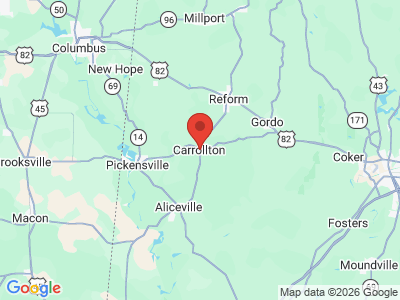
Comprising approximately 890 square miles, Pickens County lies in the west-central part of the state. It is part of the East Gulf Coastal Plain physiographic section of the Atlantic Plain region, and its rolling terrain consists mostly of sandy soils. The timbered uplands feature pine and oak. The county is bordered by Lamar County to the north, Tuscaloosa County to the east, Greene and Sumter Counties to the south, and the state of Mississippi to the west.
Pickens County Map
Comprising approximately 890 square miles, Pickens County lies in the west-central part of the state. It is part of the East Gulf Coastal Plain physiographic section of the Atlantic Plain region, and its rolling terrain consists mostly of sandy soils. The timbered uplands feature pine and oak. The county is bordered by Lamar County to the north, Tuscaloosa County to the east, Greene and Sumter Counties to the south, and the state of Mississippi to the west.
The Tombigbee River and its many tributaries run throughout the county. The lower portion of the Sipsey River forms the boundary line between Pickens and Greene Counties. The Sipsey River Swamp is one of the last wild free-flowing swamp streams in Alabama with at least 50,000 acres of wetlands, making it one of the largest such areas within Alabama.
U.S. Highway 82 is Pickens County's main transportation route, running east-west just north of the center of the county. The George Downer Airport in Aliceville and the North Pickens Airport in Reform are the county's two public airports.
Events and Places of Interest
 U.S. Snagboat Montgomery
Pickens County offers many opportunities for recreational activities. Aliceville Lake (sometimes called Pickensville Lake) is an 8,300-acre reservoir located approximately 12 miles northwest of Aliceville. The lake was formed by the Tom Bevill Lock and Dam (named for 15-term U.S. representative Tom Bevill), located one mile southwest of Pickensville. The lake and surrounding area offer abundant recreational opportunities such as camping, picnicking, boating, fishing, and other water sports.
U.S. Snagboat Montgomery
Pickens County offers many opportunities for recreational activities. Aliceville Lake (sometimes called Pickensville Lake) is an 8,300-acre reservoir located approximately 12 miles northwest of Aliceville. The lake was formed by the Tom Bevill Lock and Dam (named for 15-term U.S. representative Tom Bevill), located one mile southwest of Pickensville. The lake and surrounding area offer abundant recreational opportunities such as camping, picnicking, boating, fishing, and other water sports.
The Tom Bevill Visitor Center, constructed in 1984 near Pickensville, serves as the main visitor center for the Tennessee-Tombigbee Waterway. An authentic reproduction of a mid-nineteenth century plantation mansion, it contains displays related to the history and development of the Tombigbee River and Waterway. Docked beside the center is the U.S. Snagboat Montgomery, one of the last steam-powered stern-wheelers to ply the waters of the South. The boat was used to keep Alabama's rivers free of debris such as sunken logs, called snags, and is listed on the National Register of Historic Places and contains exhibits about the boat's operation and history.
The Aliceville Museum and Cultural Center opened in 1995 to preserve artifacts from Camp Aliceville, one of the largest German POW camps in the United States that housed more than 6,000 prisoners. Letters, uniforms, art, photos, and books relating to World War II are on display, and other exhibits include the Aliceville Coca-Cola Bottling Company as well as Pickens County military and agricultural history displays.
 Willie King
Pickens County also hosts several annual festivals and special events. Each May, Aliceville hosts the Willie King Freedom Creek Festival. Named for blues legend Willie King, who died in 2009, the festival has featured national and local blues acts and attracted international attention with its authentic blues music. Aliceville also hosts the Dogwood Festival each year in April, featuring a rodeo, softball tournament, helicopter rides, charity run/walks, food, and games. The town of Gordo in east Pickens County holds Mule Day/Chickenfest every June, including a parade featuring mule- and horse-drawn carts, arts and crafts booths, and live entertainment.
Willie King
Pickens County also hosts several annual festivals and special events. Each May, Aliceville hosts the Willie King Freedom Creek Festival. Named for blues legend Willie King, who died in 2009, the festival has featured national and local blues acts and attracted international attention with its authentic blues music. Aliceville also hosts the Dogwood Festival each year in April, featuring a rodeo, softball tournament, helicopter rides, charity run/walks, food, and games. The town of Gordo in east Pickens County holds Mule Day/Chickenfest every June, including a parade featuring mule- and horse-drawn carts, arts and crafts booths, and live entertainment.
Additional Resources
- Clanahan, James F. The History of Pickens County, Alabama, 1540-1920. Carrollton, Ala.: Clanahan Publication, 1964.
- The Heritage of Pickens County, Alabama. Clanton, Ala.: Heritage Publishing Consultants, 1999.