Monroe County
 Old Monroe County Courthouse
Located in the southwest part of the state, Monroe County is known as the literary capital of Alabama. Pulitzer Prize–winning author Nelle Harper Lee was born and raised in the town of Monroeville, which served as the inspiration for her novel, To Kill a Mockingbird. The county was also the home of fellow Pulitzer Prize-winning journalist Cynthia Tucker. Other famous writers who called Monroeville home include Mark Childress and Truman Capote. Coastal Alabama Community College's Monroeville branch (formerly Alabama Southern Community College) is the home of the Alabama Writers' Hall of Fame, and in May, in conjunction with a month-long production of To Kill a Mockingbird, the school conducts a major writer's festival celebrating the state's literary tradition. The now-abandoned site of Claiborne was home to three Alabama governors: John Gayle, John Murphy, and Arthur P. Bagby. The county is governed by an elected five-member commission and includes several incorporated communities.
Old Monroe County Courthouse
Located in the southwest part of the state, Monroe County is known as the literary capital of Alabama. Pulitzer Prize–winning author Nelle Harper Lee was born and raised in the town of Monroeville, which served as the inspiration for her novel, To Kill a Mockingbird. The county was also the home of fellow Pulitzer Prize-winning journalist Cynthia Tucker. Other famous writers who called Monroeville home include Mark Childress and Truman Capote. Coastal Alabama Community College's Monroeville branch (formerly Alabama Southern Community College) is the home of the Alabama Writers' Hall of Fame, and in May, in conjunction with a month-long production of To Kill a Mockingbird, the school conducts a major writer's festival celebrating the state's literary tradition. The now-abandoned site of Claiborne was home to three Alabama governors: John Gayle, John Murphy, and Arthur P. Bagby. The county is governed by an elected five-member commission and includes several incorporated communities.
- Founding Date: June 29, 1815
- Area: 1,025 square miles
- Population: 19,722 (2020 Census estimate)
- Major Waterways: Alabama River
- Major Highways: U.S. 84
- County Seat: Monroeville
- Largest City: Monroeville
History
Monroe County was established by David Holmes, governor of Mississippi Territory, on June 29, 1815, from land acquired from the Creek Indians in the 1814 Treaty of Fort Jackson. Originally encompassing all the land ceded by the Creeks, the county amounted to a large portion of Alabama. It later was reduced in size, however, by the creation of Montgomery, Conecuh, and Wilcox Counties. The county was named in honor of U.S. Pres. James Monroe, who was then secretary of state under Pres. James Madison. The first settlers were largely of English descent and came from Georgia, the Carolinas, and Virginia. Some of the earliest settlements and towns were Claiborne, Monroeville, Manistee, and Perdue Hill.
 First Monroe County Courthouse
Claiborne served as the first county seat of Monroe County. In 1832, the seat was moved to the more centrally located Monroeville. A year later, the first county courthouse burned and all records were lost. A new brick courthouse and jail were constructed in the 1850s. In 1903, the Monroe County government built a new courthouse, and the old building became the county's first bank. The 1903 courthouse, now known as the Old Courthouse, is part of the Monroe County Heritage Museum. The present-day courthouse, known as the New Courthouse, was built in 1963 and continues to serve Monroe County.
First Monroe County Courthouse
Claiborne served as the first county seat of Monroe County. In 1832, the seat was moved to the more centrally located Monroeville. A year later, the first county courthouse burned and all records were lost. A new brick courthouse and jail were constructed in the 1850s. In 1903, the Monroe County government built a new courthouse, and the old building became the county's first bank. The 1903 courthouse, now known as the Old Courthouse, is part of the Monroe County Heritage Museum. The present-day courthouse, known as the New Courthouse, was built in 1963 and continues to serve Monroe County.
Major Cities and Demographics
 Monroe County Courthouse
According 2020 Census estimates, the population of Monroe County was 19,722. Of that total, 54.4 percent of respondents identified themselves as white, 42.5 percent as African American, 1.0 percent as two or more races, 1.4 percent as Native American, 0.6 percent as Asian, 0.4 percent as Hispanic, and 0.1 percent as Hawaiian or Pacific Islander. The county seat Monroeville is the largest city in the county, with an estimated population of 5,837. Other significant population centers include Frisco City, Excel, Beatrice, and Vredenburgh. The median household income was $31,969, compared with $52,035 for the state as a whole, and the per capita income was $21,885, compared with $28,934 for the state as a whole.
Monroe County Courthouse
According 2020 Census estimates, the population of Monroe County was 19,722. Of that total, 54.4 percent of respondents identified themselves as white, 42.5 percent as African American, 1.0 percent as two or more races, 1.4 percent as Native American, 0.6 percent as Asian, 0.4 percent as Hispanic, and 0.1 percent as Hawaiian or Pacific Islander. The county seat Monroeville is the largest city in the county, with an estimated population of 5,837. Other significant population centers include Frisco City, Excel, Beatrice, and Vredenburgh. The median household income was $31,969, compared with $52,035 for the state as a whole, and the per capita income was $21,885, compared with $28,934 for the state as a whole.
Economy
 To Kill a Mockingbird Outdoor Stage Set
Farming was the prevailing occupation in Monroe County until well into the twentieth century. The two major crops were cotton and corn. With easy access to more than 20 river landings, the county soon became home to the largest cotton market in the state. Although farmers attempted to diversify in the early twentieth century, no other major crops proved as successful. The county's many acres of forest along the Alabama River brought the timber industry to the area, and paper mills dotted the county by the middle to late nineteenth century. In 1937, Vanity Fair opened the first apparel plant in Monroeville, and the county slowly began to shift from an agriculture-based economy to an industry-based economy. During the 1970s, the county saw its greatest industrial expansion with the opening of the Georgia-Pacific Plywood Mill, Temple-Inland Particle Board Mill, and the Alabama River Pulp-Paper Mill. Today, tourism centering on Harper Lee and To Kill a Mockingbird is a significant economic driver for the county.
To Kill a Mockingbird Outdoor Stage Set
Farming was the prevailing occupation in Monroe County until well into the twentieth century. The two major crops were cotton and corn. With easy access to more than 20 river landings, the county soon became home to the largest cotton market in the state. Although farmers attempted to diversify in the early twentieth century, no other major crops proved as successful. The county's many acres of forest along the Alabama River brought the timber industry to the area, and paper mills dotted the county by the middle to late nineteenth century. In 1937, Vanity Fair opened the first apparel plant in Monroeville, and the county slowly began to shift from an agriculture-based economy to an industry-based economy. During the 1970s, the county saw its greatest industrial expansion with the opening of the Georgia-Pacific Plywood Mill, Temple-Inland Particle Board Mill, and the Alabama River Pulp-Paper Mill. Today, tourism centering on Harper Lee and To Kill a Mockingbird is a significant economic driver for the county.
Employment
According to 2020 Census estimates, the workforce in Monroe County was divided among the following industrial categories:
- Manufacturing (25.9 percent)
- Educational services, and health care and social assistance (23.9 percent)
- Retail trade (12.9 percent)
- Construction (6.9 percent)
- Public administration (5.1 percent)
- Arts, entertainment, recreation, and accommodation and food services (4.9 percent)
- Transportation and warehousing, and utilities (4.5 percent)
- Professional, scientific, management, and administrative and waste management services (4.2 percent)
- Agriculture, forestry, fishing and hunting, and extractive (3.2 percent)
- Finance and insurance, and real estate, rental, and leasing (3.1 percent)
- Other services, except public administration (3.0 percent)
- Wholesale trade (1.3 percent)
- Information (1.0 percent)
Education
The Monroe County school system oversees 12 primary and secondary schools, and Monroeville also has Monroe Academy, a private K–12 school. A branch of Coastal Alabama Community College is located in Monroeville and offers academic and technical education programs.
Geography
 Monroe County Map
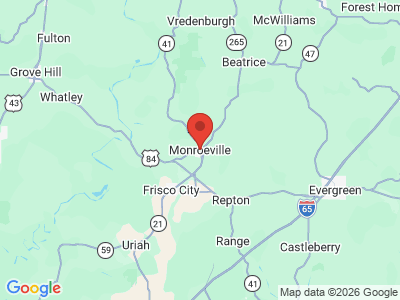
Located in the southwest part of the state, Monroe County lies within the Coastal Plain physiographic section of the Atlantic Plain region. The county is comprised of approximately 1,025 square miles, making it the ninth-largest county in the state. It is bordered to the north by Wilcox County, to the east by Butler and Conecuh Counties, to the south by Escambia and Baldwin Counties, and to the west by Clarke County. The Gosport Sandstone, a layer of rocks underlying Claiborne in Monroe County, is known for the great number and variety of its fossils, representing more than 150 species.
Monroe County Map
Located in the southwest part of the state, Monroe County lies within the Coastal Plain physiographic section of the Atlantic Plain region. The county is comprised of approximately 1,025 square miles, making it the ninth-largest county in the state. It is bordered to the north by Wilcox County, to the east by Butler and Conecuh Counties, to the south by Escambia and Baldwin Counties, and to the west by Clarke County. The Gosport Sandstone, a layer of rocks underlying Claiborne in Monroe County, is known for the great number and variety of its fossils, representing more than 150 species.
The Alabama River runs along the western border of the county and is home to 144 species of fish. Tributaries of the lower Alabama River fan out across the county, offering a range of recreational opportunities and scenic views. Monroeville is the only major city in the lower basin.
U.S. Highway 84 is Monroe County's major transportation route. It runs east-west in a southerly direction across the middle of the county. The Monroe County Airport and the Monroeville Aviation and Avionics Center are the county's two airports.
Events and Places of Interest
 Little River State Forest
Monroe County offers many opportunities for recreational activities. Located in the southeast part of the county, the Claude Kelley Recreational Area in Little River State Forest covers 1,200 acres and includes a 25-acre lake. The park offers visitors a range of outdoor activities, including swimming, fishing, boating, picnicking, camping, and canoeing. It is popular with birders and is one of the few sites in the state that offers opportunities for disabled hunters. The Monroe County State Lake is a 94-acre lake located just west of Beatrice known for its bass, channel catfish, and bluegill fishing.
Little River State Forest
Monroe County offers many opportunities for recreational activities. Located in the southeast part of the county, the Claude Kelley Recreational Area in Little River State Forest covers 1,200 acres and includes a 25-acre lake. The park offers visitors a range of outdoor activities, including swimming, fishing, boating, picnicking, camping, and canoeing. It is popular with birders and is one of the few sites in the state that offers opportunities for disabled hunters. The Monroe County State Lake is a 94-acre lake located just west of Beatrice known for its bass, channel catfish, and bluegill fishing.
The Monroe County Heritage Museum encompasses several buildings in Monroeville. The 1903 Old Courthouse Museum offers permanent exhibitions on two famous Monroe County citizens: Truman Capote and Harper Lee. It is also the site of an annual three-week production of a stage version of To Kill a Mockingbird. Produced by the Monroe County Historical Museum with an all-volunteer cast, the play takes place in the historic Old Courthouse during the month of May. Rikard's Mill Historical Park includes a water-powered grist mill that has been in operation since 1845 and offers visitors re-enactments of folk traditions such as blacksmithing and cane-syrup making.
 Rikard's Mill Historical Park
The community of Claiborne is an abandoned town located on the Old Federal Road. It was the site of Fort Claiborne, a stockade established by Gen. Ferdinand Claiborne during the Creek War of 1813-14. The fort was a stop on the Marquis de Lafayette's tour of the United States in 1825 to celebrate the nation's 50th anniversary. Today, visitors can tour the James Dellet plantation, the William B. Travis House, and three historic cemeteries. Just south of Claiborne, visitors can tour one of the state's oldest buildings, the Perdue Hill Masonic Hall, built in 1823.
Rikard's Mill Historical Park
The community of Claiborne is an abandoned town located on the Old Federal Road. It was the site of Fort Claiborne, a stockade established by Gen. Ferdinand Claiborne during the Creek War of 1813-14. The fort was a stop on the Marquis de Lafayette's tour of the United States in 1825 to celebrate the nation's 50th anniversary. Today, visitors can tour the James Dellet plantation, the William B. Travis House, and three historic cemeteries. Just south of Claiborne, visitors can tour one of the state's oldest buildings, the Perdue Hill Masonic Hall, built in 1823.
Each May, the Alabama Writers' Symposium meets at Coastal Alabama Community College's Monroeville campus. Published and aspiring writers from Monroe County and the rest of the state come together to read and critique each other's writing. The old railroad town of Peterman hosts the annual Peterman Station Arts and Crafts Show in November.
Additional Resources
- Brantley, Mary E. Early Settlers along the Old Federal Road in Monroe and Conecuh Counties, Alabama. Baltimore: Gateway Press, 1976.
- The Heritage of Monroe County, Alabama. Clanton, Ala.: Heritage Publishing Consultants, 2004.