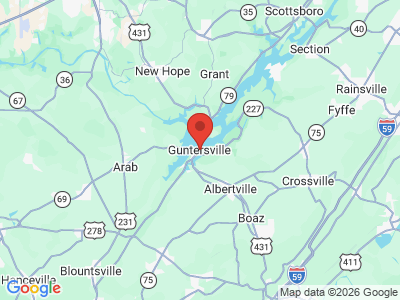
Marshall County
 Elvin Light Museum
Located in the northeast part of the state, Marshall County lies between the major metropolitan centers of Huntsville to the northwest and Birmingham to the southwest. Marshall County sits atop cave systems, and Cathedral Caverns State Park, in the northern part of the county, boasts the largest cave entrance in the world. The county is home to a mixture of suburban and rural communities and is one of the fastest-growing areas in the state. Marshall is governed by an elected five-member commission. Congressman Joe Starnes was born in Guntersville, and dramatist William Berney grew up in Albertville.
Elvin Light Museum
Located in the northeast part of the state, Marshall County lies between the major metropolitan centers of Huntsville to the northwest and Birmingham to the southwest. Marshall County sits atop cave systems, and Cathedral Caverns State Park, in the northern part of the county, boasts the largest cave entrance in the world. The county is home to a mixture of suburban and rural communities and is one of the fastest-growing areas in the state. Marshall is governed by an elected five-member commission. Congressman Joe Starnes was born in Guntersville, and dramatist William Berney grew up in Albertville.
- Founding Date: January 9, 1836
- Area: 567 square miles
- Population: 97,612 (2020 Census estimate)
- Major Waterways: Tennessee River, Black Warrior River
- Major Highways: U.S. 431, U.S. 231
- County Seat: Guntersville
- Largest City: Albertville
History
Present-day Marshall County was created by the Alabama legislature on January 9, 1836, from Cherokee land acquired in the 1835 Treaty of New Echota. The county was named in honor of John Marshall, chief justice of the U.S. Supreme Court from 1801 to 1835. Most early county settlers came from Tennessee, Virginia, and the Carolinas. The earliest towns in the area were Beard's Bluff, Guntersville, Warrenton, and Claysville.
 Marshall County Courthouse in Guntersville
For 12 years, the county debated the location for the county seat. Claysville served as the first county seat, but in 1838 the seat was moved to Marshall (now Wyeth City) and court was held in an old cotton-gin loft. This was soon deemed unsuitable, and the county seat was moved again to Warrenton in 1841, where a frame house served as the courthouse. Finally, in 1848, the county seat was moved to Guntersville, where it remains today. The original two-story brick courthouse served as the nucleus for all future courthouse remodelings and additions. In 1935, a second courthouse was built in Albertville for the convenience of Marshall County citizens living on Sand Mountain. Today, both courts remain in use.
Marshall County Courthouse in Guntersville
For 12 years, the county debated the location for the county seat. Claysville served as the first county seat, but in 1838 the seat was moved to Marshall (now Wyeth City) and court was held in an old cotton-gin loft. This was soon deemed unsuitable, and the county seat was moved again to Warrenton in 1841, where a frame house served as the courthouse. Finally, in 1848, the county seat was moved to Guntersville, where it remains today. The original two-story brick courthouse served as the nucleus for all future courthouse remodelings and additions. In 1935, a second courthouse was built in Albertville for the convenience of Marshall County citizens living on Sand Mountain. Today, both courts remain in use.
On April 27, 2011, a massive storm, causing numerous powerful tornadoes, struck the southeastern United States. More than 250 people were killed in Alabama, including five people in the Marshall County community of Ruth.
Major Cities and Demographics
 Kayakers at Short Creek Falls
According to 2020 Census estimates, the population of Marshall County was 97,612. Approximately 90.3 percent of respondents identified themselves as white, 14.1 percent as Hispanic, 2.9 percent as African American, 3.7 percent as two or more races, 1.2 percent as Native American, and 0.6 percent as Asian. The largest city in the county is Albertville, with an estimated population of 22,632. Other significant population centers include Boaz, Guntersville, Union Grove, and Arab. The median household income was $50,216, compared with $52,035 for the state as a whole, and the per capita income was $25,861, compared with $28,934 for the state as a whole.
Kayakers at Short Creek Falls
According to 2020 Census estimates, the population of Marshall County was 97,612. Approximately 90.3 percent of respondents identified themselves as white, 14.1 percent as Hispanic, 2.9 percent as African American, 3.7 percent as two or more races, 1.2 percent as Native American, and 0.6 percent as Asian. The largest city in the county is Albertville, with an estimated population of 22,632. Other significant population centers include Boaz, Guntersville, Union Grove, and Arab. The median household income was $50,216, compared with $52,035 for the state as a whole, and the per capita income was $25,861, compared with $28,934 for the state as a whole.
Economy
 Guntersville Dam
Until the middle of the twentieth century, farming was the prevailing occupation among Marshall County residents, and the staple crops were cotton and corn. During the 1930s, however, farming diversified into other food crops and livestock because of changes brought about by the arrival of the boll weevil and the hardships caused by the Great Depression. The mineral-rich soil of Marshall County brought mining interests to the area as well. With the completion of the Guntersville Dam by the Tennessee Valley Authority in 1939, the county moved from an agrarian economy to a more industrial economy. The dam made Guntersville the southernmost port of the Tennessee River navigation system, allowing the shipping industry to flourish. It also led to a number of recreational opportunities, including boating and fishing.
Guntersville Dam
Until the middle of the twentieth century, farming was the prevailing occupation among Marshall County residents, and the staple crops were cotton and corn. During the 1930s, however, farming diversified into other food crops and livestock because of changes brought about by the arrival of the boll weevil and the hardships caused by the Great Depression. The mineral-rich soil of Marshall County brought mining interests to the area as well. With the completion of the Guntersville Dam by the Tennessee Valley Authority in 1939, the county moved from an agrarian economy to a more industrial economy. The dam made Guntersville the southernmost port of the Tennessee River navigation system, allowing the shipping industry to flourish. It also led to a number of recreational opportunities, including boating and fishing.
Employment
According to 2020 Census estimates, the workforce in Marshall County was divided among the following industrial categories:
- Manufacturing (22.2 percent)
- Educational services, and health care and social assistance (19.0 percent)
- Retail trade (11.4 percent)
- Construction (8.5 percent)
- Professional, scientific, management, and administrative and waste management services (8.4 percent)
- Arts, entertainment, recreation, and accommodation and food services (5.8 percent)
- Transportation and warehousing, and utilities (5.3 percent)
- Other services, except public administration (5.0 percent)
- Finance and insurance, and real estate, rental, and leasing (3.9 percent)
- Public administration (3.7 percent)
- Wholesale trade (3.0 percent)
- Information (2.0 percent)
- Agriculture, forestry, fishing and hunting, and extractive (1.7 percent)
Education
Together, the Marshall County School System oversees 13 primary and secondary schools. Cities with their own public school systems include Albertville (five schools), Arab (four schools), Boaz (five schools), and Guntersville (four schools). Snead State Community College, a two-year institution located in Boaz, offers academic and technical education programs.
Geography
 Marshall County Map
Comprising approximately 567 square miles, Marshall County is one of the five smallest counties in the state. The county lies in the northeast part of the state in the Cumberland Plateau physiographic section in the Atlantic Plain region, and its topography encompasses sandstone plateaus, rough mountain slopes, and limestone valleys. It is bordered on the northwest by Madison County, on the northeast by Jackson County, on the east by DeKalb County, on the southeast by Etowah County, on the southwest by Blount and Cullman Counties, and on the west by Morgan County.
Marshall County Map
Comprising approximately 567 square miles, Marshall County is one of the five smallest counties in the state. The county lies in the northeast part of the state in the Cumberland Plateau physiographic section in the Atlantic Plain region, and its topography encompasses sandstone plateaus, rough mountain slopes, and limestone valleys. It is bordered on the northwest by Madison County, on the northeast by Jackson County, on the east by DeKalb County, on the southeast by Etowah County, on the southwest by Blount and Cullman Counties, and on the west by Morgan County.
The Tennessee River runs southwest from the northeast portion of the county and exits in the northwest. The Tennessee River Basin is considered one of the most biologically diverse river systems in the United States, and many of its plant and animal species are endangered or at-risk. The Paint Rock River forms a portion of the county's northern boundary, and several tributaries of the Black Warrior River run through the southwest part of the county.
U.S. Highways 431 and 231 are the county's major transportation routes. U.S. 431 runs north-south through the middle of the county, and U.S. 231 runs north-south along Marshall County's western boundary. The county is served by two public airports: Albertville Municipal Airport and Guntersville Municipal Airport.
Events and Places of Interest
 Lake Guntersville Resort State Park
Marshall offers a range of recreational opportunities. Lake Guntersville State Park in the Tennessee Valley overlooks the 69,000-acre Guntersville Reservoir. The park ranges over 6,000 acres of natural woodlands and provides visitors with such diverse activities as fishing, hiking, camping, boating, swimming, biking, and golfing. Cathedral Caverns State Park is located in the northern part of the county. The entrance to the cave system is 126 feet wide and 25 feet high, making it the world's largest cave opening, and the cave is home to the world's largest stalagmite, Goliath. Buck's Pocket State Park, located in a natural valley of the Appalachian Mountain chain in the western part of the county, ranges over 2,000 acres and is so remote that Alabama political mythology designates it as the place where state politicians retire to complete obscurity. The park offers hiking, camping, and picnicking.
Lake Guntersville Resort State Park
Marshall offers a range of recreational opportunities. Lake Guntersville State Park in the Tennessee Valley overlooks the 69,000-acre Guntersville Reservoir. The park ranges over 6,000 acres of natural woodlands and provides visitors with such diverse activities as fishing, hiking, camping, boating, swimming, biking, and golfing. Cathedral Caverns State Park is located in the northern part of the county. The entrance to the cave system is 126 feet wide and 25 feet high, making it the world's largest cave opening, and the cave is home to the world's largest stalagmite, Goliath. Buck's Pocket State Park, located in a natural valley of the Appalachian Mountain chain in the western part of the county, ranges over 2,000 acres and is so remote that Alabama political mythology designates it as the place where state politicians retire to complete obscurity. The park offers hiking, camping, and picnicking.
 Guntersville Museum & Cultural Center Entrance
Along with its natural terrain, Marshall County also offers many cultural and historical sites. The Guntersville Museum and Cultural Center hosts year-round exhibitions, and its permanent collections include a number of Native American artifacts. The Guntersville Historical Society is housed in the historic Gilbreath House, one of two not burned by the U.S. Army during the Civil War. In cooperation with the city of Arab, the Arab Historical Society developed the Arab Historic Village, which features 10 buildings that each represent a different time period from the late-eighteenth century through the 1940s and offer visitors a timeline of home life. Albertville's Pre-Civil War Cemetery preserves rows of historic headstones with lengthy inscriptions and stories about the people who lived there. The Albertville Museum, housed in a former church, offers exhibits on the town's history and heritage. Other historic sites include the Snead Junior College Historic District located in Boaz, the Thomas A. Snellgrove Homestead also in Boaz, and the Albert G. Henry House in Guntersville.
Guntersville Museum & Cultural Center Entrance
Along with its natural terrain, Marshall County also offers many cultural and historical sites. The Guntersville Museum and Cultural Center hosts year-round exhibitions, and its permanent collections include a number of Native American artifacts. The Guntersville Historical Society is housed in the historic Gilbreath House, one of two not burned by the U.S. Army during the Civil War. In cooperation with the city of Arab, the Arab Historical Society developed the Arab Historic Village, which features 10 buildings that each represent a different time period from the late-eighteenth century through the 1940s and offer visitors a timeline of home life. Albertville's Pre-Civil War Cemetery preserves rows of historic headstones with lengthy inscriptions and stories about the people who lived there. The Albertville Museum, housed in a former church, offers exhibits on the town's history and heritage. Other historic sites include the Snead Junior College Historic District located in Boaz, the Thomas A. Snellgrove Homestead also in Boaz, and the Albert G. Henry House in Guntersville.
Additional Resources
- Duncan, Katherine McKinstry. The History of Marshall County, Alabama. Albertville, Ala.: Thompson Print., 1969.
- The Heritage of Marshall County, Alabama. Clanton, Ala.: Heritage Pub. Consultants, 2000.
External Links
- Marshall County
- Marshall County Schools
- City of Guntersville
- City of Albertville
- City of Boaz
- City of Arab
- Marshall County Economic Development Council
- Explore Lake Guntersville
- Lake Guntersville Chamber of Commerce
- Arab Chamber of Commerce
- National Register of Historic Places: Marshall County
- Snead State Community College
- Arab Historic Village
- Guntersville Museum and Cultural Center
- Cathedral Caverns State Park
- Bucks Pocket State Park
- Lake Guntersville State Park
- Visit North Alabama