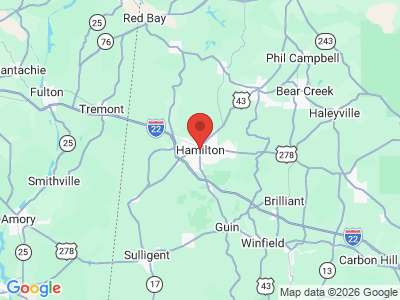
Marion County
 Mule Day
Located in northwest Alabama, Marion County is the birthplace of the Country Music Hall of Fame and Alabama Music Hall of Fame inductee Sonny James of Hackleburg. Marion was named in honor of Revolutionary war hero Gen. Francis Marion (1732–1795), a South Carolinian known as "The Swamp Fox." The county is governed by an elected five-member commission and includes the incorporated city of Winfield.
Mule Day
Located in northwest Alabama, Marion County is the birthplace of the Country Music Hall of Fame and Alabama Music Hall of Fame inductee Sonny James of Hackleburg. Marion was named in honor of Revolutionary war hero Gen. Francis Marion (1732–1795), a South Carolinian known as "The Swamp Fox." The county is governed by an elected five-member commission and includes the incorporated city of Winfield.
- Founding Date: February 13, 1818
- Area: 743 square miles
- Population: 29,341 (2020 Census estimate)
- Major Waterways: Tombigbee River, Tennessee River
- Major Highways: U.S. 43, U.S. 78, U.S. 278
- County Seat: Hamilton
- Largest City: Hamilton
History
 Old Marion County Courthouse
Marion County was created by the Alabama Territorial Legislature on February 13, 1818, preceding Alabama's statehood by almost two years. The county was created from land acquired from the Chickasaw Indians by the Treaty of 1816. The county included all of the current territory of Marion County and parts of what are now Winston, Walker, Fayette, and Lamar Counties in Alabama as well as portions of present-day Lowndes, Monroe, and Itawamba Counties in Mississippi. Most of Marion County's early settlers came from Kentucky and Tennessee after the completion of Jackson's Military Road (named for Gen. Andrew Jackson). The first towns in the area were Pikeville, Hamilton (formerly Toll Gate), Winfield, and Guin.
Old Marion County Courthouse
Marion County was created by the Alabama Territorial Legislature on February 13, 1818, preceding Alabama's statehood by almost two years. The county was created from land acquired from the Chickasaw Indians by the Treaty of 1816. The county included all of the current territory of Marion County and parts of what are now Winston, Walker, Fayette, and Lamar Counties in Alabama as well as portions of present-day Lowndes, Monroe, and Itawamba Counties in Mississippi. Most of Marion County's early settlers came from Kentucky and Tennessee after the completion of Jackson's Military Road (named for Gen. Andrew Jackson). The first towns in the area were Pikeville, Hamilton (formerly Toll Gate), Winfield, and Guin.
 Marion County Courthouse
In 1818, the first county courthouse was constructed at Cotton Gin Port, near Amory. It was moved in 1819 to the home of Henry Greer along the Buttachatchee River. Pikeville served as Marion County's first permanent county seat from 1820-82. The town is now abandoned, but the home of Judge John Dabney Terrell Sr., which served as the third county courthouse, still stands. In 1883, Hamilton became the county seat. The first courthouse in Hamilton was destroyed by fire on March 30, 1887, and the second courthouse, constructed in the same place, also burned. A new courthouse, opened in 1901, is still in use.
Marion County Courthouse
In 1818, the first county courthouse was constructed at Cotton Gin Port, near Amory. It was moved in 1819 to the home of Henry Greer along the Buttachatchee River. Pikeville served as Marion County's first permanent county seat from 1820-82. The town is now abandoned, but the home of Judge John Dabney Terrell Sr., which served as the third county courthouse, still stands. In 1883, Hamilton became the county seat. The first courthouse in Hamilton was destroyed by fire on March 30, 1887, and the second courthouse, constructed in the same place, also burned. A new courthouse, opened in 1901, is still in use.
On April 27, 2011, a massive storm, causing numerous powerful tornadoes, struck the southeastern United States. More than 250 people were killed in Alabama, including 23 people in the Marion County communities of Hackleburg (18) and Hamilton (5).
Major Cities and Demographics
According to 2020 Census estimates, the population of Marion County was 29,341. Approximately 92.3 percent of respondents identified themselves as white, 3.8 percent as African American, 2.6 percent Hispanic, 1.8 percent as two or more races, 0.5 as Native American, and 0.1 percent as Asian. The county seat of Hamilton is the largest city in the county with an estimated population of 7,074. Other significant population centers include Guin, Winfield, Gu-Win (which lies between Guin and Winfield), Twin, and Hackleburg. The median household income was $40,978, compared with $52,035 for the state as a whole, and the per capita income was $22, 486, compared with $28,934 for the state.
Economy
 Marion County Dairy Farmers 1927
Like most Alabama counties, farming was the prevailing occupation in Marion County until well into the twentieth century. Until the 1930s, cotton was the county's major crop, after which time farmers began to diversify into cattle, corn, and soybeans. The economy was mainly agriculturally based until the mid-twentieth century, when its many acres of forest attracted the timber industry.
Marion County Dairy Farmers 1927
Like most Alabama counties, farming was the prevailing occupation in Marion County until well into the twentieth century. Until the 1930s, cotton was the county's major crop, after which time farmers began to diversify into cattle, corn, and soybeans. The economy was mainly agriculturally based until the mid-twentieth century, when its many acres of forest attracted the timber industry.
Employment
According to 2020 Census estimates, the workforce in Marion County was divided among the following industrial categories:
- Manufacturing (22.4 percent)
- Educational services, and health care and social assistance (21.9 percent)
- Retail trade (10.1 percent)
- Finance and insurance, and real estate, rental, and leasing (7.6 percent)
- Transportation and warehousing, and utilities (7.5 percent)
- Construction (7.2 percent)
- Professional, scientific, management, and administrative and waste management services (6.1 percent)
- Public administration (4.6 percent)
- Other services, except public administration (3.7 percent)
- Arts, entertainment, recreation, and accommodation and food services (3.8 percent)
- Agriculture, forestry, fishing and hunting, and extractive (2.6 percent)
- Wholesale trade (2.1 percent)
- Information (0.6 percent)
Much of the business sector is centered along a stretch of U.S. 78 known as Corridor X, located southwest of Hamilton, that connects Memphis, Tennessee, to Birmingham. Some of the largest employers in the county are Buccaneer Homes, Wrangler, NTN Bower, Harden Manufacturing, and 3M.
Education
The Marion County School System oversees 12 primary and secondary schools and the Winfield City Schools oversees three primary and secondary schools. Bevill State Community College, a two-year institution offering both academic and technical and vocational programs, has a campus in Hamilton.
Geography
 Marion County Map
Comprising approximately 743 square miles, Marion County lies in the northwest corner of the state. Despite its northern location, it lies with the East Gulf Coastal Plain physiographic section. It is bordered on the north by Franklin County, on the east by Winston and Walker Counties, on the south by Fayette and Lamar Counties, and on the west by the state of Mississippi.
Marion County Map
Comprising approximately 743 square miles, Marion County lies in the northwest corner of the state. Despite its northern location, it lies with the East Gulf Coastal Plain physiographic section. It is bordered on the north by Franklin County, on the east by Winston and Walker Counties, on the south by Fayette and Lamar Counties, and on the west by the state of Mississippi.
Numerous tributaries of the Tombigbee and Tennessee Rivers run throughout the county. The Tombigbee River is one of the most critical watersheds in the nation, with more than 125 species of fish, 10 of which are endangered. The river's many tributaries offer recreational opportunities.
U.S. Highways 43, 78, and 278 are the county's major transportation routes. U.S. Highway 43 runs north-south through the middle of the county, and U.S. Highways 78 and 278 run east-west across the middle of the county. Marion County-Rankin Fite Airport is the county's only public airport.
Events and Places of Interest
Marion County offers a range of recreational activities. The Sam R. Murphy Wildlife Management Area consists of 25,150 acres of game hunting. The Upper Bear Creek Reservoir and the Marion County Public Fishing Lake offer boating, canoeing, kayaking, fishing, and birdwatching. Twin Forks Park, near the Bear Creek Reservoir, includes picnic and campsite areas as well.
 Kayakers on Bear Creek
Marion County is home to several buildings listed on both the National and Alabama Registers of Historic Places. Pearce's Mill, for example, was built in the 1840s along the Buttachatchee River and restored after the Civil War by James P. Pearce, one of the county's largest landowners; it was nominated to the National Register in 1976. Registered as an Alabama Historic site, Norris Hardware in Brilliant was built in 1905. Today, visitors to the historic building can examine antique farm and livestock equipment as well as antique housewares. The Ernest Baxter Fite House in Hamilton, significant for its Colonial Revival architecture, was built in 1929 and added to the Alabama Register in 1992 and the National Register in 1997. Although not listed on the registers, visitors can tour the abandoned town of Pikeville, with its old courthouse, Civil War cemetery, the grave of an unknown soldier from the War of 1812, and the remnants of Andrew Jackson's Military Road.
Kayakers on Bear Creek
Marion County is home to several buildings listed on both the National and Alabama Registers of Historic Places. Pearce's Mill, for example, was built in the 1840s along the Buttachatchee River and restored after the Civil War by James P. Pearce, one of the county's largest landowners; it was nominated to the National Register in 1976. Registered as an Alabama Historic site, Norris Hardware in Brilliant was built in 1905. Today, visitors to the historic building can examine antique farm and livestock equipment as well as antique housewares. The Ernest Baxter Fite House in Hamilton, significant for its Colonial Revival architecture, was built in 1929 and added to the Alabama Register in 1992 and the National Register in 1997. Although not listed on the registers, visitors can tour the abandoned town of Pikeville, with its old courthouse, Civil War cemetery, the grave of an unknown soldier from the War of 1812, and the remnants of Andrew Jackson's Military Road.
Marion County is also home to Mule Day, held annually in Winfield on the fourth Saturday in September. Festivities include food, music, dancing, a Civil War reenactment, arts and crafts, and various games. Drawing crowds of more than 25,000, the festival has been held since 1975. The Northwest Alabama Arts Council sponsors the Jerry Brown Arts Festival, an indoor juried arts event, in Hamilton on the first weekend in March.
Additional Resources
- The Heritage of Marion County, Alabama. Clanton, Ala.: Heritage Pub. Consultants, 2000.
External Links
- Marion County
- Marion County Board of Education
- City of Hamilton
- City of Winfield
- City of Guin
- Town of Brilliant
- Hamilton Area Chamber of Commerce
- National Register of Historic Places: Marion County
- Bevill State Community College
- Visit North Alabama
- Jerry Brown Arts Festival
- Bear Creek Reservoir
- Sam R. Murphy Wildlife Management Area