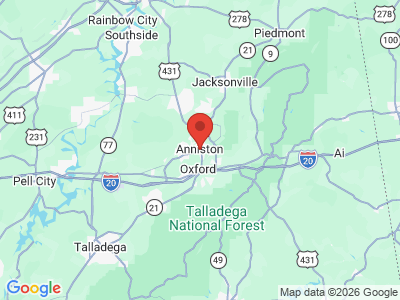
Calhoun County
 Calhoun County Courthouse
Located in northeast Alabama, Calhoun County is home to Anniston, a leader in textile and iron ore production during the late-nineteenth and early-twentieth centuries. Calhoun County is also home to two major military installations, the now-decommissioned Fort McClellan and Anniston Army Depot. The Anniston Star, founded and run by the Ayers family, was a leader in antisegregationist journalism during the civil rights movement. Journalist and author Elise Ayers Sanguinetti spent much of her life in Calhoun County in her family's newspaper business. The county is governed by an elected five-member commission and includes seven incorporated communities, each governed by a mayor and city council.
Calhoun County Courthouse
Located in northeast Alabama, Calhoun County is home to Anniston, a leader in textile and iron ore production during the late-nineteenth and early-twentieth centuries. Calhoun County is also home to two major military installations, the now-decommissioned Fort McClellan and Anniston Army Depot. The Anniston Star, founded and run by the Ayers family, was a leader in antisegregationist journalism during the civil rights movement. Journalist and author Elise Ayers Sanguinetti spent much of her life in Calhoun County in her family's newspaper business. The county is governed by an elected five-member commission and includes seven incorporated communities, each governed by a mayor and city council.
- Founding Date: December 18, 1832
- Area: 611 square miles
- Population: 116,441 (2020 Census estimate)
- Major Waterways: Coosa River
- Major Highways; I-20, U.S. 431, U.S. 78
- County Seat: Anniston
- Largest City: Anniston
History
 John Tyler Morgan
Calhoun County was created by legislative act on December 18, 1832. The county was initially named Benton County in honor of Missouri senator Thomas Hart Benton, an arch defender of westward expansion and slavery. After Benton declared himself an opponent of slavery in the 1850s, Alabama supporters of slavery voted to change the county's name to Calhoun in honor of radical secessionist John C. Calhoun. During the territorial period, the county was home to the Creek and Cherokee Indians. In 1813, the county was the site of one of the first battles of the Creek War of 1813-1814 when Gen. Andrew Jackson ordered Gen. John Coffee to destroy the Creek town of Tallasseehatchee, located in the present-day community of Alexandria. During the attack, which was a retaliation for the Fort Mims massacre, U.S. forces and allied Creeks massacred 187 men, women, and children in the town. During the Civil War, local senator John Tyler Morgan raised and organized the 51st Alabama Cavalry, which fought with Gen. Joe Wheeler. In addition, one of the most lauded soldiers of the war, Maj. John Pelham, also known as the "Gallant Pelham," was born in Calhoun County, and the county's 10th Alabama Volunteers and the Calhoun Sharpshooters (Company B of the 5th Alabama Battalion) both served during the Civil War. The land encompassing present-day Calhoun County was ceded to the federal government by the Creeks in the March 1832 Treaty of Cusseta.
John Tyler Morgan
Calhoun County was created by legislative act on December 18, 1832. The county was initially named Benton County in honor of Missouri senator Thomas Hart Benton, an arch defender of westward expansion and slavery. After Benton declared himself an opponent of slavery in the 1850s, Alabama supporters of slavery voted to change the county's name to Calhoun in honor of radical secessionist John C. Calhoun. During the territorial period, the county was home to the Creek and Cherokee Indians. In 1813, the county was the site of one of the first battles of the Creek War of 1813-1814 when Gen. Andrew Jackson ordered Gen. John Coffee to destroy the Creek town of Tallasseehatchee, located in the present-day community of Alexandria. During the attack, which was a retaliation for the Fort Mims massacre, U.S. forces and allied Creeks massacred 187 men, women, and children in the town. During the Civil War, local senator John Tyler Morgan raised and organized the 51st Alabama Cavalry, which fought with Gen. Joe Wheeler. In addition, one of the most lauded soldiers of the war, Maj. John Pelham, also known as the "Gallant Pelham," was born in Calhoun County, and the county's 10th Alabama Volunteers and the Calhoun Sharpshooters (Company B of the 5th Alabama Battalion) both served during the Civil War. The land encompassing present-day Calhoun County was ceded to the federal government by the Creeks in the March 1832 Treaty of Cusseta.
Attracted by the rich ore deposits in the Calhoun County countryside, Daniel Tyler, a former Union general from Connecticut, and Englishman Samuel Noble joined forces in 1872 to establish Woodstock Iron Company. The two men built what they deemed an "ideal" industrial community in the south-central area of the county. Originally called "Annie's Town" after Tyler's daughter-in-law, the town's name was eventually shortened to Anniston. By 1893, the community contained two iron furnaces, a cotton textile mill, schools, parks, paved streets, a water system, and the first electric lighting system in the state of Alabama. By the 1880s, it was the state's fastest-growing town, prompting Atlanta newspaper man and New South booster Henry Grady to term it "the model city of the New South." By the 1920s, the city had diversified by adding several textile mills to its 13 iron foundries, which made Anniston the world's largest producer of cast-iron pipe.
 Attack on Freedom Riders in Anniston
Later in the century, Anniston made national headlines when the Ku Klux Klan burned a bus carrying the Freedom Riders on Mother's Day in 1961. During the civil rights era, The Anniston Star newspaper gained a reputation as one of the few liberal newspapers in Alabama. In 2002, Anniston again found itself in the national news when the Washington Post reported that multinational chemical company Monsanto, which bought the company that produced PCBs in the 1930s, had been dumping toxic waste and PCBs into nearby creeks. Several citizens living near the Monsanto plant filed class-action lawsuits against the company. In 2003, the Anniston Army Depot was likewise criticized for its disposal of chemical weapons.
Attack on Freedom Riders in Anniston
Later in the century, Anniston made national headlines when the Ku Klux Klan burned a bus carrying the Freedom Riders on Mother's Day in 1961. During the civil rights era, The Anniston Star newspaper gained a reputation as one of the few liberal newspapers in Alabama. In 2002, Anniston again found itself in the national news when the Washington Post reported that multinational chemical company Monsanto, which bought the company that produced PCBs in the 1930s, had been dumping toxic waste and PCBs into nearby creeks. Several citizens living near the Monsanto plant filed class-action lawsuits against the company. In 2003, the Anniston Army Depot was likewise criticized for its disposal of chemical weapons.
On April 27, 2011, a massive storm, causing numerous powerful tornadoes, struck the southeastern United States. More than 250 people were killed in Alabama, including nine people in Calhoun County. Victims were from the following communities: Ohatchee (5 deaths), Piedmont (1 death), Webster's Chapel (1 death), and Wellington (2 deaths). In March 2018, an EF-3 tornado cut across the middle of the county on its way from northwest Alabama and into neighboring Calhoun County and Georgia. It was the strongest of multiple tornados that touched down during that weather event. Most of the damage was concentrated in Jacksonville and at Jacksonville State University in particular, uprooting trees, tearing the roofs off many buildings and homes, and prompting the temporary cancellation of classes.
Major Cities and Demographics
 Aderholt Mill in Jacksonville
According to 2020 Census estimates, Calhoun County recorded population of 116,441. Approximately 73.3 percent of respondents identified themselves as white, 21.2 percent as African American, 3.9 percent as Hispanic, 2.5 percent as two or more races, 0.8 as Asian, 0.3 percent as Hawaiian or Pacific Islander, and 0.3 as Native American. The county seat, Anniston, had an estimated population of 21,518. Other significant population centers in the county are Jacksonville, Oxford, Piedmont, and Weaver. The median household income for Calhoun County was $50,128, compared with $52,035 for the state as a whole, and the per capita income was $26,238, compared with $28,934 for the state as a whole.
Aderholt Mill in Jacksonville
According to 2020 Census estimates, Calhoun County recorded population of 116,441. Approximately 73.3 percent of respondents identified themselves as white, 21.2 percent as African American, 3.9 percent as Hispanic, 2.5 percent as two or more races, 0.8 as Asian, 0.3 percent as Hawaiian or Pacific Islander, and 0.3 as Native American. The county seat, Anniston, had an estimated population of 21,518. Other significant population centers in the county are Jacksonville, Oxford, Piedmont, and Weaver. The median household income for Calhoun County was $50,128, compared with $52,035 for the state as a whole, and the per capita income was $26,238, compared with $28,934 for the state as a whole.
Economy
 Chemical Artillery Shells at Anniston Depot
Like many of the counties in Alabama, Calhoun was a largely agricultural area during the nineteenth century. Local farmers grew a mixed crop of cotton, corn, and wheat, and the first grist mill, Aderholdt's Mill, located on Tallaseehatchee Creek, opened in 1836. Economic strain, during and after the Civil War, forced the region's industrialists and entrepreneurs to diversify. In 1890, leaders of the town of Piedmont, located in the northern section of the county, formed the Piedmont Land and Improvement Company which built a successful cotton mill and hotel along the railroad lines that ran through the town. In addition, Calhoun County's mineral wealth made it an ideal location for several iron-ore foundries. The town of Anniston was founded in 1872 as a model industrial community and by the turn of the century had become an economic powerhouse in the cast-iron and textile industries. In 1917, the U.S. War Department established Camp McClellan to train soldiers for World War I. In 1929, the army changed the name to Fort McClellan, and in 1940 the first of approximately 500,000 World War II soldiers arrived for training. In addition to Fort McClellan, the War Department also added the Anniston Army Depot in 1940. In 1972, the renowned Alabama Shakespeare Festival was founded in Anniston and remained there until 1985, when it relocated to Montgomery.
Chemical Artillery Shells at Anniston Depot
Like many of the counties in Alabama, Calhoun was a largely agricultural area during the nineteenth century. Local farmers grew a mixed crop of cotton, corn, and wheat, and the first grist mill, Aderholdt's Mill, located on Tallaseehatchee Creek, opened in 1836. Economic strain, during and after the Civil War, forced the region's industrialists and entrepreneurs to diversify. In 1890, leaders of the town of Piedmont, located in the northern section of the county, formed the Piedmont Land and Improvement Company which built a successful cotton mill and hotel along the railroad lines that ran through the town. In addition, Calhoun County's mineral wealth made it an ideal location for several iron-ore foundries. The town of Anniston was founded in 1872 as a model industrial community and by the turn of the century had become an economic powerhouse in the cast-iron and textile industries. In 1917, the U.S. War Department established Camp McClellan to train soldiers for World War I. In 1929, the army changed the name to Fort McClellan, and in 1940 the first of approximately 500,000 World War II soldiers arrived for training. In addition to Fort McClellan, the War Department also added the Anniston Army Depot in 1940. In 1972, the renowned Alabama Shakespeare Festival was founded in Anniston and remained there until 1985, when it relocated to Montgomery.
Employment
According to 2020 Census estimates, the workforce in Calhoun County was divided among the following industrial categories:
- Educational services, and health care and social assistance (22.7 percent)
- Manufacturing (18.1 percent)
- Retail trade (13.2 percent)
- Arts, entertainment, recreation, and accommodation and food services (8.5 percent)
- Public administration (7.7 percent)
- Professional, scientific, management, administrative, and waste management services (6.9 percent)
- Construction (5.2 percent)
- Transportation and warehousing, and utilities (4.3 percent)
- Other services, except public administration (4.4 percent)
- Finance and insurance, and real estate, rental, and leasing (3.8 percent)
- Wholesale trade (2.6 percent)
- Information (1.3 percent)
- Agriculture, forestry, fishing and hunting, and extractive (1.3 percent)
Education
The Calhoun County School System oversees 39 schools. In addition, Calhoun County also contains 15 private schools. Jacksonville State University is a public coeducational university in Jacksonville founded in 1883 as the State Normal School.
Geography
 Calhoun County Map
Comprising approximately 611 square miles, Calhoun County lies in the northeastern area of the state, wholly within the Valley and Ridge physiographic section. Parts of Calhoun County were carved out when Cleburne and Etowah counties were established. It is bounded to the northwest by Etowah County, to the northeast by Cherokee County, to the east by Cleburne County, to the south by Talladega County, and to the west by St. Clair County. Portions of the eastern and southern edges of the county lie within the Talladega National Forest.
Calhoun County Map
Comprising approximately 611 square miles, Calhoun County lies in the northeastern area of the state, wholly within the Valley and Ridge physiographic section. Parts of Calhoun County were carved out when Cleburne and Etowah counties were established. It is bounded to the northwest by Etowah County, to the northeast by Cherokee County, to the east by Cleburne County, to the south by Talladega County, and to the west by St. Clair County. Portions of the eastern and southern edges of the county lie within the Talladega National Forest.
The Coosa River runs along the western edge of the county, and several of its tributaries, including Cane, Ohatchee, and Choccolocco creeks, intersect the area. The Coosa River was dammed in 1969 by Alabama Power to create H. Neely Henry Lake. U.S. 431 is Calhoun County's major transportation route, running north to south in the west-central part of the state. Interstate 20 runs through the southern tip of the county, and U.S. 78 parallels the county's southern border. Anniston Metropolitan Airport is the county's only public airport.
Events and Places of Interest
 Egyptian Mummies at the Anniston Museum of Natural History
Calhoun County's location makes it ideal for several outdoor activities. Talladega National Forest in the eastern part of the county is home to several acres of mountain longleaf pine forest. Choccolocco State Forest, near White Plains, encompasses 4,406 acres and offers hiking, biking, and camping as well as educational programming by Jacksonville State University. The 100-mile Pinhoti Trail, one of the top destinations in the Talladega National Forest, begins at the town of Piedmont in the northern part of Calhoun County. H. Neely Henry Lake located along the western edge of the region is renowned for its largemouth, smallmouth, and spotted bass and catfish fishing. Coldwater Spring, a tributary of the Coosa River that serves as Anniston's primary water source, is home to the endangered pygmy sculpin, a rare fish species found only in the spring.
Egyptian Mummies at the Anniston Museum of Natural History
Calhoun County's location makes it ideal for several outdoor activities. Talladega National Forest in the eastern part of the county is home to several acres of mountain longleaf pine forest. Choccolocco State Forest, near White Plains, encompasses 4,406 acres and offers hiking, biking, and camping as well as educational programming by Jacksonville State University. The 100-mile Pinhoti Trail, one of the top destinations in the Talladega National Forest, begins at the town of Piedmont in the northern part of Calhoun County. H. Neely Henry Lake located along the western edge of the region is renowned for its largemouth, smallmouth, and spotted bass and catfish fishing. Coldwater Spring, a tributary of the Coosa River that serves as Anniston's primary water source, is home to the endangered pygmy sculpin, a rare fish species found only in the spring.
The downtown historic district of Anniston includes several Art Deco and Classical Revival structures, including the Kilby House belonging to Gov. Thomas Kilby. The Berman Museum of World History, located in Anniston, boasts 8,000 artifacts, and the Anniston Museum of Natural History includes seven open-air exhibit halls. The two museums are collectively operated as Anniston Museum and Gardens. The town of Oxford is home to Cider Ridge Golf Course, an 18-hole course that traverses Hillabee and Choccolocco Creeks. Each year, the city of Anniston hosts the Knox Concert Series, which features classical and popular music concerts by world-renowned performers. The Dr. J. C. Francis Medical Museum and Apothecary in Jacksonville is housed in the circa-1850 Greek Revival office of J. C. Francis, a local family doctor; it features exhibits of medical and pharmaceutical tools from the mid-nineteenth century.
Additional Resources
- Gates, Grace Hooton. Model City of the New South: Anniston, Alabama, 1872-1900. Huntsville, Ala.: Strode Publishers, c. 1978.
- Stewart, Margaret Estelle. Alabama's Calhoun County. Centre, Ala.: Stewart University Press, 1976.
- Heritage of Calhoun County, Alabama. Clanton, Ala.: Heritage Publishing Consultants, Inc., 1998.
External Links
- Calhoun County
- Calhoun County School District
- City of Anniston
- City of Jacksonville
- City of Oxford
- City of Piedmont
- City of Weaver
- Public Library of Anniston-Calhoun County
- Calhoun County Chamber of Commerce
- National Register of Historic Places: Calhoun County
- Jacksonville State University
- Anniston Museum and Gardens
- Talladega National Forest
- Choccolocco State Forest
- Mountain Longleaf National Wildlife Refuge