Bullock County
Located in the Black Belt region, Bullock County is home to one of the first public gardens in the United States and the oldest chartered garden club in the nation. Currently, the region is known for its hunting and field trial lands. The county is run by an elected five-member commission.
- Founding Date: December 5, 1866
- Area: 625 square miles
- Population: 10,357 (2020 Census estimates)
- Major Waterways: Conecuh River
- Major Highways: U.S. 29, U.S. 82
- County Seat: Union Springs
- Largest City: Union Springs
History
 Edward C. Bullock
Bullock County was created by an Act of the State Legislature on December 5, 1866. Carved out of parts of Macon, Pike, Montgomery, and Barbour counties, it was named for Confederate colonel Edward C. Bullock. A native of South Carolina, Bullock moved to Eufaula in the 1840s and later served two terms in the Alabama State Senate. Like much of southeastern Alabama, Bullock County was once the home of the Creek Indians. During the Treaty of Fort Jackson in 1814, the Creeks ceded 23 million acres of land in Alabama and Georgia to the U.S. government. The boundary of the lands ceded by the Creeks ran across present-day Bullock County from northeast of Mitchell Station to southeast of Pine Grove. Following Alabama statehood in 1819 and again after Creek Indian Removal in the 1830s, settlers poured into present day Bullock County. The richness of the soil in the area made it highly conducive to cotton production and the county quickly became one of the richest in the state.
Edward C. Bullock
Bullock County was created by an Act of the State Legislature on December 5, 1866. Carved out of parts of Macon, Pike, Montgomery, and Barbour counties, it was named for Confederate colonel Edward C. Bullock. A native of South Carolina, Bullock moved to Eufaula in the 1840s and later served two terms in the Alabama State Senate. Like much of southeastern Alabama, Bullock County was once the home of the Creek Indians. During the Treaty of Fort Jackson in 1814, the Creeks ceded 23 million acres of land in Alabama and Georgia to the U.S. government. The boundary of the lands ceded by the Creeks ran across present-day Bullock County from northeast of Mitchell Station to southeast of Pine Grove. Following Alabama statehood in 1819 and again after Creek Indian Removal in the 1830s, settlers poured into present day Bullock County. The richness of the soil in the area made it highly conducive to cotton production and the county quickly became one of the richest in the state.
 Bullock County Courthouse
Like many counties in Alabama, Bullock County was devastated by the Civil War. Bullock County had once been a major area of agricultural production, with a pre-war population of enslaved people of approximately 70 percent, but Emancipation and Reconstruction caused a sharp decline in its output. Bullock County elected two African Americans to the state legislature, but the aftermath of the war, along with the boll weevil, greatly reduced the wealth of the area. In the early twentieth century, several cotton mills owned by the Comer family opened in Union Springs. In addition, the early 1920s saw once fertile cotton fields converted by wealthy landowners into the site of the Amateur Field Trial competitions for bird dogs. The largest, and one of the most profitable, of the game reserves was owned by the Maytag family, founders of Maytag Appliance Corporation.
Bullock County Courthouse
Like many counties in Alabama, Bullock County was devastated by the Civil War. Bullock County had once been a major area of agricultural production, with a pre-war population of enslaved people of approximately 70 percent, but Emancipation and Reconstruction caused a sharp decline in its output. Bullock County elected two African Americans to the state legislature, but the aftermath of the war, along with the boll weevil, greatly reduced the wealth of the area. In the early twentieth century, several cotton mills owned by the Comer family opened in Union Springs. In addition, the early 1920s saw once fertile cotton fields converted by wealthy landowners into the site of the Amateur Field Trial competitions for bird dogs. The largest, and one of the most profitable, of the game reserves was owned by the Maytag family, founders of Maytag Appliance Corporation.
Major Cities and Demographics
According to 2020 Census estimates, Bullock County reported a population of 10,357. Approximately 68.6 percent of respondents identified themselves as African American, 26.2 percent as white, 8.1 percent as Hispanic, 1.3 percent as Asian, and 0.7 percent as two or more races. The county seat, Union Springs, had a population of 3,465. The only other significant population center is Midway. The median household income for Bullock County was $33,866, as compared with $52,035 for the state as a whole, and the per capita income was $20,783, as compared with $28,934 for the state as a whole.
Economy
 Bullock County Cotton
During the nineteenth century, Bullock County was the center of the cotton industry. The rich soils of the Black Belt were excellent for cotton farming, and Bullock County became one of the wealthiest counties. In the wake of the devastation brought about by the Civil War and the boll weevil, farmers attempted to diversify with other crops such as corn and alfalfa. In addition, exhausted agricultural lands were sold as bird-dog training and hunting lands.
Bullock County Cotton
During the nineteenth century, Bullock County was the center of the cotton industry. The rich soils of the Black Belt were excellent for cotton farming, and Bullock County became one of the wealthiest counties. In the wake of the devastation brought about by the Civil War and the boll weevil, farmers attempted to diversify with other crops such as corn and alfalfa. In addition, exhausted agricultural lands were sold as bird-dog training and hunting lands.
According to the Census, Bullock County is consistently among the poorest counties in Alabama and in the top 25 poorest in the nation, with 33 percent of the population living below the poverty line. The majority of jobs in present-day Bullock county are centered around agriculture, forestry, and hunting and fishing. In addition, several poultry and poultry-processing plants are located in the area, as is the Bonnie Plant Farm headquarters.
Employment
According to 2020 Census estimates, the workforce in present-day Bullock County was divided among the following industrial categories:
- Manufacturing (39.0 percent)
- Educational services, and health care and social assistance (14.1 percent)
- Retail trade (10.6 percent)
- Public administration (8.8 percent)
- Arts, entertainment, and recreation, and accommodation and food services (8.1 percent)
- Construction (7.3 percent)
- Other services, except public administration (3.4 percent)
- Transportation and warehousing, and utilities (4.1 percent)
- Professional, scientific, management, administrative, and waste management services (3.2 percent)
- Agriculture, forestry, fishing and hunting, and extractive (2.6 percent)
- Finance and insurance, and real estate, rental, and leasing (1.7 percent)
- Information (1.3 percent)
- Wholesale trade (0.9 percent)
Education
The Bullock County School System oversees six schools. In addition, the county contains one private school.
Geography
 Bullock County Map
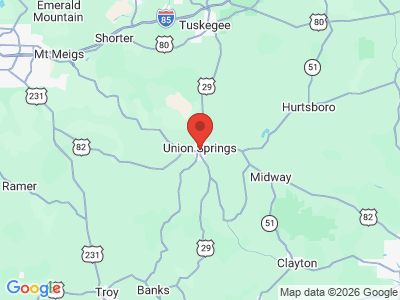
Comprising approximately 625 square miles, Bullock County lies in the southeastern area of the state, wholly within the Black Belt region in the East Gulf Coastal Plain physiographic section. It is bounded to the north by Macon County, to the east and southeast by Russell and Barbour Counties, to the southwest Pike County, and to the west by Montgomery County.
Bullock County Map
Comprising approximately 625 square miles, Bullock County lies in the southeastern area of the state, wholly within the Black Belt region in the East Gulf Coastal Plain physiographic section. It is bounded to the north by Macon County, to the east and southeast by Russell and Barbour Counties, to the southwest Pike County, and to the west by Montgomery County.
The Conecuh River runs through the center of the county, and the Pea River, a tributary of the Choctawhatchee River, runs along its southeastern border. In addition, numerous creeks such as the Bughall Creek, a tributary of the Tallapoosa River, Old Town Creek, and Line Creek intersect the area. U.S. 29 and U.S. 82 are Bullock County's major transportation routes, running east-west and north-south.
Events and Places of Interest
Bullock County is renowned as one of the best hunting areas in the state. Beginning in the early twentieth century, Sedgefields Plantation, near Union Springs, began hosting hunters from all over the world. Each February Bullock County hosts a series of field trials, known as Amateur Free For Alls, at which bird dogs and their trainers display their quail-hunting abilities. Union Springs, the county seat and largest town in the area, is known as the Field Trial Capital of the World. In addition, Bullock County is home to several deer and turkey hunting preserves and hosts one of the few fox-hunting communities in the nation.
 Bird Dog Field Trial Monument
Bullock County is home to several antebellum historic homes, including the Bonus-Foster-Chapman House, family home of Alabama civil rights activist Virginia Foster Durr, and the McCaslan-Garner House. In 2003, Trinity Episcopal Church in Union Springs was converted into the Red Door Theatre, a regional theater that produces several highly regarded shows a year. From 2004 to 2010, it presented an annual production of Conecuh People . . . The Experience, a play adapted from Bullock County native and historian Wade Hall's autobiographical book of the same name. Also notable is Chunnenuggee Garden, one of the first public gardens in the United States and Alabama's first public garden. The Chunnenuggee Garden Club maintains the gardens and is the oldest chartered garden club in the United States.
Bird Dog Field Trial Monument
Bullock County is home to several antebellum historic homes, including the Bonus-Foster-Chapman House, family home of Alabama civil rights activist Virginia Foster Durr, and the McCaslan-Garner House. In 2003, Trinity Episcopal Church in Union Springs was converted into the Red Door Theatre, a regional theater that produces several highly regarded shows a year. From 2004 to 2010, it presented an annual production of Conecuh People . . . The Experience, a play adapted from Bullock County native and historian Wade Hall's autobiographical book of the same name. Also notable is Chunnenuggee Garden, one of the first public gardens in the United States and Alabama's first public garden. The Chunnenuggee Garden Club maintains the gardens and is the oldest chartered garden club in the United States.
Additional Resources
- Hall, Wade. Conecuh People: Words of Life from the Alabama Black Belt. Montgomery, Ala.: New South Books, 2004.
- Hamilton, John Floyd. "A Study of the Social and Economic Conditions in Bullock County." Master's thesis, Auburn University, 1939.
- Heritage of Bullock County. Clanton, Ala.: Heritage Pub. Consultants, Inc, 1999.