Barbour County
 Octagon House in Clayton
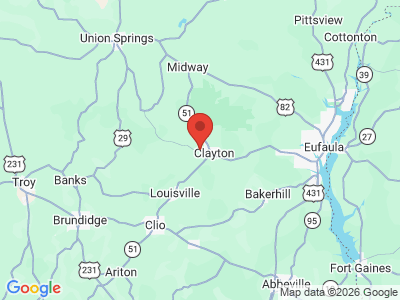
Located in southeast Alabama along the Alabama-Georgia border, Barbour County was home to six Alabama governors. The county was a center of agriculture and forestry during the late nineteenth and early twentieth centuries. The Eufaula National Wildlife Refuge is one of the largest preserved natural areas in the state. The county is governed by an elected seven-member commission.
Octagon House in Clayton
Located in southeast Alabama along the Alabama-Georgia border, Barbour County was home to six Alabama governors. The county was a center of agriculture and forestry during the late nineteenth and early twentieth centuries. The Eufaula National Wildlife Refuge is one of the largest preserved natural areas in the state. The county is governed by an elected seven-member commission.
- Founding Date: December 18, 1832
- Area: 884 square miles
- Population: 25,223 (2020 Census estimate)
- Major Waterways: Chattahoochee River, Choctawhatchee River
- Major Highways: U.S. 82, U.S. 431
- County Seat: Clayton
- Largest City: Eufaula
History
 Old Barbour County Courthouse
Barbour County was created on December 18, 1832, and its original boundary lines encompassed lands acquired from the Creek Indians in the 1814 Treaty of Fort Jackson as well as lands in the eastern part of Pike County. It was named in honor of James Barbour (1775–1842), a distinguished statesman and governor of Virginia. The initial non-Indian settlers came from Virginia, the Carolinas, and Georgia via the Federal Road. The first towns in the area were Williamstown (no longer in existence), Eufaula (known as Irwinton between 1837 and 1843), Louisville (established by Daniel Lewis as a trading post), and Clayton.
Old Barbour County Courthouse
Barbour County was created on December 18, 1832, and its original boundary lines encompassed lands acquired from the Creek Indians in the 1814 Treaty of Fort Jackson as well as lands in the eastern part of Pike County. It was named in honor of James Barbour (1775–1842), a distinguished statesman and governor of Virginia. The initial non-Indian settlers came from Virginia, the Carolinas, and Georgia via the Federal Road. The first towns in the area were Williamstown (no longer in existence), Eufaula (known as Irwinton between 1837 and 1843), Louisville (established by Daniel Lewis as a trading post), and Clayton.
 Barbour County Courthouse
As the former seat of Pike County, Louisville was chosen as the seat for the newly created Barbour County in 1833, and Pike County selected Monticello as its new seat. In March 1834, however, a commission selected Clayton as the new county seat because of its central geographical location. A log building served as the county's first courthouse until 1854, when it was replaced with a brick structure that was remodeled and expanded in 1924. By the 1870s, Eufaula had surpassed Clayton as the most populous and important city in Barbour County. There was some debate about whether the county seat should be located at the geographical or commercial center of the county. A compromise resulted in the approval of Act No. 106 on February 12, 1879, which established courts in both Eufaula and Clayton. In the 1960s, a modern courthouse replaced the nineteenth-century building in Clayton. Today, courts continue in both Eufaula and Clayton and oversee county business in their respective parts of the county.
Barbour County Courthouse
As the former seat of Pike County, Louisville was chosen as the seat for the newly created Barbour County in 1833, and Pike County selected Monticello as its new seat. In March 1834, however, a commission selected Clayton as the new county seat because of its central geographical location. A log building served as the county's first courthouse until 1854, when it was replaced with a brick structure that was remodeled and expanded in 1924. By the 1870s, Eufaula had surpassed Clayton as the most populous and important city in Barbour County. There was some debate about whether the county seat should be located at the geographical or commercial center of the county. A compromise resulted in the approval of Act No. 106 on February 12, 1879, which established courts in both Eufaula and Clayton. In the 1960s, a modern courthouse replaced the nineteenth-century building in Clayton. Today, courts continue in both Eufaula and Clayton and oversee county business in their respective parts of the county.
Major Cities and Demographics
 Fendall Hall
According to 2020 Census estimates, Barbour County recorded a population of 25,223. Approximately 47.7 percent as African American, 46.3 percent of respondents reported themselves as white, 4.4 percent as Hispanic, 2.1 percent as more than two races, 0.5 percent as Asian, and 0.4 percent as Native American. The largest city in the county is Eufaula, with an estimated population of 11,878. Clayton, the county seat, had a population of 2,853, and other significant population centers include Blue Springs and Clio. The median household income was $34,940, compared with $52,035 for the rest of the state, and per capita income was $22,480, compared with $28,934 for the state.
Fendall Hall
According to 2020 Census estimates, Barbour County recorded a population of 25,223. Approximately 47.7 percent as African American, 46.3 percent of respondents reported themselves as white, 4.4 percent as Hispanic, 2.1 percent as more than two races, 0.5 percent as Asian, and 0.4 percent as Native American. The largest city in the county is Eufaula, with an estimated population of 11,878. Clayton, the county seat, had a population of 2,853, and other significant population centers include Blue Springs and Clio. The median household income was $34,940, compared with $52,035 for the rest of the state, and per capita income was $22,480, compared with $28,934 for the state.
Economy
 Barbour County Cotton
Until the middle of the twentieth century, farming was the prevailing occupation of most residents of Barbour County, and numerous business, such as gins and warehouses, sprang up in Eufaula. Cotton cultivation dominated the county's economy until the late nineteenth century, at which time farmers diversified into corn, pecans, and peanuts. The area's rolling grassland provided good forage land for cattle as well. The economy centered mainly on agriculture until the 1960s, when Barbour's abundant hardwood and pine forests attracted the timber industry.
Barbour County Cotton
Until the middle of the twentieth century, farming was the prevailing occupation of most residents of Barbour County, and numerous business, such as gins and warehouses, sprang up in Eufaula. Cotton cultivation dominated the county's economy until the late nineteenth century, at which time farmers diversified into corn, pecans, and peanuts. The area's rolling grassland provided good forage land for cattle as well. The economy centered mainly on agriculture until the 1960s, when Barbour's abundant hardwood and pine forests attracted the timber industry.
Employment
According to 2020 Census estimates, the workforce in present-day Barbour County was divided among the following industrial categories:
- Manufacturing (24.0 percent)
- Educational services, and health care and social assistance (18.6 percent)
- Retail trade (10.7 percent)
- Public administration (7.1 percent)
- Arts, entertainment, recreation, and accommodation and food services (6.6 percent)
- Construction (6.0 percent)
- Agriculture, forestry, fishing and hunting, and extractive (5.7 percent)
- Transportation and warehousing, and utilities (5.7 percent)
- Professional, scientific, management, and administrative and waste management services (5.1 percent)
- Finance and insurance, and real estate, rental, and leasing (3.9 percent)
- Other services, except public administration (3.8 percent)
- Wholesale trade (2.1 percent)
- Information (0.8 percent)
Education
The Barbour County School System and the Eufaula city school system together oversee 11 primary and secondary schools. One of the first two-year colleges established in Alabama, George C. Wallace Community College, has its Sparks campus in Eufaula. The college is recognized across the nation for its allied health and nursing programs, and the school leads among two-year Alabama colleges in the number of allied health and nursing graduates. Eufaula's Alabama Technology Network, part of the Alabama Community College System and the Manufacturing Extension Partnership, provides services in workforce development, software training, technical assistance for local industry, and technology research.
Geography

Comprising approximately 884 square miles, Barbour County lies in the southeastern part of the state within the East Gulf Coastal Plain physiographic section. It is bordered on the north by Russell and Bullock Counties, on the west by Pike County, on the south by Dale and Henry Counties, and on the east by the state of Georgia. Two of the state's major rivers run through the county: the Chattahoochee River on the eastern border and the Choctawhatchee River on the southwestern border. The Choctawhatchee boasts an impressive array of aquatic biodiversity, including 118 species of fish, 11 of which are considered at-risk. Numerous tributaries, including the Pea River, offer scenic views and recreational opportunities. U.S. Highways 82 and 431 are the county's major transportation routes. U.S. Highway 431 runs north–south along the eastern part of the county, while U.S. Highway 82 runs east-west across the northern part of the county. Clayton Municipal Airport located in Clayton and Weedon Field Airport, located in Eufaula, are Barbour County's only two public airports.
Events and Places of Interest
 Blue Springs State Park
Barbour County's rolling terrain offers many opportunities for recreational activities. The Eufaula National Wildlife Refuge, which spans 11,184 acres on the eastern and western shores of the Chattahoochee River, includes wetlands, agricultural fields, woodlands, and grasslands. The refuge is home to such diverse animals as bald eagles, American alligators, bobcats, and peregrine falcons. It provides visitors with excellent opportunities for hunting, fishing, camping, and hiking. The 1,220-acre Lakepoint Resort State Park, located seven miles north of Eufaula and adjacent to the refuge offers golfing, boating, fishing, and swimming. Blue Springs State Park, near Clio, is home to a unique swimming pool fed with crystal clear water from an underground spring. It remains at a cool 58 degrees throughout the year. Each May, Clio hosts its annual Chitlin' Jamboree, which features a cooking contest and a parade.
Blue Springs State Park
Barbour County's rolling terrain offers many opportunities for recreational activities. The Eufaula National Wildlife Refuge, which spans 11,184 acres on the eastern and western shores of the Chattahoochee River, includes wetlands, agricultural fields, woodlands, and grasslands. The refuge is home to such diverse animals as bald eagles, American alligators, bobcats, and peregrine falcons. It provides visitors with excellent opportunities for hunting, fishing, camping, and hiking. The 1,220-acre Lakepoint Resort State Park, located seven miles north of Eufaula and adjacent to the refuge offers golfing, boating, fishing, and swimming. Blue Springs State Park, near Clio, is home to a unique swimming pool fed with crystal clear water from an underground spring. It remains at a cool 58 degrees throughout the year. Each May, Clio hosts its annual Chitlin' Jamboree, which features a cooking contest and a parade.
With more than 700 structures listed on the National Register of Historic Places, the Seth Lore and Irwinton Historic District in Eufaula is currently the largest in East Alabama and the second-largest in the state. One of the county's most unique tourist attractions is Governor's Park, which overlooks Lake Eufaula. The park honors six distinguished Barbour County residents who served as governor of Alabama: John Gill Shorter, William D. Jelks, Braxton Bragg Comer, Chauncey Sparks, George C. Wallace, and Lurleen B. Wallace. Eufaula is also home to Fendall Hall, an 1860 Italianate mansion built by E. B. Young, who constructed the first tall bridge over the Chattahoochee River. The home now serves the community as a museum, and visitors can tour its many rooms with period furnishings and Victorian murals.
 Shorter Mansion
Other points of interest in Barbour County include Fairview Cemetery, which includes an old Jewish section, the graves of European settlers and Confederate soldiers, and burial grounds for enslaved people. The Robert G. Wehle Nature Center, located on the Barbour and Bullock county line, offers educational and hands-on nature programs. The Shorter Mansion, completed in 1906 by cotton merchant Eli Sims Shorter (nephew of John Gill Shorter), is now a museum honoring the Barbour County residents who became Alabama governors and the headquarters of the Eufaula Heritage Association. The historic Hart House, built around 1850, formerly served as the headquarters of the Historic Chattahoochee Commission.
Shorter Mansion
Other points of interest in Barbour County include Fairview Cemetery, which includes an old Jewish section, the graves of European settlers and Confederate soldiers, and burial grounds for enslaved people. The Robert G. Wehle Nature Center, located on the Barbour and Bullock county line, offers educational and hands-on nature programs. The Shorter Mansion, completed in 1906 by cotton merchant Eli Sims Shorter (nephew of John Gill Shorter), is now a museum honoring the Barbour County residents who became Alabama governors and the headquarters of the Eufaula Heritage Association. The historic Hart House, built around 1850, formerly served as the headquarters of the Historic Chattahoochee Commission.
Additional Resources
- Dorman, Lewy. History of Barbour County, Alabama. Eufaula, Ala.: Barbour County Genealogy and Local History Society and Friends of the Library Genealogical Committee, 2006.
- The Heritage of Barbour County, Alabama. Clanton, Ala.: Heritage Publishing Consultants, 2001.
- Hightower, D. L. To Remember a Vanishing World: D. L. Hightower's Photographs of Barbour County, Alabama, c. 1930-1965. Eufaula, Ala.: Historic Chattahoochee Commission, 1997.