Walker County
 Alabama Mining Museum
The city of Jasper in Walker County was the childhood home of actor George Lindsey, best known for his portrayal of Goober Pyle on The Andy Griffith Show. The county was the birthplace of Tom Bevill (1921-2005), a 15-term congressman known for directing federal funds to his district. He was born in Townley and graduated from Walker County High School. The county also was the home to the Bankhead family, which produced two U.S. senators, the speaker of the House of Representatives, one of the most important state archivists, and the famous Broadway and film actress, Tallulah Bankhead. Congressman Carl Elliott, co-author of the National Defense Education Act and other significant public library and health legislation, also lived in Jasper. Located in the northwest part of the state, Walker County is governed by an elected five-member commission and includes the incorporated cities of Jasper, Cordova, Carbon Hill, Sumiton, and Dora.
Alabama Mining Museum
The city of Jasper in Walker County was the childhood home of actor George Lindsey, best known for his portrayal of Goober Pyle on The Andy Griffith Show. The county was the birthplace of Tom Bevill (1921-2005), a 15-term congressman known for directing federal funds to his district. He was born in Townley and graduated from Walker County High School. The county also was the home to the Bankhead family, which produced two U.S. senators, the speaker of the House of Representatives, one of the most important state archivists, and the famous Broadway and film actress, Tallulah Bankhead. Congressman Carl Elliott, co-author of the National Defense Education Act and other significant public library and health legislation, also lived in Jasper. Located in the northwest part of the state, Walker County is governed by an elected five-member commission and includes the incorporated cities of Jasper, Cordova, Carbon Hill, Sumiton, and Dora.
- Founding Date: December 26, 1823
- Area: 803 square miles
- Population: 63,802 (2020 Census estimate)
- Major Waterways: Black Warrior River, Sipsey River
- Major Highways: U.S. 78
- County Seat: Jasper
- Largest City: Jasper
History
 Walker County Courthouse
Walker County was established by the Alabama legislature on December 26, 1823, from parts of Marion and Tuscaloosa Counties. The final boundaries were established in 1850, when the northern portion of Walker County was used to establish Winston County. Walker County was named for U.S. senator John Williams Walker (1783-1823), the first senator from Alabama. Most of the county's earliest settlers came from Kentucky and Tennessee via Gen. Andrew Jackson's Old Federal Road. Other early settlers came from the Carolinas and Georgia. Some of the earliest towns and settlements in Walker County were Jasper, Eldridge, Oakman, Parrish, and Sipsey. By the end of the nineteenth century, the towns of Walker County were flourishing owing to booming coal and timber industries aided by the construction of new railroad lines.
Walker County Courthouse
Walker County was established by the Alabama legislature on December 26, 1823, from parts of Marion and Tuscaloosa Counties. The final boundaries were established in 1850, when the northern portion of Walker County was used to establish Winston County. Walker County was named for U.S. senator John Williams Walker (1783-1823), the first senator from Alabama. Most of the county's earliest settlers came from Kentucky and Tennessee via Gen. Andrew Jackson's Old Federal Road. Other early settlers came from the Carolinas and Georgia. Some of the earliest towns and settlements in Walker County were Jasper, Eldridge, Oakman, Parrish, and Sipsey. By the end of the nineteenth century, the towns of Walker County were flourishing owing to booming coal and timber industries aided by the construction of new railroad lines.
 Sipsey Mine Workers, 1913
Jasper became Walker County's first and only county seat in 1823. Named in honor of Sgt. William Jasper, a Revolutionary War hero, Jasper was first settled in 1815. The town was served by a number of courthouses, all of which were lost to fires. In 1932, the present courthouse was built, and since then it has undergone a number of renovations and additions.
Sipsey Mine Workers, 1913
Jasper became Walker County's first and only county seat in 1823. Named in honor of Sgt. William Jasper, a Revolutionary War hero, Jasper was first settled in 1815. The town was served by a number of courthouses, all of which were lost to fires. In 1932, the present courthouse was built, and since then it has undergone a number of renovations and additions.
On April 27, 2011, a massive storm, causing numerous powerful tornadoes, struck the southeastern United States. More than 250 people were killed in Alabama, including seven people in the Walker County communities of Argo (2), Cordova (2), Oakman (1), and Sipsey (2).
Major Cities and Demographics
 Bankhead House and Heritage Center
According to 2020 Census estimates, the population of Walker County was 63,802. Of that total, 89.6 percent of respondents identified themselves as white, 6.0 percent as African American, 2.7 percent as two or more races, 2.6 percent as Hispanic, 0.4 percent as Asian, and 0.3 percent as American Indian. The county seat Jasper is the largest city in Walker County, with an estimated population of 13,584. Other significant population centers include Sumiton, Dora, Cordova, Kansas, Nauvoo, and Carbon Hill. The median household income was $45,833, compared with $52,035 for the state as a whole, and the per capita income was $25,330, compared with $28,934 for the state as a whole.
Bankhead House and Heritage Center
According to 2020 Census estimates, the population of Walker County was 63,802. Of that total, 89.6 percent of respondents identified themselves as white, 6.0 percent as African American, 2.7 percent as two or more races, 2.6 percent as Hispanic, 0.4 percent as Asian, and 0.3 percent as American Indian. The county seat Jasper is the largest city in Walker County, with an estimated population of 13,584. Other significant population centers include Sumiton, Dora, Cordova, Kansas, Nauvoo, and Carbon Hill. The median household income was $45,833, compared with $52,035 for the state as a whole, and the per capita income was $25,330, compared with $28,934 for the state as a whole.
Economy
 Indian Head Mills Cotton Workers
Walker County remained largely agricultural throughout the nineteenth century, with wheat and corn serving as the county's major crops. Coal and timber industries were especially important to the local economy by the late nineteenth century. The Warrior Coal Field underlies Walker County, which was second only to Jefferson County in coal production by 1900, and coal is still an important component of the economy. Throughout the early twentieth century, a series of locks and dams along the Black Warrior and Sipsey rivers allowed Walker County to increase its industrial economy using hydroelectric power. Furthermore, the Smith Dam on the Sipsey Fork of the Black Warrior River created more than 8,000 acres of surface water for boating, fishing and other aquatic activities, resulting in a booming recreational industry.
Indian Head Mills Cotton Workers
Walker County remained largely agricultural throughout the nineteenth century, with wheat and corn serving as the county's major crops. Coal and timber industries were especially important to the local economy by the late nineteenth century. The Warrior Coal Field underlies Walker County, which was second only to Jefferson County in coal production by 1900, and coal is still an important component of the economy. Throughout the early twentieth century, a series of locks and dams along the Black Warrior and Sipsey rivers allowed Walker County to increase its industrial economy using hydroelectric power. Furthermore, the Smith Dam on the Sipsey Fork of the Black Warrior River created more than 8,000 acres of surface water for boating, fishing and other aquatic activities, resulting in a booming recreational industry.
Employment
According to 2020 Census estimates, the workforce in Walker County was divided among the following industrial categories:
- Educational services, and health care and social assistance (21.1 percent)
- Retail trade (13.7 percent)
- Manufacturing (12.6 percent)
- Arts, entertainment, recreation, and accommodation and food services (8.7 percent)
- Construction (7.0 percent)
- Professional, scientific, management, and administrative and waste management services (7.0 percent)
- Other services, except public administration (6.3 percent)
- Transportation and warehousing, and utilities (6.2 percent)
- Agriculture, forestry, fishing and hunting, and extractive (5.3 percent)
- Finance and insurance, and real estate, rental, and leasing (4.4 percent)
- Public administration (4.2 percent)
- Wholesale trade (2.1 percent)
- Information (1.3 percent)
Education
The Walker County School System oversees 23 primary and secondary schools. Jasper City Schools oversees six primary and secondary schools. Bevill State Community College, with its largest campus in Sumiton, is a public, two-year institution that offers career and technical programs.
Geography
 Walker County Map
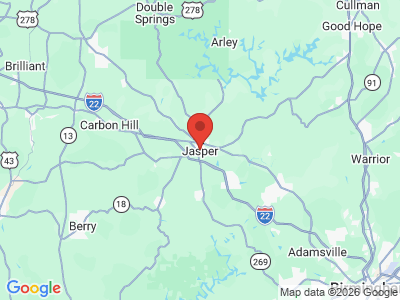
Comprising slightly more than 800 square miles, Walker County is located in the northwest region of the state. It is part of the Cumberland Plateau physiographic section of the Appalachian Highlands region and consists of narrow valleys and broad plateaus covered with oak and pine forests. The county is bordered to the north by Winston County, to the northwest by Cullman County, to the east by Blount and Jefferson Counties, to the southwest by Tuscaloosa County, and to the west by Fayette and Marion Counties.
Walker County Map
Comprising slightly more than 800 square miles, Walker County is located in the northwest region of the state. It is part of the Cumberland Plateau physiographic section of the Appalachian Highlands region and consists of narrow valleys and broad plateaus covered with oak and pine forests. The county is bordered to the north by Winston County, to the northwest by Cullman County, to the east by Blount and Jefferson Counties, to the southwest by Tuscaloosa County, and to the west by Fayette and Marion Counties.
Walker County is drained by the Black Warrior River Basin and the Mulberry and Sipsey Forks. The principal forks of the Black Warrior River—the Sipsey, Mulberry, and Locust—converge at the Jefferson-Walker county line. The riverbed overlies vast deposits of coal from the Warrior Coal Field, the southernmost large-scale coal-producing area in North America. Pine and oak forests cover much of Walker County. U.S. Highway 78 serves as Walker County's main transportation route. Connecting Walker County to Birmingham, U.S. 78 runs east-west through the middle of the county, and Interstate 22 connects Walker County with Jefferson and Marion Counties. Bevill Field, located in Jasper, is Walker County's only airport.
Events and Places of Interest
 Bankhead National Forest
There are several recreational opportunities for visitors to Walker County. William B. Bankhead National Forest offers camping, fishing, hiking, and horseback riding, and the Lewis Smith Lake and the Walker County Lake also provide outdoor activities. Lewis Smith Lake is an Alabama Power Company reservoir created in 1961 by the construction of the 300-foot high Lewis Smith Dam, one of the largest earthen dams in the eastern United States. The lake encompasses 21,000 acres with 500 miles of shoreline, and is home to more than 70 species of fish. Recreational activities include fishing, boating, camping, and hiking. The 160-acre Walker County Lake lies within Jasper City limits, and the grounds include a two-acre pond for children, pavilion and picnic areas, and boat rentals.
Bankhead National Forest
There are several recreational opportunities for visitors to Walker County. William B. Bankhead National Forest offers camping, fishing, hiking, and horseback riding, and the Lewis Smith Lake and the Walker County Lake also provide outdoor activities. Lewis Smith Lake is an Alabama Power Company reservoir created in 1961 by the construction of the 300-foot high Lewis Smith Dam, one of the largest earthen dams in the eastern United States. The lake encompasses 21,000 acres with 500 miles of shoreline, and is home to more than 70 species of fish. Recreational activities include fishing, boating, camping, and hiking. The 160-acre Walker County Lake lies within Jasper City limits, and the grounds include a two-acre pond for children, pavilion and picnic areas, and boat rentals.
The Alabama Mining Museum in Dora honors Walker County's mining heritage. Housed in a gym built in 1935 by the Works Progress Administration, the museum exhibits historical artifacts from the nineteenth and early twentieth centuries. A turn-of-the-century train and mining cars, as well as a one-room schoolhouse and turn-of-the-century post office, are housed in the museum. The Nauvoo Depot Museum in Nauvoo is housed in a replica of the town's original depot and houses exhibits on mining, rail travel, and local industry.
 Carl Elliott House Museum
Jasper City has a number of historic buildings, many of which are listed on the National Register of Historic Places. The Jasper Downtown Historic District has a number of late-nineteenth and early-twentieth-century buildings in the Neoclassical Revival and Queen Anne architectural styles. The Bankhead House, home of the Bankhead political family, notably John Hollis Bankhead Sr., is on the National Register of Historic Places, and the home of William B. Bankhead now operates as the Bankhead House and Heritage Center. Also in Jasper, the First United Methodist Church is an excellent example of the Beaux Arts style of the turn of the nineteenth century. The Carl Elliott House Museum in Jasper honors Congressman Carl Elliott, who served in the U.S. House of Representatives from 1949 to 1965. Elliott received the first John F. Kennedy Profile in Courage Award in 1990 for his work on equal rights.
Carl Elliott House Museum
Jasper City has a number of historic buildings, many of which are listed on the National Register of Historic Places. The Jasper Downtown Historic District has a number of late-nineteenth and early-twentieth-century buildings in the Neoclassical Revival and Queen Anne architectural styles. The Bankhead House, home of the Bankhead political family, notably John Hollis Bankhead Sr., is on the National Register of Historic Places, and the home of William B. Bankhead now operates as the Bankhead House and Heritage Center. Also in Jasper, the First United Methodist Church is an excellent example of the Beaux Arts style of the turn of the nineteenth century. The Carl Elliott House Museum in Jasper honors Congressman Carl Elliott, who served in the U.S. House of Representatives from 1949 to 1965. Elliott received the first John F. Kennedy Profile in Courage Award in 1990 for his work on equal rights.
Additional Resources
- The Heritage of Walker County, Alabama. Clanton, Ala.: Heritage Publishing Consultants, 1999.
External Links
- Walker County
- Walker County Schools
- City of Argo
- City of Dora
- City of Jasper
- Town of Parrish
- City of Sumiton
- Walker County Chamber of Commerce
- National Register of Historic Places: Walker County
- Bevill State Community College
- Lewis Smith Lake
- William B. Bankhead National Forest
- Bankhead House and Heritage Center
- Carl Elliott House Museum