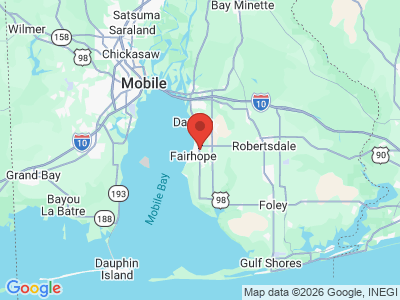
Fairhope
 Ernest Berry Gaston
What is now the city of Fairhope, Baldwin County, was established in 1894 as a model community based on what Ernest Berry Gaston, a young Iowa journalist and Populist Party officer, called "cooperative individualism," a term he introduced to the lexicon of American reform. To strike a balance between the two extremes of unregulated individualism and state socialism, he advocated public ownership and operation of so-called "natural monopolies" such as transportation, utilities, and communication while favoring free enterprise in the areas of production and distribution. He envisioned a society that would simultaneously encourage individual initiative and promote cooperative ventures and attitudes. Mixed-media artist and teacher Pinky Bass has made her home in Fairhope for decades.
Ernest Berry Gaston
What is now the city of Fairhope, Baldwin County, was established in 1894 as a model community based on what Ernest Berry Gaston, a young Iowa journalist and Populist Party officer, called "cooperative individualism," a term he introduced to the lexicon of American reform. To strike a balance between the two extremes of unregulated individualism and state socialism, he advocated public ownership and operation of so-called "natural monopolies" such as transportation, utilities, and communication while favoring free enterprise in the areas of production and distribution. He envisioned a society that would simultaneously encourage individual initiative and promote cooperative ventures and attitudes. Mixed-media artist and teacher Pinky Bass has made her home in Fairhope for decades.
The Fairhope Plan
 Fairhope Pier, 1912
The centerpiece of the Fairhope plan came from the writings of Henry George, author of Progress and Poverty (1879) among other books. George argued that land should be common property, made available for use rather than speculative profit. To achieve this end, he and his followers proposed to raise all government revenue from a single tax on land values, akin to a rental charge for the use of commonly owned land. Fairhope thus became known as the Single Tax Colony. Its main founding principle was that the value of land was created by the community, not the individual; the rent charged for the use of the land thus constituted a group investment in the value of the community. The members chose the name Fairhope when one of their number remarked that they had a "fair hope" of succeeding.
Fairhope Pier, 1912
The centerpiece of the Fairhope plan came from the writings of Henry George, author of Progress and Poverty (1879) among other books. George argued that land should be common property, made available for use rather than speculative profit. To achieve this end, he and his followers proposed to raise all government revenue from a single tax on land values, akin to a rental charge for the use of commonly owned land. Fairhope thus became known as the Single Tax Colony. Its main founding principle was that the value of land was created by the community, not the individual; the rent charged for the use of the land thus constituted a group investment in the value of the community. The members chose the name Fairhope when one of their number remarked that they had a "fair hope" of succeeding.
Originally called the Fairhope Industrial Association, the colony's name was changed in 1904 to the Fairhope Single Tax Corporation. In accordance with George's principle, the colony issued 99-year leases, free of charge, to its members (and later to nonmembers as well). In return for the annual payment of a single tax on the land value of the lease, the colony paid the lessee's local, county, and state property taxes.
Gaston was elected secretary of the yet-to-be-established colony as soon as its constitution was approved and held the position for 41 of the next 43 years. While still in Iowa, he served as editor of the Fairhope Courier, the colony-owned paper. He purchased it several years later and remained editor until his death in 1937. It continues to be published in Fairhope. Through the Courier and other means, he recruited members from various parts of the country. A search committee then visited several southern sites. (The South was favored because land was cheaper and the weather warmer than in Iowa or other likely locations.) Gaston then led the founding party to the chosen site on the eastern shore of Mobile Bay. The group, numbering 19 adults and nine children, arrived on November 15, 1894. By 1900, the town included homes and stores and the population had increased to 100.
Early History
The early history of the colony was fraught with disappointment and decisions that would eventually make fulfillment of its goals impossible. Unable to raise sufficient funds from national single taxers or other reformers, the colonists could not purchase enough contiguous land for their model community. Unable to attract enough members to live and work on the lands they did have, they were forced to open their settlement to nonmembers, many of whom opposed the founding principles. Their complaints about rent charges, among other things, led to the incorporation of the Town of Fairhope in 1908. The new town encompassed both colony and deeded land along with two different forms of government and revenue collection.
 Fairhope Mayor and City Council, 1908
The idealism, imagination, and tenacity of the colony's members, however, gave the community remarkable staying power and a measure of fame. The policy of offering free land attracted industrious men and women of modest means, who formed the backbone of the town. The public improvements and community-owned utilities enhanced the quality of life for its residents as did the communal bay-front parkland, all of which was designated as public property from the outset. Such amenities and idealistic values brought writers, actors, artists, and craftspeople to the community, initiating an enduring commitment to creative expression. In addition, a number of famous visitors enriched the intellectual and cultural life of the community and fostered a cosmopolitan atmosphere.
Fairhope Mayor and City Council, 1908
The idealism, imagination, and tenacity of the colony's members, however, gave the community remarkable staying power and a measure of fame. The policy of offering free land attracted industrious men and women of modest means, who formed the backbone of the town. The public improvements and community-owned utilities enhanced the quality of life for its residents as did the communal bay-front parkland, all of which was designated as public property from the outset. Such amenities and idealistic values brought writers, actors, artists, and craftspeople to the community, initiating an enduring commitment to creative expression. In addition, a number of famous visitors enriched the intellectual and cultural life of the community and fostered a cosmopolitan atmosphere.
A New Dynamism
 Marietta Johnson School of Organic Education
In 1907, Marietta Johnson, a Minnesota school teacher drawn to Fairhope by its reformist philosophy, founded the School of Organic Education in the town and opened it free of charge to local children. She also became a leader of the national Progressive education movement and turned what she called the "Fairhope Idea in Education" into a modest national force. The addition of the school brought a new dynamism to the mission of the community. Like John Dewey, America's leading philosopher of progressive education, Johnson argued that children reared on the competitive ethic of the American school system could not provide the necessary foundation for the cooperative, reform-minded, justice-oriented citizens that the colonists wished to produce. With enthusiastic colony support, her school worked to provide that foundation. Dewey himself came to visit in 1913 and liked what he saw: a model of "how the ideal of equality of opportunity for all is to be transmuted into reality."
Marietta Johnson School of Organic Education
In 1907, Marietta Johnson, a Minnesota school teacher drawn to Fairhope by its reformist philosophy, founded the School of Organic Education in the town and opened it free of charge to local children. She also became a leader of the national Progressive education movement and turned what she called the "Fairhope Idea in Education" into a modest national force. The addition of the school brought a new dynamism to the mission of the community. Like John Dewey, America's leading philosopher of progressive education, Johnson argued that children reared on the competitive ethic of the American school system could not provide the necessary foundation for the cooperative, reform-minded, justice-oriented citizens that the colonists wished to produce. With enthusiastic colony support, her school worked to provide that foundation. Dewey himself came to visit in 1913 and liked what he saw: a model of "how the ideal of equality of opportunity for all is to be transmuted into reality."
Dewey neglected to note that the "ideal of equality" was limited to white people. Johnson was aware that the system of racial segregation in the South violated her educational principles, and E. B. Gaston wrote that it was contrary to his commitment to equal access to land for everyone. Both also knew that their experiments in equality would be shut down by the surrounding white-supremacist culture were they to open their town and school to people of color. Both believed that the success of their demonstrations would, in time, help to break down racial prejudice. In Fairhope's case, however, that never happened.
Despite its segregated status, Fairhope's reputation as a reform-minded community continued to climb, reaching its height in the 1920s. The population of the town when it was incorporated in 1908 was 569; by 1920 it had reached 853. During the next 10 years it rose by more than 80 percent, reaching 1,549 in 1930, making Fairhope the largest town in the county. The Organic School enrolled about half of the local children as well as many boarders from the North. The town appeared in numerous articles and hosted many curious visitors to the school and the Single Tax Colony headquarters.
Watershed Years
 Fairhope, 1946
The Great Depression of the 1930s and the World War II era were watershed years in Fairhope's history. The Depression brought diminished funds, shrinking outside interest in both the colony and the school, and the passing of the old leadership. E. B. Gaston died in 1937, Marietta Johnson in 1938. A new generation of leaders kept the school and the colony functioning, but neither was ever again a dominant influence in the town. During the war years the establishment of shipyards, an air force base, and other war-related activities in nearby Mobile brought thousands of workers to south Alabama. Fairhope's population nearly doubled.
Fairhope, 1946
The Great Depression of the 1930s and the World War II era were watershed years in Fairhope's history. The Depression brought diminished funds, shrinking outside interest in both the colony and the school, and the passing of the old leadership. E. B. Gaston died in 1937, Marietta Johnson in 1938. A new generation of leaders kept the school and the colony functioning, but neither was ever again a dominant influence in the town. During the war years the establishment of shipyards, an air force base, and other war-related activities in nearby Mobile brought thousands of workers to south Alabama. Fairhope's population nearly doubled.
 Marietta Johnson Memorial
This demographic revolution transformed Fairhope. The population increased steadily during the post-war years, and Fairhope gained a new reputation as both a resort community and an enticing alternative to Florida for retirees. Few of the new residents understood or shared the sense of purpose that had earlier defined the town. The architectural distinctiveness, marked by modest but appealing homes, began to disappear as wealthy newcomers razed the old structures and built large, imposing homes, initiating what some critics have labeled McMansion culture. The Single Tax Corporation no longer had the ability to control land speculation and had long-since run out of the free land that had once been its raison d'être.
Marietta Johnson Memorial
This demographic revolution transformed Fairhope. The population increased steadily during the post-war years, and Fairhope gained a new reputation as both a resort community and an enticing alternative to Florida for retirees. Few of the new residents understood or shared the sense of purpose that had earlier defined the town. The architectural distinctiveness, marked by modest but appealing homes, began to disappear as wealthy newcomers razed the old structures and built large, imposing homes, initiating what some critics have labeled McMansion culture. The Single Tax Corporation no longer had the ability to control land speculation and had long-since run out of the free land that had once been its raison d'être.
Demographics
According to 2020 Census estimates, Fairhope recorded a population of 22,035. Of that total, 90.3 percent identified themselves as white, 5.2 percent as Hispanic, 2.9 percent as Asian, 2.7 percent as African American, 0.7 percent as American Indian, and 0.5 percent as two or more races. The town's median household income was $80,106, and per capita income was $43,477.
Employment
According to 2020 Census estimates, the workforce in Fairhope was divided among the following industrial categories:
- Educational services, and health care and social assistance (30.5 percent)
- Arts, entertainment, recreation, and accommodation and food services (12.6 percent)
- Professional, scientific, management, and administrative and waste management services (12.2 percent)
- Retail trade (9.1 percent)
- Finance, insurance, and real estate, rental, and leasing (6.5 percent)
- Construction (6.1 percent)
- Public administration (6.1 percent)
- Manufacturing (4.6 percent)
- Other services, except public administration (3.2 percent)
- Transportation and warehousing and utilities (2.9 percent)
- Wholesale trade (2.4 percent)
- Information (1.8 percent)
- Agriculture, forestry, fishing and hunting, and extractive (0.6 percent)
Education
Public schools in Fairhope are part of the Baldwin County Public Schools; the city has one kindergarten, one elementary school, one intermediate school, one junior high school, and one high school. The town is also home to the historic Marietta Johnson School of Organic Education, which continues to operate and hosts a campus of Coastal Alabama Community College.
Transportation
Fairhope is intersected by U.S. Highway 98, which runs north-south through the city, and County Road 48, which runs east-west. Herbert L. "Sonny" Callahan Airport, named for the Baldwin County congressman, serves general aviation and lies just south of the city.
Events and Places of Interest
 Fairhope Museum of History
The Fairhope Museum of History houses exhibits that focus on various aspects of the city's history and its residents and also features a large plaza with a green space and fountain. The Marietta Johnson Museum preserves the history of this unique experiment in education and the life of its founder. And for outdoor enthusiasts, the Weeks Bay Nature Reserve offers elevated walkways through bogs and marshes. The reserve and several other conservation properties in Baldwin and Mobile Counties are overseen by the South Alabama Land Trust. The Grand Hotel Golf Resort and Spa, part of the Marriot Hotels Autograph Collection of boutique hotels, gives visitors access to beaches on Mobile Bay as well as restaurants, a pool complex, and a renovated and expanded historic hotel. The associated golf course, The Lakewood Club, is part of the Robert Trent Jones Golf Trail.
Fairhope Museum of History
The Fairhope Museum of History houses exhibits that focus on various aspects of the city's history and its residents and also features a large plaza with a green space and fountain. The Marietta Johnson Museum preserves the history of this unique experiment in education and the life of its founder. And for outdoor enthusiasts, the Weeks Bay Nature Reserve offers elevated walkways through bogs and marshes. The reserve and several other conservation properties in Baldwin and Mobile Counties are overseen by the South Alabama Land Trust. The Grand Hotel Golf Resort and Spa, part of the Marriot Hotels Autograph Collection of boutique hotels, gives visitors access to beaches on Mobile Bay as well as restaurants, a pool complex, and a renovated and expanded historic hotel. The associated golf course, The Lakewood Club, is part of the Robert Trent Jones Golf Trail.
Fairhope currently advertises itself as "best known for its romantic, sweeping views of Mobile Bay and the storybook charm of its shops and flowers." Politically the town's populace has moved to the right, but Fairhope remains home to a vibrant and creative community of writers, artists, and free thinkers. However distant from its founding ideals, it retains its historic magnetism.
Additional Resources
- Allums, Larry. Fairhope, 1894-1994: A Pictorial History. Virginia Beach, Va.: The Donning Company, 1994.
- Alyea, Paul E., and Blanche R. Fairhope, 1894-1954: The Story of a Single Tax Colony. Tuscaloosa: University of Alabama Press, 1956.
- Gaston, Paul M. Man and Mission: E. B. Gaston and the Origins of the Fairhope Single Tax Colony. Montgomery, Ala.: Black Belt Press, 1993.
- ———. Women of Fair Hope. Athens: University of Georgia Press, 1984
- ———. “My Yellow Ribbon Town: A Meditation on My Country and My Home,” in Anthony Dunbar (ed.), Where We Stand: Voices of Southern Dissent. Montgomery, Ala.: NewSouth Books, 2004, pp. 70-86.
- ———. Coming of Age in Utopia: The Odyssey of an Idea. Montgomery, Ala.: New South Books, 2010.