Gee's Bend (Boykin)
 Gee's Bend Quilt Mural Trail
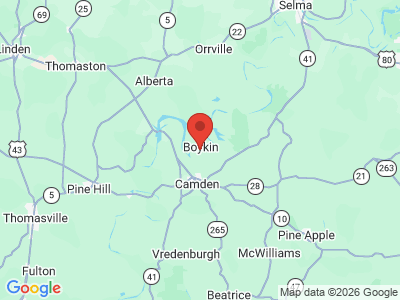
Known officially since 1949 as the town of Boykin, the community of Gee's Bend is situated in Wilcox County in the west Alabama Black Belt. Today, mostly descendants of enslaved African Americans live in the community on the banks of the Alabama River. Although beset by the same poverty and economic underdevelopment that characterize other sections of west Alabama, Gee's Bend has demonstrated a persistent cultural wealth in the vibrant folk art of its quilt makers, whose work has gained national attention and critical acclaim.
Gee's Bend Quilt Mural Trail
Known officially since 1949 as the town of Boykin, the community of Gee's Bend is situated in Wilcox County in the west Alabama Black Belt. Today, mostly descendants of enslaved African Americans live in the community on the banks of the Alabama River. Although beset by the same poverty and economic underdevelopment that characterize other sections of west Alabama, Gee's Bend has demonstrated a persistent cultural wealth in the vibrant folk art of its quilt makers, whose work has gained national attention and critical acclaim.
 Gee's Bend During the Great Depression
Early inhabitants of Alabama tended to create communities along the many waterways of the state, and thus Gee's Bend's location is typical of many Alabama settlements. Joseph Gee, a large landowner from Halifax County in North Carolina, settled in 1816 on the north side of a large bend in the Alabama River near what would become the northeastern border of Wilcox County. He brought 18 enslaved Black people with him and established a cotton plantation. When he died, he left 47 slaves and his estate to two of his nephews, Sterling and Charles Gee. In 1845, the Gee brothers sold the plantation to a relative, Mark H. Pettway, and the Pettway family name remains prominent in Wilcox County. After emancipation, freed Blacks who stayed on at the plantation worked as sharecroppers and tenant farmers. The Pettway family held the land until 1895, when they sold it to Adrian Sebastian Van de Graaff, an attorney from Tuscaloosa who operated the plantation as an absentee landowner who was also the father of famed inventor and physicist Robert Jemison Van de Graaff.
Gee's Bend During the Great Depression
Early inhabitants of Alabama tended to create communities along the many waterways of the state, and thus Gee's Bend's location is typical of many Alabama settlements. Joseph Gee, a large landowner from Halifax County in North Carolina, settled in 1816 on the north side of a large bend in the Alabama River near what would become the northeastern border of Wilcox County. He brought 18 enslaved Black people with him and established a cotton plantation. When he died, he left 47 slaves and his estate to two of his nephews, Sterling and Charles Gee. In 1845, the Gee brothers sold the plantation to a relative, Mark H. Pettway, and the Pettway family name remains prominent in Wilcox County. After emancipation, freed Blacks who stayed on at the plantation worked as sharecroppers and tenant farmers. The Pettway family held the land until 1895, when they sold it to Adrian Sebastian Van de Graaff, an attorney from Tuscaloosa who operated the plantation as an absentee landowner who was also the father of famed inventor and physicist Robert Jemison Van de Graaff.
 Gee's Bend Ferry in Camden
The 1930s was a period of significant change in Gee's Bend. A local merchant who had extended credit to the residents of the town died, and his family demanded immediate payment of all debts owed to him. Families watched as all their food, animals, tools, and seed were taken from them. Members of the community might have perished but for rations distributed by the Red Cross and a decision by the Van de Graaff family to waive rents. In 1937, the Van de Graaff family sold their land to the federal government, and the Farm Security Administration (FSA) established Gee's Bend Farms Inc., a pilot project of a cooperative program designed to sustain the inhabitants. The government built houses, subdivided the property, and sold tracts of land to the local families, for the first time giving the African American population control of the land they worked. During this period, the community also became the subject of several FSA-sponsored photographers, including Marion Post Wolcott and Arthur Rothstein.
Gee's Bend Ferry in Camden
The 1930s was a period of significant change in Gee's Bend. A local merchant who had extended credit to the residents of the town died, and his family demanded immediate payment of all debts owed to him. Families watched as all their food, animals, tools, and seed were taken from them. Members of the community might have perished but for rations distributed by the Red Cross and a decision by the Van de Graaff family to waive rents. In 1937, the Van de Graaff family sold their land to the federal government, and the Farm Security Administration (FSA) established Gee's Bend Farms Inc., a pilot project of a cooperative program designed to sustain the inhabitants. The government built houses, subdivided the property, and sold tracts of land to the local families, for the first time giving the African American population control of the land they worked. During this period, the community also became the subject of several FSA-sponsored photographers, including Marion Post Wolcott and Arthur Rothstein.
 Gee's Bend Quilters
In the later years of the Great Depression, the advent of widespread use of mechanization in agriculture brought additional hardships to small farmers and caused the first major exodus from Gee's Bend. Many residents, however, stayed on their land because it belonged to them. In 1949, a U.S. post office was established in Gee's Bend, and the federal government imposed the name Boykin on the community, against the wishes of most of the residents. Then in 1962, a dam was constructed on the Alabama River, flooding thousands of acres of the most fertile land in the Gee's Bend community. During the civil rights era, Wilcox County officials terminated ferry service across the Alabama River, necessitating a two-hour drive to Camden, the county seat. At the time, not a single black person was registered to vote in Wilcox County, and the cessation of ferry service was one of many efforts to prevent them from doing so.
Gee's Bend Quilters
In the later years of the Great Depression, the advent of widespread use of mechanization in agriculture brought additional hardships to small farmers and caused the first major exodus from Gee's Bend. Many residents, however, stayed on their land because it belonged to them. In 1949, a U.S. post office was established in Gee's Bend, and the federal government imposed the name Boykin on the community, against the wishes of most of the residents. Then in 1962, a dam was constructed on the Alabama River, flooding thousands of acres of the most fertile land in the Gee's Bend community. During the civil rights era, Wilcox County officials terminated ferry service across the Alabama River, necessitating a two-hour drive to Camden, the county seat. At the time, not a single black person was registered to vote in Wilcox County, and the cessation of ferry service was one of many efforts to prevent them from doing so.
 Gee's Bend Residents
Since the 1960s, Gee's Bend has gained significant national attention from the quilts produced by women in the community, including many women in the Pettway family, as well as those produced by the Freedom Quilting Bee in neighboring Alberta. Photographer John Reese and writer and storyteller Kathryn Tucker Windham visited Gee's Bend in 1980-81 as part of a National Endowment for the Humanities project to document the community. In the late 1990s, William Arnett, a folk-art collector from Atlanta, Georgia, came to the area and bought hundreds of quilts after seeing a photograph by Roland Freeman of a quilt draped over a woodpile. The pieces have been heralded as brilliant pieces of modern art. A collection of quilts from Gee's Bend was shown at the Houston Museum of Art before traveling to the Whitney Museum in New York City, where it again received high acclaim. The exhibit also proved to be controversial, however, and initiated serious academic discussions on the definition of art and concerns about the exploitation of the quilters. In 2003, the quilters established the Gee's Bend Quilters Collective to market and promote their quilts and community, and in 2007 the community installed a series of murals of quilt designs on the main road in the town.
Gee's Bend Residents
Since the 1960s, Gee's Bend has gained significant national attention from the quilts produced by women in the community, including many women in the Pettway family, as well as those produced by the Freedom Quilting Bee in neighboring Alberta. Photographer John Reese and writer and storyteller Kathryn Tucker Windham visited Gee's Bend in 1980-81 as part of a National Endowment for the Humanities project to document the community. In the late 1990s, William Arnett, a folk-art collector from Atlanta, Georgia, came to the area and bought hundreds of quilts after seeing a photograph by Roland Freeman of a quilt draped over a woodpile. The pieces have been heralded as brilliant pieces of modern art. A collection of quilts from Gee's Bend was shown at the Houston Museum of Art before traveling to the Whitney Museum in New York City, where it again received high acclaim. The exhibit also proved to be controversial, however, and initiated serious academic discussions on the definition of art and concerns about the exploitation of the quilters. In 2003, the quilters established the Gee's Bend Quilters Collective to market and promote their quilts and community, and in 2007 the community installed a series of murals of quilt designs on the main road in the town.
Demographics
According to 2020 Census estimates, the population of the Boykin community was 544. Of that number, 99.4 percent of respondents identified themselves as African American and 0.6 percent as white. Median household income was $16,023, and per capita income was $8,083.
Employment
According to 2020 Census estimates, the workforce in xxx was divided among the following industrial categories:
- Other services, except public administration (26.3 percent)
- Educational services and health care and social assistance (22.9 percent)
- Transportation and warehousing, and utilities (16.1 percent)
- Retail trade (12.7 percent)
- Manufacturing (11.0 percent)
- Public administration (5.9 percent)
- Arts, entertainment, and recreation, and accommodation and food services (5.1 percent)
Education
There are no schools in the Boykin Community. Education is overseen by the Wilcox County Public Schools.
Transportation
County Road 29 runs east-west through Boykin. There is a ferry service between Boykin and the city of Camden on the south side of the Alabama River.
Events and Places of Interest
Roland Cooper State Park lies across the Alabama River to the southeast of the community. In 2007, the community created the Gee's Bend Quilt Mural Trail, which displays 10 of the more notable quilt patterns used by the quilters of Gee's Bend on large murals throughout the area.
Additional Resources
- Beardsley, John. The Quilts of Gee's Bend. Atlanta, Ga.: Tinwood Books/Houston Museum of Fine Arts, 2002.
- Jackson, Harvey H., III. Rivers of History: Life on the Coosa, Tallapoosa, Cahaba, and Alabama. Tuscaloosa: University of Alabama Press, 1995.
- Keurten, Bruce, and John DiJulio, directors. From Fields of Promise. DVD. 57 mins. Auburn, Ala.: Auburn Television, 1993.
- Windham, Kathryn Tucker. Twice Blessed. Montgomery, Ala.: Black Belt, 1996.